
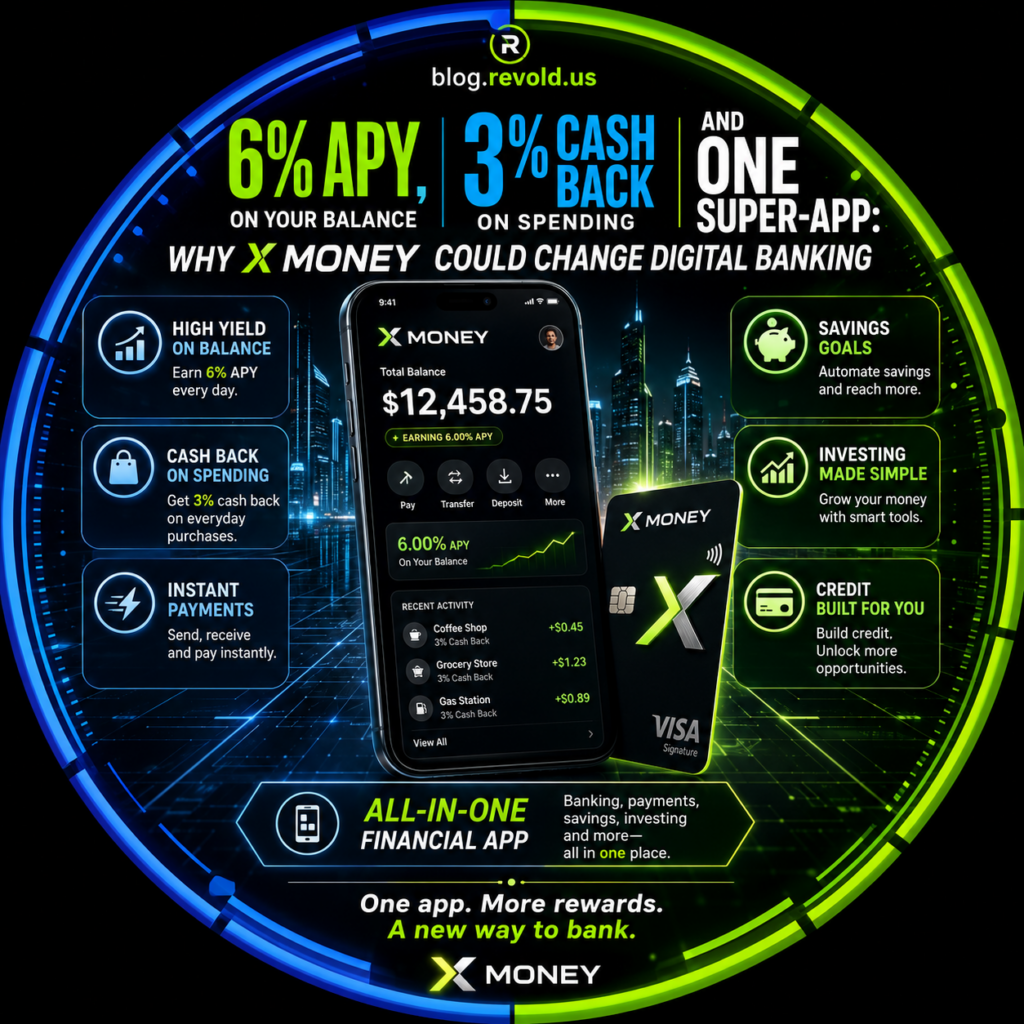
X Money is making an offer designed to be almost impossible to ignore: up to 6.00% APY on eligible balances, 3% cash back on eligible purchases, early direct deposit, instant payments and a Visa debit card—all inside X.
The numbers are powerful.
The strategy behind them is even more important.
X Money is not simply trying to become another digital wallet. It is attempting to create a financial environment where users receive income, hold cash, earn interest, pay bills, send money and make daily purchases without moving funds to another platform.
The 6% APY encourages deposits.
The 3% cash-back offer encourages spending.
Direct deposit makes incoming money recurring.
The X Card connects the platform to millions of merchants through Visa.
Peer-to-peer payments connect financial activity to X’s existing network of identities.
Together, these features create a closed financial loop capable of competing with banks, payment applications and fintech platforms simultaneously.
But the headline requires careful analysis.
Six percent APY and 3% cash back do not equal a 9% return. They apply to different activities and different amounts. The highest yield is connected to X membership or qualifying deposits. Cash back applies only to eligible transactions. Rates and reward terms can change. Subscription costs may materially reduce the customer’s effective benefit.
The product can still be highly competitive.
The real question is not whether the advertised numbers are attractive.
It is whether X Money can convert a promotional advantage into a durable financial ecosystem.
What X Money Currently Offers
As of August 2026, X Money is rolling out to selected users in the United States.
Its published features include:
- Up to 6.00% APY on eligible balances;
- 3% cash back on eligible X Card purchases;
- Direct deposit;
- Paycheck access up to two days early;
- Instant transfers between eligible X users;
- Virtual and physical Visa debit cards;
- ATM-fee reimbursement;
- No foreign transaction fee charged by X Money;
- Domestic wires;
- Bill payment;
- Mailed checks;
- Apple Pay and Google Pay support;
- Adjustable transaction and spending limits;
- Passkey-based account security;
- In-app transaction disputes;
- FDIC-insurance eligibility through partner banks.
X Money is operated by X Payments LLC. It is not a chartered bank and is not itself insured by the Federal Deposit Insurance Corporation.
Deposit accounts and banking services are provided through Cross River Bank, Member FDIC. Cross River also issues the X Card under a license from Visa.
Eligible deposits may be distributed among participating institutions through an IntraFi cash sweep program. X advertises the potential for as much as $10 million in aggregate pass-through FDIC coverage when applicable program requirements and insurance conditions are satisfied.
From the customer’s perspective, X Money resembles a digital bank account.
Behind the interface, however, it is an embedded-finance product built on regulated banking and card-network infrastructure.
How the 6% APY Works
X currently publishes different rates for Premium and Premium+ subscribers.
| X membership | Standard rate | Potential boosted rate |
|---|---|---|
| Premium | 4.00% APY | 6.00% APY |
| Premium+ | 6.00% APY | Not applicable |
Premium users may qualify for the boosted 6.00% APY after receiving at least $1,000 in qualifying deposits within a trailing 34-day period.
Qualifying activity may include:
- Eligible payroll direct deposits;
- Certain X creator payouts;
- X Original Content Rewards.
Premium+ users are currently eligible for 6.00% APY without the additional qualifying-deposit condition.
The published rates became effective July 27, 2026. They are variable and can change at any time.
This means the advertised 6% rate is not a guaranteed long-term return. It is a current product rate governed by eligibility requirements and account terms.
Six Percent APY Is Not the Same as Six Percent Interest Paid Immediately
APY stands for annual percentage yield.
It represents the approximate annual return after accounting for compounding, assuming the balance and rate remain applicable for the full period.
A 6% APY does not mean that X Money immediately adds 6% to a deposit.
Interest is calculated over time based on eligible balances. Deposits, withdrawals, rate changes and account activity affect the amount actually earned.
Simplified gross annual interest at a constant 6% APY would be approximately:
| Average eligible balance | Approximate gross annual interest |
| $1,000 | $60 |
| $2,500 | $150 |
| $5,000 | $300 |
| $10,000 | $600 |
| $25,000 | $1,500 |
| $50,000 | $3,000 |
| $100,000 | $6,000 |
These examples assume the average balance remains constant and the rate does not change. They exclude subscription expenses, taxes, fees and the return available from another account.
How Competitive Is 6%?
The FDIC’s national-rate data for August 2026 listed the average U.S. savings-account rate at approximately 0.38%.
Using a constant $10,000 balance:
| Account yield | Approximate gross annual interest |
| 0.38% | $38 |
| 3.30% | $330 |
| 4.00% | $400 |
| 5.00% | $500 |
| 6.00% | $600 |
Against the national average, X Money’s headline rate is extremely competitive.
A $10,000 balance earning 6% would generate approximately $562 more in gross annual interest than the same balance earning 0.38%.
However, the national average is not the only relevant benchmark.
Consumers may have access to:
- High-yield savings accounts;
- Money-market deposit accounts;
- Money-market funds;
- Treasury bills;
- Certificates of deposit;
- Fintech cash-management accounts.
Some alternatives may offer competitive returns without requiring a paid social-media subscription. Others may involve different liquidity, insurance, investment or market risks.
The correct comparison is therefore:
X Money’s net benefit versus the best realistic alternative available to the customer.
The Subscription Is Part of the Financial Product
The most important hidden cost is the X membership.
Current U.S. web pricing lists:
- Premium at approximately $84 per year;
- Premium+ at approximately $395 per year.
Prices can vary based on taxes, platform, payment method and location.
If a user already pays for X membership because of Grok, reduced advertising, creator tools or other platform features, the subscription may not be treated entirely as a cost of X Money.
But if a person subscribes primarily to access the financial benefits, the subscription must be deducted from the expected return.
Premium vs Premium+: Which Is Better for X Money?
For a financially focused customer, Premium may provide better value than Premium+.
A Premium subscriber who receives at least $1,000 in qualifying deposits during the required period can currently receive the same 6.00% APY offered to Premium+ users.
The difference in listed annual web pricing is approximately:
$395 − $84 = $311
If both users earn 6%, Premium+ does not provide an additional interest-rate advantage.
The extra $311 pays for nonfinancial Premium+ benefits, including higher platform limits and other X features.
Premium+ may still be worthwhile for users who value those features. But it should not automatically be selected solely to obtain X Money’s 6% APY.
For users capable of meeting the qualifying-deposit requirement, the standard Premium tier currently appears to offer the stronger financial proposition.
The Break-Even Balance
The simplest break-even calculation asks how much money must remain in the account for gross interest to equal the annual subscription price.
Premium at $84 annually
$84 ÷ 6% = approximately $1,400
A constant balance of approximately $1,400 earning 6% would generate around $84 in gross annual interest.
Premium+ at $395 annually
$395 ÷ 6% = approximately $6,583
A constant balance of approximately $6,583 earning 6% would generate around $395 in gross annual interest.
But this comparison assumes the alternative pays zero interest.
That is not a realistic financial benchmark for a consumer who could use a competitive savings account elsewhere.
Break-Even Against a 3.30% Alternative
Suppose another savings product pays 3.30%.
X Money’s incremental advantage at 6% is:
6.00% − 3.30% = 2.70 percentage points
The approximate balance required for the additional yield to offset the subscription becomes:
Premium
$84 ÷ 2.70% ≈ $3,111
Premium+
$395 ÷ 2.70% ≈ $14,630
This is a more meaningful calculation.
A Premium user maintaining approximately $3,111 at 6% would earn about $84 more than the same balance at 3.30%, approximately offsetting the listed annual subscription cost.
A Premium+ user would need approximately $14,630 for the additional yield to offset the $395 annual subscription cost.
Taxes, rate changes and other membership benefits are excluded.
Effective Return After Subscription Costs
Assuming a constant 6% APY for one year and assigning the entire membership cost to X Money:
Premium at $84 per year
| Average balance | Gross interest | Net after subscription | Effective return |
| $1,000 | $60 | -$24 | -2.40% |
| $2,500 | $150 | $66 | 2.64% |
| $5,000 | $300 | $216 | 4.32% |
| $10,000 | $600 | $516 | 5.16% |
| $25,000 | $1,500 | $1,416 | 5.66% |
| $50,000 | $3,000 | $2,916 | 5.83% |
Premium+ at $395 per year
| Average balance | Gross interest | Net after subscription | Effective return |
| $1,000 | $60 | -$335 | -33.50% |
| $5,000 | $300 | -$95 | -1.90% |
| $10,000 | $600 | $205 | 2.05% |
| $25,000 | $1,500 | $1,105 | 4.42% |
| $50,000 | $3,000 | $2,605 | 5.21% |
| $100,000 | $6,000 | $5,605 | 5.61% |
These figures are simplified and pre-tax.
They demonstrate why an advertised APY should never be evaluated without fixed membership costs.
As balances increase, the subscription consumes a smaller percentage of the return. For small balances, the membership price can eliminate the interest advantage entirely.
The 3% Cash-Back Offer
The X Card advertises 3% cash back on eligible purchases.
Potential gross rewards at a full 3% rate would be:
| Annual eligible spending | Potential cash back |
| $3,000 | $90 |
| $6,000 | $180 |
| $12,000 | $360 |
| $24,000 | $720 |
| $36,000 | $1,080 |
| $50,000 | $1,500 |
For a customer with limited savings but substantial eligible spending, cash back could be more valuable than the APY.
A person maintaining only $2,500 at 6% would generate approximately $150 in annual interest. But $12,000 in fully eligible card spending could theoretically generate another $360 in cash back.
That would produce $510 in combined gross benefits before subscription costs and taxes.
However, “eligible” is the decisive word.
Six Percent Plus Three Percent Does Not Equal Nine Percent
This is the most common mathematical mistake in describing X Money.
The 6% APY applies to an eligible account balance.
The 3% cash-back rate applies to eligible spending.
They use different denominators and cannot simply be added together.
For example:
- Average balance: $10,000;
- Eligible annual spending: $12,000;
- Interest at 6%: approximately $600;
- Cash back at 3%: approximately $360;
- Combined gross benefit: approximately $960.
The customer did not earn 9% on $10,000.
The interest was calculated on $10,000, while cash back was calculated on $12,000 of spending.
A combined effective-value calculation would require defining the customer’s total balances, spending, subscription cost and competing financial alternatives.
Any article describing X Money as providing a simple “9% return” would be financially misleading.
What Does Not Qualify for 3% Cash Back?
X’s rewards terms exclude multiple transaction types and merchant categories.
Published exclusions include certain:
- Wire transfers;
- Money orders;
- Cash disbursements;
- Financial-institution transactions;
- Foreign-currency transactions;
- Account-funding activity;
- Securities brokers and dealers;
- Rent payments;
- Tax payments;
- Government services;
- Fines;
- Gambling and lotteries;
- Precious metals, coins and jewelry purchases;
- Digital gaming transactions.
Cash back may be removed when a purchase is returned or refunded.
X also reserves the ability to:
- Apply different reward percentages;
- Establish reward caps;
- Determine transaction eligibility;
- Request receipts or supporting documentation;
- Recover rewards credited to ineligible transactions.
Merchant category codes are important. A customer may think a purchase belongs to an ordinary category while the payment network classifies the merchant under an excluded code.
The advertised 3% should therefore be understood as a potential reward on qualifying activity—not a universal return on all card spending.
A Realistic Value Scenario
Consider an illustrative Premium user with:
- A $10,000 average eligible balance;
- At least $1,000 in qualifying direct deposits;
- $12,000 in eligible annual X Card purchases;
- An $84 annual Premium subscription;
- A constant 6% APY;
- The full 3% cash-back rate.
The simplified calculation would be:
| Component | Annual value |
| Interest on $10,000 at 6% | $600 |
| Cash back on $12,000 at 3% | $360 |
| Gross combined benefit | $960 |
| Premium subscription | -$84 |
| Simplified net benefit | $876 |
This excludes taxes and assumes all spending qualifies.
Now compare it with an alternative account paying 3.30% and a separate card earning 2% cash back:
| Component | Alternative value |
| Interest on $10,000 at 3.30% | $330 |
| Cash back on $12,000 at 2% | $240 |
| Subscription cost | $0 |
| Simplified total | $570 |
Under these assumptions, X Money would produce approximately $306 more in annual pre-tax value.
But the result changes if:
- The X Money rate falls;
- Spending is excluded;
- Rewards are capped;
- The user pays for Premium+ instead;
- The alternative savings rate increases;
- The alternative card earns a higher reward;
- The X subscription has no independent value to the customer.
The product should be evaluated as a personalized financial equation, not a universal winner.
Can 6% APY Be Sustainable?
A 6% deposit rate is expensive when market interest rates are lower.
Cross River and participating banks may earn income by deploying deposits into loans, securities, reserves or other permitted assets. But the spread between asset yields and a 6% customer rate may be narrow or negative after operating and regulatory expenses.
This suggests several possible sources of support:
- X may subsidize the rate as a customer-acquisition expense;
- Subscription revenue may offset part of the cost;
- The rate may apply during a launch or growth period;
- Cross-selling and customer retention may justify the expense;
- X may expect some users to earn lower effective returns because of eligibility rules;
- The rate may decline if broader interest rates fall;
- Larger balances may create revenue opportunities elsewhere in the ecosystem.
X does not guarantee that the 6% APY will remain permanent.
That does not make the current rate unreal. It means customers should treat it as variable rather than building long-term projections around it.
The most likely sustainable advantage is not a permanent 6% rate.
It is X’s ability to adjust the financial offer while distributing it to users inside its own platform.
Can 3% Debit Cash Back Be Sustainable?
Debit-card rewards are generally more difficult to fund than credit-card rewards.
Credit-card issuers can generate income from:
- Merchant interchange;
- Interest charged to borrowers;
- Annual fees;
- Late fees;
- Partnerships and offers.
Debit-card programs generally have more limited economics, particularly when interchange revenue is constrained.
A broad 3% debit reward can exceed the revenue generated by the card transaction itself.
That suggests the X Card may function as a loss leader: a product that sacrifices direct margin to gain customers, deposits, subscriptions and engagement.
The economics could be supported by:
- Premium revenue;
- Reduced reward eligibility;
- Merchant-funded offers;
- Program caps;
- Interest-related economics on customer balances;
- Cross-selling;
- Broader X engagement;
- Future commercial services.
The rewards program can be strategically rational even if the card itself does not immediately generate a profit.
X is not necessarily trying to maximize revenue from each card swipe.
It may be paying for customer habit.
Why Customer Habit Matters More Than the Reward
A reward attracts attention. Habit creates retention.
If customers begin using X Money for:
- Direct deposit;
- Savings;
- Card purchases;
- Bill payments;
- Peer-to-peer transfers;
- ATM withdrawals;
- Creator income;
then leaving the platform becomes increasingly inconvenient.
The account becomes connected to daily financial life.
That is how money becomes “sticky.”
Traditional banks have benefited from sticky deposits for decades. Customers often tolerate low rates because changing payroll instructions, automatic bills and cards requires effort.
X Money is using high rewards to make traditional bank deposits move.
Once the money enters X, the same integrated features can make it sticky again.
This is the core strategic logic:
Use rewards to break the customer’s old habit, then use integration to create a new one.
X Money’s Financial Flywheel
The complete model can be expressed as a cycle:
- Premium membership gives access to X Money benefits.
- High APY attracts savings.
- Direct deposit creates recurring inflows.
- The X Card converts balances into spending.
- Cash back encourages repeated card use.
- Rewards return to the account.
- Peer-to-peer transfers invite more users.
- More users increase the usefulness of the payment network.
- Financial integration strengthens Premium retention.
- Subscription revenue helps support the ecosystem.
The product’s strength comes from the cycle, not from any single feature.
A bank can copy the APY.
A fintech can copy early direct deposit.
A card issuer can offer 3% cash back.
It is more difficult to copy a financial loop connected to an existing social and creator network.
Why Banks Should Pay Attention
X Money does not need to replace traditional banks to weaken their position.
If customers receive salaries, hold balances and use cards through X, the partner banks may perform regulated functions while X controls the customer relationship.
The consumer sees X.
The application belongs to X.
The rewards belong to X.
The financial identity is connected to X.
The bank can become infrastructure behind another company’s brand.
That threatens some of the most valuable parts of retail banking:
- Customer engagement;
- Low-cost deposits;
- Card activity;
- Product recommendations;
- Financial data;
- Loyalty;
- Cross-selling.
Banks may continue holding or processing money while losing the interface through which customers experience financial services.
Why Fintech Companies Should Pay Attention
X Money also challenges PayPal, Venmo, Cash App, Chime, SoFi and other digital-finance providers.
Those platforms have meaningful advantages:
- Established financial trust;
- Mature fraud systems;
- Merchant acceptance;
- Credit products;
- Investment services;
- International reach;
- Customer-support experience.
X has a different advantage: distribution.
It can introduce Money to users who already maintain identities, audiences, business profiles and subscription relationships on the platform.
Standalone fintech companies must acquire a customer and then create engagement.
X already possesses engagement and is adding finance to it.
The Super-App Is the Real Product
Interest rates can be matched.
Cash-back percentages can be copied.
Debit cards can be redesigned.
The super-app model is harder to reproduce.
X can potentially connect:
- Public content;
- Direct messages;
- Artificial intelligence;
- Creator payments;
- Advertising;
- Product discovery;
- Business identities;
- Customer support;
- Direct deposit;
- Savings;
- Cards;
- Peer-to-peer payments;
- Commerce.
A user could discover a business, ask a question, complete a payment, receive support and publish a review without leaving X.
A creator could earn money, hold it at interest, pay expenses and send funds to collaborators through the same platform.
That architecture could make X Money strategically significant even if the launch rates are eventually reduced.
The percentages acquire customers.
The ecosystem retains them.
The Risks Consumers Should Evaluate
Rate risk
The 6% APY is variable and may decline.
Subscription risk
The membership price can reduce or eliminate the financial advantage.
Reward risk
The 3% rate applies only to eligible purchases and may be changed, capped or reduced.
Classification risk
Merchant category codes may cause unexpected exclusions.
Platform-access risk
Users need clear procedures for accessing funds if an X account is suspended, compromised or restricted.
Privacy risk
Combining social behavior, advertising, AI and financial activity requires strong data separation and transparent policies.
Support risk
A primary financial account must provide reliable assistance during payroll failures, fraud and account restrictions.
Concentration risk
Combining communication, identity and money inside one platform creates convenience but also a larger single point of failure.
Deposit-insurance limitations
FDIC coverage applies to eligible deposits held at insured partner banks. It does not insure X Payments itself or cover every type of loss.
Tax consequences
Interest may constitute taxable income. Cash-back treatment can depend on the nature of the reward and transaction.
Who Is X Money Best For?
The strongest current use case may be a customer who:
- Already values X Premium;
- Can satisfy the qualifying direct-deposit requirement;
- Maintains a meaningful cash balance;
- Has substantial eligible debit-card spending;
- Uses X regularly;
- Receives creator income;
- Values early direct deposit and social payments;
- Monitors rates and terms.
The weaker use case may be someone who:
- Would buy Premium+ only for the APY;
- Maintains a small balance;
- Rarely uses a debit card;
- Primarily spends in excluded categories;
- Already has a competitive savings account and rewards card;
- Wants strict separation between social and financial identity;
- Requires mature lending, investing or business-banking products.
The product’s real value depends on behavior.
There is no single answer for every user.
Final Analysis: X Money Is Selling Financial Gravity
Six percent APY attracts deposits.
Three percent cash back encourages spending.
Direct deposit creates recurring inflows.
The Visa card provides broad acceptance.
Peer-to-peer payments connect financial activity to the X network.
Premium membership creates recurring platform revenue.
Together, these features generate financial gravity.
Money is encouraged to enter X, remain inside the ecosystem and circulate through payments and card purchases. Rewards flow back into the same account, strengthening the cycle.
That is why X Money could change digital banking.
Not because 6% APY has never existed.
Not because 3% cash back is impossible to match.
And not because X has already replaced a bank.
X Money matters because it combines customer acquisition, savings, spending, social distribution and paid membership into one coordinated system.
Traditional banks made customer money sticky through inertia.
X is trying to loosen that money with better rewards—then make it sticky again through software.
The advertised percentages may change.
The deeper strategy will remain:
Capture the deposit. Capture the payment. Capture the customer relationship.
The next battle in banking will not be decided solely by which institution has the largest branch network or longest operating history.
It will be decided by which platform creates the strongest reason for money to enter, remain and move inside its ecosystem.
With X Money, Elon Musk is attempting to make that platform X.
The 6% APY is the invitation.
The 3% cash back is the habit.
The super-app is the objective.
Key Facts
- X Money is currently rolling out to selected users in the United States.
- Premium users currently receive a listed standard rate of 4.00% APY.
- Premium users may qualify for 6.00% APY after receiving at least $1,000 in qualifying deposits during a trailing 34-day period.
- Premium+ users are currently eligible for 6.00% APY.
- Interest rates are variable and can change.
- Current U.S. web pricing lists Premium at approximately $84 annually and Premium+ at approximately $395 annually, excluding applicable taxes and fees.
- The X Card advertises 3% cash back on eligible purchases.
- Multiple financial, government, tax, rent, gambling and other merchant categories are excluded.
- Six percent APY and 3% cash back cannot be combined and described as a simple 9% return.
- X Payments LLC is not an FDIC-insured bank.
- Deposit accounts and banking services are provided through Cross River Bank, Member FDIC.
- FDIC insurance applies only to eligible deposits under applicable legal and program requirements.
- The FDIC national average savings-account rate was approximately 0.38% in August 2026.
Editorial Disclosure
This article contains independent editorial analysis. REVOLD Blog has not received compensation from X Corp., X Payments LLC, Cross River Bank, Visa, IntraFi or another company mentioned in this publication.
All calculations are simplified illustrations. They do not represent guaranteed returns and do not include every potential tax, fee, balance change, reward exclusion or opportunity cost.
This material is provided solely for informational and educational purposes. It does not constitute financial, investment, tax, legal or banking advice. Rates, subscription prices, benefits, exclusions and eligibility requirements can change.
Sources
- X Money Official Product Page
- X Money Stored Value Account Rates
- X Money Frequently Asked Questions
- X Money Cash-Back Rewards Terms
- X Money Stored Value Account Agreement
- X Premium Pricing
- X Premium Features
- FDIC National Rates and Rate Caps
- Cross River: Banking Infrastructure Behind X Money
blog.revold.us — Powered by AIR RISE INC & REVOLD AI
Author: Roman Kravchina
Related Reading
- Can X Replace Your Bank? The Real Strategy Behind Elon Musk’s X Money
- Elon Musk Wants Your Paycheck: Inside X Money’s Plan to Become America’s Financial Super-App
- X Money vs PayPal: Elon Musk Returns to the Financial Battlefield He Helped Create
- PayPal Is Turning PYUSD Into Working Money — Why 4% Rewards Could Change the Stablecoin Market
- Stablecoins vs Tokenized Bank Deposits: The Battle That Could Decide the Future of Money
- 23 of 40 New U.S. Bank Charter Applications Involve Digital Assets — Banking Is Changing Fast
- PYUSD vs RLUSD: PayPal and Ripple Are Fighting for the Future of the Digital Dollar
- Ripple’s Next Act: How RLUSD, Payments, Custody and Tokenization Could Reshape Global Finance
- Bank of America Is Going On-Chain — And This Could Be Bigger Than Stablecoins
- Dollar-Cost Averaging (DCA): A Simple Yet Powerful Investment Strategy
- Crypto Market Insights: Bitcoin Nears $90K, Ripple-Cardano Collaboration, and DeFi’s Latest Challenges
- Analysis of the JPMorgan Chase Situation in Russia and Its Impact on Cryptocurrency Investments
- How to Buy Dogecoin in 5 Parts to Average Down Your Cost
- Financial Workshop: Tax Secrets and Business Strategies 2023–2024
- Ripple XRP & Stellar XLM: A Professional Analysis
- Financial Workshop: Tax Secrets and Business Strategies 2023–2025