
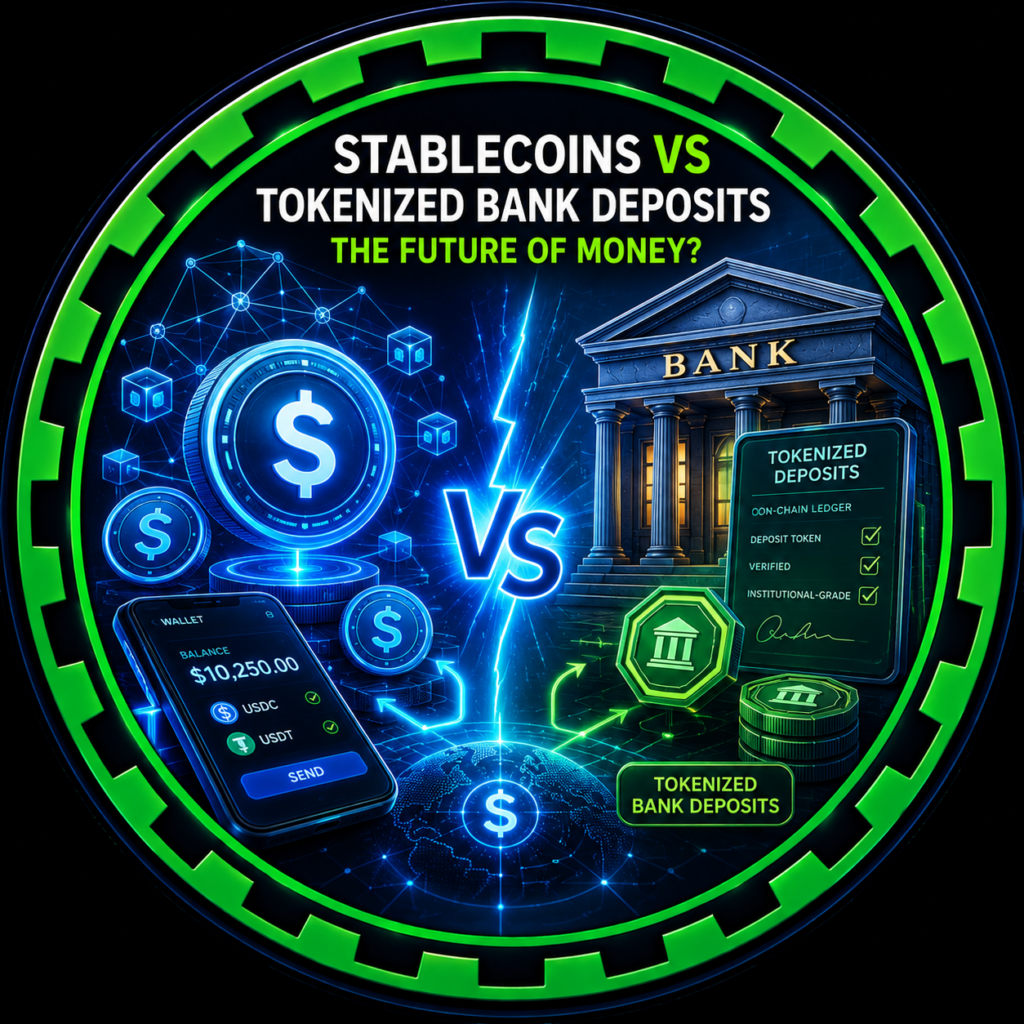
The most important competition in digital finance is no longer between cryptocurrency and the dollar. It is between two different ways of putting the dollar on-chain.
Stablecoins take dollar-denominated value outside the traditional bank-account structure.
Tokenized deposits bring traditional bank money onto programmable networks.
Both can move continuously. Both can settle blockchain transactions. Both can connect money to software.
But they distribute risk, revenue and financial power differently.
Stablecoins strengthen issuers, wallets, payment platforms and public blockchain networks. Tokenized deposits preserve the role of commercial banks, their balance sheets and their direct relationships with customers.
This is not merely a contest between financial products.
It is a contest over who will issue digital money, hold customer balances, control transaction data and provide the cash used to settle tokenized assets.
The technology matters.
The architecture of power behind it matters more.
Two Digital Dollars With Different Legal Foundations
A stablecoin and a tokenized deposit may each be designed to represent one U.S. dollar.
That does not make them equivalent.
A reserve-backed stablecoin is issued against a separate portfolio of assets. Depending on the issuer and regulatory framework, those reserves may contain cash, bank deposits, Treasury securities and other permitted liquid instruments.
The holder owns a token governed by the issuer’s redemption terms.
A tokenized deposit represents money held at a commercial bank. It remains a liability of that bank and a claim belonging to the depositor.
The distinction determines:
- Who owes the customer money;
- Where the supporting assets are held;
- Whether the balance supports bank lending;
- Which regulatory framework applies;
- What protections may be available;
- How the instrument behaves during financial stress.
A stablecoin creates a new digital payment asset.
A tokenized deposit upgrades an existing form of commercial-bank money.
Why Stablecoins Moved First
Stablecoins emerged because traditional banking infrastructure could not meet the needs of blockchain markets.
Cryptocurrency exchanges required dollar liquidity outside normal banking hours. Traders needed to move value between platforms without repeatedly entering and leaving the banking system. Blockchain applications needed a relatively stable settlement asset that could interact with smart contracts.
Stablecoins solved those problems.
They made it possible to:
- Transfer dollar value continuously;
- Move liquidity between exchanges;
- Settle blockchain trades;
- Hold dollar exposure in digital wallets;
- Provide collateral in decentralized finance;
- Send value across borders without waiting for bank operating hours.
Their primary advantage is portability.
A widely supported stablecoin can move between wallets, exchanges, payment applications and blockchain networks without remaining inside one financial institution.
This allowed stablecoins to develop network effects before major banks introduced comparable products.
The Federal Reserve reported that stablecoin market capitalization grew by approximately 50% during 2025. The Bank for International Settlements estimated roughly $35 trillion in total stablecoin transaction volume during the same year.
Those figures require context.
The BIS estimated that payment-related stablecoin flows connected to real economic activity were closer to $390 billion. Much of the larger volume reflected trading, automated transfers and movement within digital-asset markets.
Stablecoins have become important blockchain infrastructure.
They have not yet become the primary money of households or the broader corporate economy.
Why Banks Cannot Ignore Them
Stablecoins challenge banks in two places: payments and deposits.
A customer holding a stablecoin no longer needs a bank account for every dollar-denominated transaction. The balance may remain inside a wallet, exchange or payment platform.
That shifts the customer relationship away from the bank.
The bank may still appear somewhere underneath the system as a reserve custodian, but it no longer necessarily controls the interface, transaction data or surrounding financial services.
This matters because deposits are not only customer balances.
They are also a source of funding.
Banks use deposits and other liabilities to support mortgages, corporate loans, credit cards and additional forms of financing. If meaningful balances migrate toward stablecoins, banks may face higher funding costs or increased dependence on wholesale markets.
Tokenized deposits are the banking industry’s answer.
They allow a bank to provide:
- Continuous payments;
- Programmable transfers;
- Blockchain settlement;
- Integration with tokenized securities;
- Automated corporate liquidity.
But the money remains a bank deposit.
The bank preserves the customer relationship and the balance-sheet liability.
Stablecoins Do Not Simply Remove Bank Deposits
The effect of stablecoins on banking is more complicated than a direct dollar-for-dollar drain.
When a customer uses $1,000 from a bank account to purchase stablecoins, the issuer must place the corresponding reserves somewhere.
Those reserves may return to the banking system as deposits. They may also move into Treasury bills or other permitted assets.
Stablecoins can therefore:
- Reduce deposits at the customer’s original bank;
- Concentrate reserve deposits at larger institutions;
- Increase demand for short-term government debt;
- Restructure the composition of bank funding;
- Move the customer relationship to the stablecoin platform.
Federal Reserve researchers have emphasized that the outcome depends on where demand originates, which assets users convert and how issuers allocate reserves.
The important point is that the original bank can lose even when the money remains somewhere inside the financial system.
It loses the direct customer.
The stablecoin issuer controls the wallet, the redemption process and potentially the next financial product offered to that user.
The Hidden Battle Over Reserve Income
Stablecoin issuance can produce substantial revenue.
An issuer receives customer dollars and invests the backing assets in permitted reserves. When those reserves include short-term Treasury securities, they can generate interest.
The token holder does not necessarily receive that income.
The issuer may retain it, share it with distribution partners or fund customer rewards.
This creates an attractive model:
- Customers provide capital;
- The issuer holds liquid reserves;
- The reserves generate income;
- The token circulates as a payment asset.
A bank deposit creates value differently.
Banks combine deposits with capital and other funding to support loans and financial services. The customer may receive interest depending on the account, while the bank earns income from the assets financed by its balance sheet.
The competition is therefore not only about faster transactions.
It is about who captures the economic value created by customer money.
Stablecoin issuers monetize reserves.
Banks monetize intermediation.
Stablecoins Win on Openness
Stablecoins are better designed for open digital markets.
A broadly supported stablecoin can be integrated into:
- Wallets;
- Exchanges;
- Merchant platforms;
- Smart contracts;
- Trading systems;
- Blockchain applications;
- Cross-border payment services.
Developers can build around the token without forming a direct relationship with every bank whose customers may eventually use it.
This composability is difficult for tokenized deposits to match.
A bank must identify customers, control access, monitor transactions and comply with financial-crime rules. Its deposit token may be available only to approved institutional clients.
A JPMorgan deposit token is not automatically a deposit at Citi. A tokenized Citi balance is not automatically accepted by HSBC.
Stablecoins can circulate beyond the issuer’s immediate customer base.
Tokenized deposits tend to remain connected to the issuing bank.
That is a limitation—but also a source of control and legal clarity.
Tokenized Deposits Win on Banking Integration
Tokenized deposits begin inside the regulated banking system.
They can be integrated with:
- Corporate accounts;
- Treasury platforms;
- Credit facilities;
- Foreign-exchange services;
- Trade finance;
- Custody;
- Collateral management;
- Regulatory reporting.
For a multinational corporation, this can be more valuable than open wallet portability.
A corporate treasury department does not necessarily want anonymous, permissionless money. It needs funds that satisfy accounting policies, counterparty requirements, internal controls and legal obligations.
Tokenized deposits can provide blockchain functionality without forcing the company to replace its banking relationships.
JPMorgan’s institutional deposit-token platform, Citi Token Services and HSBC’s tokenized-deposit infrastructure are built around these requirements.
Their early market is not retail speculation.
It is corporate liquidity and institutional settlement.
Deposit Insurance Is a Critical Difference—but Not a Blanket Guarantee
Payment stablecoins are not FDIC-insured deposits merely because their reserves may include money held at insured banks.
The FDIC has stated that payment stablecoins are not covered by deposit insurance or guaranteed by the U.S. government.
Deposits held by a stablecoin issuer as reserves may receive protection under certain circumstances at the issuer or account level, but that does not mean every token holder receives direct deposit-insurance coverage.
Tokenized deposits occupy a different legal position.
The FDIC’s 2026 proposed rulemaking would confirm that a deposit does not stop being a deposit merely because it is represented in tokenized form.
That does not mean every deposit token is fully insured.
Coverage still depends on:
- The issuing institution;
- Legal ownership;
- Account records;
- Product structure;
- Deposit category;
- Applicable insurance limits.
Most large institutional balances exceed standard insurance limits.
The correct distinction is therefore:
- A stablecoin is generally not an insured deposit;
- A tokenized deposit may remain eligible for deposit treatment, but coverage depends on the underlying account and applicable law.
Regulation Is Narrowing the Stablecoin Trust Gap
Stablecoins historically depended heavily on issuer disclosures, reserve attestations and market confidence.
The GENIUS Act created a U.S. federal framework for permitted payment stablecoin issuers. Regulators are developing rules covering reserves, redemption, reporting, governance and risk management.
This can strengthen stablecoin credibility.
A properly supervised issuer holding high-quality liquid reserves under clear redemption rules presents a different risk profile from an opaque or algorithmic token.
Regulation may reduce the trust advantage banks currently enjoy.
But it will not make stablecoins identical to deposits.
A regulated payment stablecoin remains a separate financial instrument. Its reserve structure, redemption process and legal claim continue to differ from a commercial-bank account.
Which Model Preserves a Single Dollar?
A monetary system works efficiently when different forms of money are accepted at the same value.
A dollar in cash, a dollar at one bank and a dollar received from another bank are normally treated as equivalent.
The Bank for International Settlements describes this property as the “singleness of money.”
Stablecoins can challenge it because they may trade above or below one dollar on secondary markets. The price depends on confidence in reserves, redemption and market liquidity.
A temporary value of $0.998 may seem insignificant. At institutional scale, it creates pricing, collateral and settlement complications.
Tokenized deposits may preserve par value more effectively because they remain within the banking system.
But they introduce a different fragmentation risk.
A deposit token issued by one bank is a claim against that bank. Another institution’s token carries different credit exposure.
If the two tokens cannot convert reliably at par, the market could become a collection of bank-specific digital dollars.
Stablecoins need reliable redemption.
Tokenized deposits need interbank convertibility.
Neither achieves universal money automatically.
Central-Bank Money Is the Missing Settlement Layer
Commercial banks already issue different deposit liabilities, yet those deposits function as one currency because banks settle their obligations using central-bank money.
The same principle will matter in tokenized finance.
Tokenized deposits can move across private or public networks, but final interbank obligations still need a trusted settlement asset.
The BIS has proposed a system combining:
- Tokenized central-bank reserves;
- Tokenized commercial-bank deposits;
- Tokenized government securities.
In that structure, banks continue creating customer money and credit. Central-bank reserves provide settlement finality and preserve the unity of the currency.
Stablecoins could participate in the same system if they remain reliably convertible into bank or central-bank money.
The future will not be determined exclusively by private issuers.
Central banks will define the settlement architecture that makes different digital dollars interchangeable.
Stablecoins Have the Cross-Border Advantage
Stablecoins can transfer across public networks without requiring every transaction to pass through a sequence of correspondent banks.
This can reduce friction in markets where international payments are slow, expensive or inaccessible.
A recipient can receive a dollar stablecoin at any time without maintaining a conventional U.S. bank account.
This may be useful for:
- International contractors;
- Online merchants;
- Remittance users;
- Companies in countries with unstable currencies;
- Blockchain-native businesses.
But the on-chain transfer is only part of the payment.
The recipient may still require:
- Local currency conversion;
- A compliant exchange;
- Reliable banking access;
- Tax reporting;
- A redemption channel;
- Protection from fraud.
A stablecoin can cross a blockchain in seconds while the recipient still faces high costs when converting it into usable local money.
Stablecoins reduce some cross-border friction.
They do not eliminate the surrounding legal and financial system.
Tokenized Deposits Have the Treasury Advantage
Large companies already maintain relationships with global banks.
Their problem is often not payment access. It is fragmented liquidity.
A corporation may hold balances across numerous subsidiaries, currencies, accounts and jurisdictions. Different settlement schedules force it to keep additional cash in multiple locations.
Tokenized deposits can allow the company to:
- Move liquidity continuously;
- Reduce prefunding;
- Consolidate idle balances;
- Automate internal transfers;
- Improve cash visibility;
- Settle transactions outside local market hours.
This is where bank tokens have a strong advantage.
They can operate inside existing treasury, compliance and credit relationships.
Stablecoins offer portability.
Tokenized deposits offer institutional integration.
The Most Valuable Market May Be Securities Settlement
Consumer payments attract attention, but tokenized capital markets may determine the winner.
Bonds, funds, private-market interests and collateral are increasingly being represented on blockchain platforms.
Those assets require digital cash for settlement.
A tokenized security delivers limited efficiency if the payment must leave the network and move through a separate banking process.
Stablecoins already provide broad on-chain liquidity.
Tokenized deposits provide a direct connection to major banks, corporate balances and regulated financial markets.
The preferred settlement asset could sit at the center of:
- Tokenized bond trading;
- Fund subscriptions;
- Repurchase agreements;
- Collateral transfers;
- Foreign-exchange settlement;
- Derivatives margin;
- Private-market transactions.
Controlling the settlement asset means influencing liquidity, transaction fees, market access and data.
This is the strategic prize.
Stablecoin Risk: Redemption Can Become a Run
A stablecoin depends on confidence that tokens can be redeemed at or near par.
If holders question the issuer, reserve quality or access to banking partners, they may attempt to exit simultaneously.
Blockchain transfers can accelerate this process.
The issuer must be able to liquidate or mobilize reserves rapidly while maintaining operations.
High-quality reserves reduce risk, but they do not eliminate:
- Custody failures;
- Banking disruptions;
- Cyberattacks;
- Legal disputes;
- Operational outages;
- Secondary-market dislocations.
A stablecoin can be fully backed and still experience temporary price deviation if market participants lose confidence in redemption.
The token is stable only while the institutional structure supporting it remains credible.
Deposit-Token Risk: Bank Runs Can Move at Software Speed
Tokenized deposits preserve bank credit exposure.
If confidence in the issuing bank falls, depositors may move funds continuously into another bank, a stablecoin or tokenized government securities.
Traditional banking frictions can slow withdrawals.
Tokenization removes many of them.
That improves liquidity during normal conditions and can accelerate outflows during stress.
A bank run that once developed over days could intensify during a weekend or overnight period.
Banks and regulators will need:
- Continuous liquidity monitoring;
- Weekend funding arrangements;
- Real-time fraud and sanctions controls;
- Faster access to emergency liquidity;
- Clearly defined suspension authorities;
- Operational support outside business hours.
Programmable banking requires programmable crisis management.
Stablecoins Face Compliance at the Edge
Stablecoin issuers can verify customers who mint or redeem tokens directly.
They have less control over every secondary-market holder.
Tokens can pass through self-custody wallets, decentralized exchanges, bridges and smart contracts.
Blockchain analytics and address-screening tools can identify some risks, but difficult questions remain:
- Who decides whether a wallet should be frozen?
- Can an innocent holder challenge the decision?
- What happens when suspicious funds pass through automated software?
- How should privacy be balanced against transaction monitoring?
Stablecoins gain reach by moving beyond the conventional account relationship.
That same feature makes compliance more difficult.
Deposit Tokens Face Control and Access Risk
Tokenized deposits make identity and compliance easier because the bank controls access.
The same control can limit utility.
A bank may restrict:
- Eligible customers;
- Approved counterparties;
- Supported jurisdictions;
- Transaction types;
- Blockchain networks;
- Transfer limits.
Accounts may also be frozen or closed under legal, compliance or risk policies.
For institutional finance, these controls may be necessary.
For users seeking globally portable digital dollars, they can make bank tokens less attractive.
Stablecoins create issuer, reserve and network risk.
Tokenized deposits create bank-credit, access and permission risk.
The better product depends on the use case.
The Future Will Be Hybrid
The market is unlikely to select one universal digital dollar.
Different forms of money will serve different functions.
Stablecoins are positioned for:
- Public blockchain markets;
- Wallet-based payments;
- Digital commerce;
- Cross-platform transfers;
- Crypto trading;
- International access.
Tokenized deposits are positioned for:
- Corporate treasury;
- Institutional payments;
- Bank-to-bank settlement;
- Tokenized securities;
- Regulated collateral;
- Integration with lending and banking services.
A business may use tokenized deposits for internal liquidity and stablecoins for external blockchain payments.
A consumer may receive income into a bank account and convert part of it into a stablecoin for international transfers.
A financial platform may accept several digital dollars and automatically route each transaction through the most efficient settlement network.
The most valuable infrastructure may not issue money at all.
It may connect, price and convert between multiple forms of digital money.
What Will Decide the Winner
Five factors will determine which model dominates each market.
Trust
Users must believe they can access and redeem the money during normal conditions and financial stress.
Distribution
The product must be available where customers already transact.
Interoperability
Money trapped inside one wallet, bank or blockchain cannot become a universal settlement asset.
Regulation
Legal clarity will determine issuance rights, reserve requirements, consumer protections and institutional participation.
Economics
Issuers must decide who receives the income generated by reserves, deposits and transaction activity.
The fastest blockchain will not automatically produce the strongest form of money.
Money succeeds through acceptance, liquidity and trust.
Final Analysis: This Is a Battle Over Control, Not Technology
Stablecoins and tokenized deposits are two competing architectures for digital finance.
Stablecoins move monetary activity toward:
- Issuers;
- Wallet providers;
- Payment platforms;
- Public blockchain networks.
Tokenized deposits keep it centered on:
- Commercial banks;
- Regulated accounts;
- Bank balance sheets;
- Central-bank settlement.
Stablecoins challenge banks by making dollar value portable beyond the bank account.
Tokenized deposits answer by making the bank account programmable.
Neither model eliminates risk.
Stablecoins depend on reserve integrity, redemption capacity and market confidence.
Tokenized deposits depend on bank solvency, interoperability and continuous liquidity.
The future will probably combine both. But coexistence does not eliminate competition.
One form of digital money may dominate public blockchain commerce. Another may dominate corporate liquidity. A third may become the preferred cash leg for tokenized securities.
The most strategically important position will belong to the money used for settlement.
That asset will sit between payments, securities, collateral and programmable contracts. Its issuer—or the network connecting it—will control a critical layer of the financial system.
Stablecoins currently lead in open blockchain liquidity.
Tokenized deposits control the deeper connection to banks, lending and institutional finance.
The battle will not be decided by which token appears more innovative.
It will be decided by which system can make one digital dollar remain worth one dollar—across banks, platforms, blockchains and periods of financial stress.
Key Facts
- Stablecoins and tokenized bank deposits represent different legal claims.
- U.S. payment stablecoins are not FDIC-insured deposits or guaranteed by the federal government.
- A tokenized deposit may retain deposit status, but insurance depends on eligibility, ownership records and applicable limits.
- Stablecoin adoption can reduce, recycle or restructure bank deposits rather than simply remove them.
- Stablecoins currently offer broader public-blockchain portability.
- Tokenized deposits provide stronger integration with banking, corporate treasury and institutional settlement.
- Stablecoins face reserve, redemption and secondary-market risks.
- Tokenized deposits retain issuing-bank credit risk and may accelerate deposit outflows during stress.
- Central-bank money is likely to remain the anchor for final interbank settlement.
- Stablecoins and tokenized deposits will probably coexist while competing for control of tokenized-asset settlement.
Editorial Disclosure
This article contains independent editorial analysis. REVOLD Blog has not received compensation from a bank, stablecoin issuer, regulator or blockchain company mentioned in this publication.
Product structures, reserve requirements, redemption rights, deposit-insurance eligibility and regulatory treatment vary by issuer and jurisdiction. The FDIC rules discussed above were proposed as of the review date and should not be described as final requirements unless subsequently adopted.
This material is provided solely for informational and educational purposes. It does not constitute financial, investment, legal, tax or banking advice.
Sources
- Federal Reserve: Banks in the Age of Stablecoins
- Federal Reserve: Stablecoins in 2025
- Federal Reserve: Stablecoins and Tokenized Deposits
- FDIC: Proposed GENIUS Act Requirements
- FDIC: Treatment of Stablecoin Reserves and Tokenized Deposits
- BIS: Anchoring Trust in Money—Innovation Beyond Stablecoins
- BIS: The Next-Generation Monetary and Financial System
- BIS: Stablecoins—Framing the Debate
- Swift: Interoperability and Tokenized Deposits
Information reviewed and updated: August 24, 2026.
Author: Roman Kravchina
Published by: REVOLD Blog
Powered by: AIR RISE INC & REVOLD AI