Crypto companies spent years trying to reduce their dependence on banks. Now many of them are applying to become federally supervised banking institutions.
That change is visible in the Office of the Comptroller of the Currency’s latest charter pipeline.
On August 19, 2026, Comptroller of the Currency Jonathan Gould said the OCC had received 40 applications for new federal bank charters during approximately the previous 18 months.
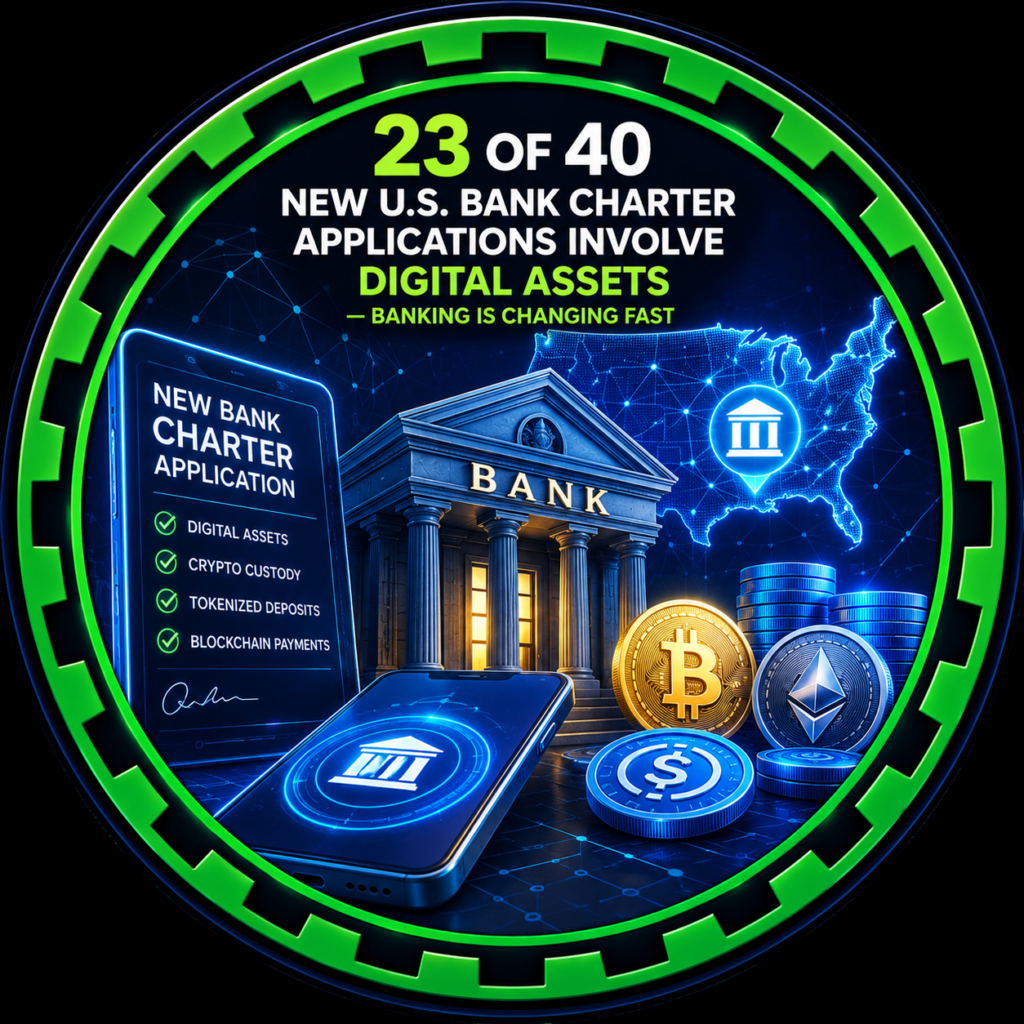
Twenty-three of those applications—more than half—included some form of digital-asset activity in their proposed business plans.
The figure is significant, but it requires careful interpretation.
It does not mean the United States has approved 23 new crypto banks.
It does not mean all the applicants plan to accept deposits, provide loans or obtain FDIC insurance.
It does not mean every application will be approved.
What it demonstrates is more consequential: digital-asset companies increasingly see federal banking supervision as a competitive advantage.
Crypto is not simply trying to replace banking from outside the system.
It is seeking permission to build a new category of financial institution from within it.
What the 23-of-40 Figure Actually Measures
The OCC charters and supervises national banks, federal savings associations and national trust banks.
According to Gould, the agency received 40 de novo charter applications over approximately 18 months. Twenty-three business plans involved digital assets.
The OCC described this as an eightfold increase compared with the four years of the Biden administration.
That historical comparison comes directly from the regulator. The OCC’s public statement did not include the full underlying application-level dataset needed to reproduce the calculation independently.
The comparison should therefore be attributed to the OCC, not presented as an independently verified industry statistic.
The broader conclusion is still supported by the regulator’s public pipeline: digital-asset custody, stablecoins, blockchain payments and tokenized financial infrastructure have become a substantial part of federal charter activity.
“Digital-Asset Activity” Is a Broad Category
The phrase does not mean every applicant wants to operate a cryptocurrency exchange.
Digital-asset activities may include:
- Custody of crypto-assets;
- Stablecoin issuance and redemption;
- Management of stablecoin reserves;
- Blockchain-based payments;
- Tokenized deposits;
- Settlement of tokenized securities;
- Institutional brokerage;
- Fiduciary administration;
- Safekeeping of private keys and digital assets.
Some applicants may never hold volatile cryptocurrencies on their balance sheets.
Their role could be closer to a custodian, settlement agent, trust company or payment infrastructure provider.
The charter pipeline therefore reflects more than demand for crypto trading.
It reflects the gradual construction of a regulated financial layer around digital assets.
A Charter Application Is Not Permission to Open
A federal bank-charter application begins a regulatory process.
It is not evidence that the applicant has already satisfied the OCC’s requirements.
The agency evaluates whether a proposed institution has:
- Adequate capital;
- Qualified management;
- A credible business plan;
- Sustainable financial projections;
- Effective compliance systems;
- Sufficient liquidity;
- Strong cybersecurity;
- Appropriate risk governance;
- Viable recovery and resolution procedures.
The OCC can approve, conditionally approve, deny or require changes to an application.
A conditional approval is still not final operating authority.
Before opening, an applicant may need to raise capital, hire approved management, implement compliance systems, complete technical infrastructure and pass a preopening examination.
Some applications may be withdrawn before the OCC reaches a final decision.
The correct statement is therefore:
Twenty-three recent charter applications involve digital assets—not 23 new crypto banks.
Not Every Chartered Institution Is a Full-Service Bank
The word “bank” normally suggests checking accounts, debit cards, mortgages and FDIC-insured deposits.
Many digital-asset applicants are pursuing national trust bank charters instead.
A national trust bank can conduct activities such as:
- Custody;
- Safekeeping;
- Fiduciary administration;
- Asset servicing;
- Settlement;
- Stablecoin reserve management.
It may not provide ordinary retail deposit accounts or conventional lending.
Some national trust banks operate without FDIC insurance because they do not accept insured deposits in the same way as commercial banks.
They are federally chartered and supervised by the OCC, but that status does not turn every customer balance or digital asset into an insured deposit.
This distinction is central to understanding the charter wave.
Many applicants are not trying to recreate Bank of America or JPMorgan.
They are trying to become federally regulated infrastructure for custody, stablecoins and tokenized markets.
Who Is Applying?
The OCC now maintains a dedicated public register of licensing applications involving digital assets.
The published pipeline includes applicants such as:
- Agora National Trust Bank;
- Catena Trust Bank;
- Dakota National Trust Bank;
- EDX Trust;
- Lorum National Trust Bank;
- OpenReserve Bank;
- Payward National Trust Company;
- PAYO Digital Bank;
- Revolut Bank US.
These applications involve different business models and charter structures. They should not be treated as equivalent proposals.
Some seek new national trust banks. Others pursue full-service banking authority or conversion from an existing institution.
The public documents are also incomplete by design.
Confidential business plans, security architecture, financial projections and proprietary operating information may not be available for public review.
The OCC’s list confirms the direction of the market, but it does not disclose every applicant’s full strategy.
Ripple, Paxos, BitGo and Fidelity Have Already Advanced
The transition became more concrete in December 2025, when the OCC conditionally approved five digital-asset-related national trust bank applications.
The agency granted preliminary conditional approval for new charters involving:
- Ripple National Trust Bank;
- First National Digital Currency Bank.
It also conditionally approved conversions to national trust bank status involving:
- BitGo Bank & Trust;
- Fidelity Digital Assets;
- Paxos Trust Company.
The companies represent different parts of the emerging digital financial system.
Ripple is developing infrastructure across payments, custody, stablecoins and tokenization.
Paxos provides regulated stablecoin and blockchain infrastructure.
BitGo and Fidelity Digital Assets focus heavily on institutional custody and asset services.
First National Digital Currency Bank is designed around digital-currency issuance and related regulated activities.
These institutions are not simply exchanges applying for prestigious titles.
They are attempting to secure federal authority for the custody, movement and administration of digital financial assets.
Why Digital-Asset Companies Want Federal Charters
Crypto companies have historically operated through a fragmented structure of state licenses, trust charters and banking partnerships.
That model can work, but it creates operational dependence and regulatory complexity.
A company may need:
- State money-transmitter licenses;
- Separate trust-company authority;
- Multiple banking partners;
- External reserve custodians;
- Payment processors;
- Correspondent accounts.
A federal charter can provide a more unified regulatory foundation for certain banking and trust activities.
Its strategic benefits may include:
- Nationally recognized supervision;
- Greater institutional credibility;
- Clearer custody and fiduciary authority;
- More consistent operating standards;
- Reduced dependence on state-by-state trust licensing;
- Stronger access to counterparties;
- Better positioning for stablecoin and tokenized-asset markets.
For a digital-asset company targeting institutions, regulatory status is not only a compliance obligation.
It is part of the product.
An asset manager is more likely to entrust significant holdings to an institution with enforceable custody duties, audited controls and a federal supervisor.
The Real Goal Is Infrastructure Independence
Digital-asset companies depend on banks for essential services:
- Holding cash;
- Processing wires;
- Settling customer transactions;
- Maintaining stablecoin reserves;
- Paying employees;
- Connecting to dollar-payment systems.
This dependence creates a structural vulnerability.
If a banking partner restricts or terminates the relationship, the crypto company can lose access to core operating functions even when its underlying business remains legal.
A charter can allow an institution to internalize part of that infrastructure.
It may hold assets in a regulated custody framework, administer reserves or provide fiduciary services directly.
The charter will not eliminate every dependency. A trust bank may still require correspondent banks, settlement accounts, payment networks and external service providers.
But it can reduce the number of critical functions controlled by unrelated institutions.
The company becomes less dependent on renting access to banking infrastructure.
It begins owning part of that infrastructure.
Stablecoins Are Accelerating the Charter Race
The GENIUS Act established a federal framework for payment stablecoins in the United States.
That development increased the strategic value of regulated institutions capable of issuing, safeguarding and administering digital dollars.
A stablecoin business needs reliable systems for:
- Issuance;
- Redemption;
- Reserve management;
- Customer verification;
- Sanctions screening;
- Transaction monitoring;
- Financial reporting;
- Operational resilience.
Not every stablecoin issuer must become a bank.
But companies expecting stablecoins to become major payment and settlement assets have a strong incentive to secure durable regulatory status.
A federal charter can provide credibility with banks, corporations, asset managers and payment networks.
It can also become a barrier to entry.
Once a company has spent the capital and time required to satisfy federal supervision, less regulated competitors may find it difficult to match its institutional trust.
The Value Lies in Banking Powers, Not the Word “Bank”
The strategic value of a charter comes from the activities it permits.
A digital-asset institution may want authority to:
- Safeguard tokenized assets;
- Manage stablecoin reserves;
- Act as a fiduciary;
- Process redemptions;
- Settle tokenized securities;
- Connect blockchain assets with bank money;
- Serve regulated institutional investors.
These functions occupy important positions in the financial value chain.
They generate fees, transaction data and durable client relationships.
The future bank does not necessarily need branches or a consumer mortgage portfolio.
It may operate:
- Digital custody;
- Programmable settlement;
- Stablecoin infrastructure;
- Tokenized collateral;
- Institutional payment networks.
The charter wave is therefore changing the definition of a bank.
A bank can increasingly be a regulated software and asset-administration platform.
The OCC Has Shifted Toward Activity-Based Supervision
Recent OCC policy has clarified that national banks may engage in several digital-asset activities when those activities are conducted safely and in compliance with applicable law.
The agency has addressed bank authority involving:
- Crypto-asset custody;
- Stablecoin payment activities;
- Participation in blockchain networks;
- Payment of blockchain transaction fees;
- Limited holdings needed for testing or network operations;
- Riskless principal crypto-asset transactions.
The Federal Reserve also withdrew earlier special notification and supervisory non-objection expectations for certain crypto and dollar-token activities in 2025.
This does not mean banks can engage in digital assets without limits.
It means regulators are moving toward evaluating the actual activity and its risks rather than treating all blockchain involvement as presumptively unacceptable.
The central question has changed.
It is no longer simply:
Should banks be allowed to interact with digital assets?
It is increasingly:
Can the institution manage custody, liquidity, compliance, cybersecurity and operational risk safely?
A Federal Charter Is Not a Safety Guarantee
A charter places an institution inside a regulatory framework.
It does not guarantee that the company cannot fail.
A digital-asset bank or trust company may still face:
- Cyberattacks;
- Private-key compromise;
- Smart-contract defects;
- Liquidity problems;
- Fraud;
- Compliance failures;
- Operational outages;
- Third-party technology failures;
- Concentration in a limited number of assets or clients.
Some risks differ from those of a conventional bank.
A traditional institution may lose money because borrowers default.
A digital custodian may maintain sufficient capital but still fail operationally if it loses access to customer assets or mishandles cryptographic keys.
Blockchain transactions can also be irreversible. An operational mistake may not be recoverable through conventional payment reversal.
Federal supervision can require stronger controls.
It cannot remove the underlying technical and market risks.
Federal Chartering and FDIC Insurance Are Separate
A federal charter and federal deposit insurance are not the same approval.
The OCC can charter a national bank or national trust bank. The FDIC separately decides whether to insure deposits where insurance is required or requested.
An uninsured national trust bank may still be federally chartered and supervised.
Before using a digital-asset institution, customers must determine:
- Which legal entity provides the service;
- Whether it accepts deposits;
- Whether those deposits are insured;
- Whether assets are held in custody;
- Whether cash is held at another bank;
- Whether pass-through insurance may apply;
- Whether digital assets remain uninsured.
Marketing language can obscure these distinctions.
“Federally chartered” means the institution operates under federal chartering authority.
“Federally regulated” means a federal regulator supervises aspects of its operations.
“FDIC insured” refers to eligible deposits at an insured depository institution, subject to applicable limits and ownership rules.
The terms are not interchangeable.
Why Traditional Banks Should Take the Applications Seriously
Digital-asset applicants are targeting some of banking’s most valuable businesses:
- Payments;
- Custody;
- Foreign exchange;
- Stablecoin reserves;
- Corporate treasury;
- Securities settlement;
- Collateral management;
- Institutional asset servicing.
Traditional banks historically controlled these functions through their accounts, licenses and access to settlement systems.
A federally chartered digital-asset institution could compete with newer technology and a narrower cost structure.
It may be:
- API-driven;
- Designed for continuous operation;
- Built around tokenized assets;
- Free from legacy branch infrastructure;
- Focused on a specific institutional market.
This does not mean crypto banks will displace major banks.
Large incumbents possess capital, distribution, customer relationships and access to central-bank infrastructure that new entrants cannot reproduce quickly.
But incumbents will have to compete, partner or acquire capabilities.
Refusing to participate will not prevent the market from developing.
Federal Charters Could Make Digital Assets More Institutional
The crypto industry has repeatedly suffered from weak custody, poor governance, commingled assets and unclear legal responsibility.
Federally supervised institutions can introduce stronger requirements around:
- Asset segregation;
- Capital;
- Liquidity;
- Compliance;
- Cybersecurity;
- Business continuity;
- Independent governance;
- Recordkeeping;
- Audits.
Institutional investors require more than proof that assets exist at a blockchain address.
They need to know:
- Who legally owns the assets;
- Whether the custodian’s creditors can claim them;
- How keys are protected;
- What happens during bankruptcy;
- Who is responsible after an unauthorized transfer;
- How the institution restores operations after an outage.
A charter can create a clearer accountability structure.
The digital assets do not become risk-free.
Their administration can become more credible.
Regulation May Also Concentrate the Market
Obtaining a federal charter is expensive.
Applicants need capital, legal expertise, qualified executives, compliance teams, cybersecurity controls and sustainable financial projections.
Large companies can absorb those costs more easily than startups.
The charter wave could therefore produce a safer but more concentrated industry.
Smaller companies may be forced to:
- Partner with chartered institutions;
- Use third-party custodians;
- License regulated infrastructure;
- Operate only as software providers;
- Abandon certain financial activities.
This may improve customer protection while reducing competition.
Regulators will need to balance safety with market access.
A charter should be demanding enough to protect the financial system without becoming a privilege available only to the largest corporations.
Political Support Is Not Permanent Legal Certainty
The increase in applications reflects market demand, clearer digital-asset rules and a more receptive OCC.
Policy can change.
A future administration may impose different supervisory expectations or interpret permissible activities more narrowly.
Applicants therefore need business models capable of surviving political cycles.
A bank charter should rest on:
- Durable statutory authority;
- Sustainable customer demand;
- Strong risk controls;
- Demonstrable economic value.
It should not depend solely on supportive statements from current officials.
The OCC’s reported eightfold increase shows that regulatory posture affects application activity.
It does not guarantee that the current pace will continue.
What the Number Proves—and What It Does Not
The 23-of-40 figure proves that digital assets have become a material part of the federal bank-charter pipeline.
It shows that crypto companies increasingly want national supervision and that custody, stablecoins and tokenized finance are moving closer to regulated banking.
It does not prove that:
- All 23 applications will be approved;
- Twenty-three full-service banks will open;
- Every applicant will accept deposits;
- Customer assets will receive FDIC protection;
- Digital-asset banking will be commercially successful;
- Crypto-related activities have become low risk.
Applications demonstrate strategic intent.
Final approvals, opened institutions, audited financial results and operational performance will determine whether that intent becomes a durable industry.
Final Analysis: Crypto Is Applying to Join the Banking System
The first generation of crypto companies attempted to operate around banks.
The next generation is applying for federal charters.
This is not a retreat from innovation.
It is a recognition that payments, custody and settlement require durable legal institutions.
As digital assets move beyond trading, companies need authority to safeguard customer property, administer reserves, process redemptions and connect blockchain networks with the dollar system.
A federal charter can provide part of that foundation.
The 23 applications do not mean 23 crypto banks are about to open.
Some applicants will be rejected. Others may withdraw or receive narrow authority. Many will operate as trust institutions rather than full-service banks.
A smaller number may become important providers of digital custody, stablecoin infrastructure and tokenized settlement.
The larger trend is clear.
Banks are adopting blockchain.
Crypto companies are pursuing bank charters.
Payment platforms are issuing digital dollars.
Custodians are becoming nationally supervised institutions.
The border between banking and digital assets is being redrawn.
The future may belong neither to traditional banks operating entirely on legacy infrastructure nor to crypto companies trying to remain outside regulation.
It may belong to institutions capable of combining federal banking authority with programmable financial technology.
The OCC’s 23-of-40 figure does not prove that this transformation is complete.
It proves that the competition has moved inside the regulated financial system.
Key Facts
- The OCC received 40 de novo federal charter applications over approximately 18 months.
- Twenty-three included some form of digital-asset activity.
- The number refers to applications—not approved or operating banks.
- Digital-asset activities may include custody, stablecoins, payments and tokenized settlement.
- The applications include national trust banks and other charter structures.
- National trust banks do not necessarily provide conventional retail banking.
- An OCC charter does not automatically provide FDIC insurance.
- Ripple and First National Digital Currency Bank received preliminary conditional charter approvals in 2025.
- BitGo, Fidelity Digital Assets and Paxos received conditional approval to convert to national trust bank status.
- Conditional approval does not authorize immediate operation.
- Federal supervision can improve governance but cannot eliminate technical, liquidity or operational risk.
Editorial Disclosure
This article contains independent editorial analysis. REVOLD Blog has not received compensation from the OCC or any applicant mentioned in this publication.
The 23-of-40 figure and the eightfold historical comparison are attributed to the OCC’s August 19, 2026 statement. The agency did not publish the complete underlying dataset required to reproduce the historical comparison independently.
A charter application is not an approval. Conditional approval is not final authorization to open. Federal charter status is not equivalent to FDIC insurance.
This material is provided solely for informational and educational purposes. It does not constitute financial, investment, legal, tax or banking advice.
Sources
- OCC: 23 of 40 Charter Applications Involve Digital Assets
- OCC: Digital-Asset Licensing Applications
- OCC: Conditional Approvals for Five National Trust Banks
- OCC: Charters and Licensing
- OCC: Reinvigorating De Novo Chartering
- OCC: Stablecoins and Blockchain Payment Activities
- OCC: Riskless Principal Crypto-Asset Transactions
- FDIC: Applying for Deposit Insurance
Information reviewed and updated: August 24, 2026.
Author: Roman Kravchina
Published by: REVOLD Blog
Powered by: AIR RISE INC & REVOLD AI