
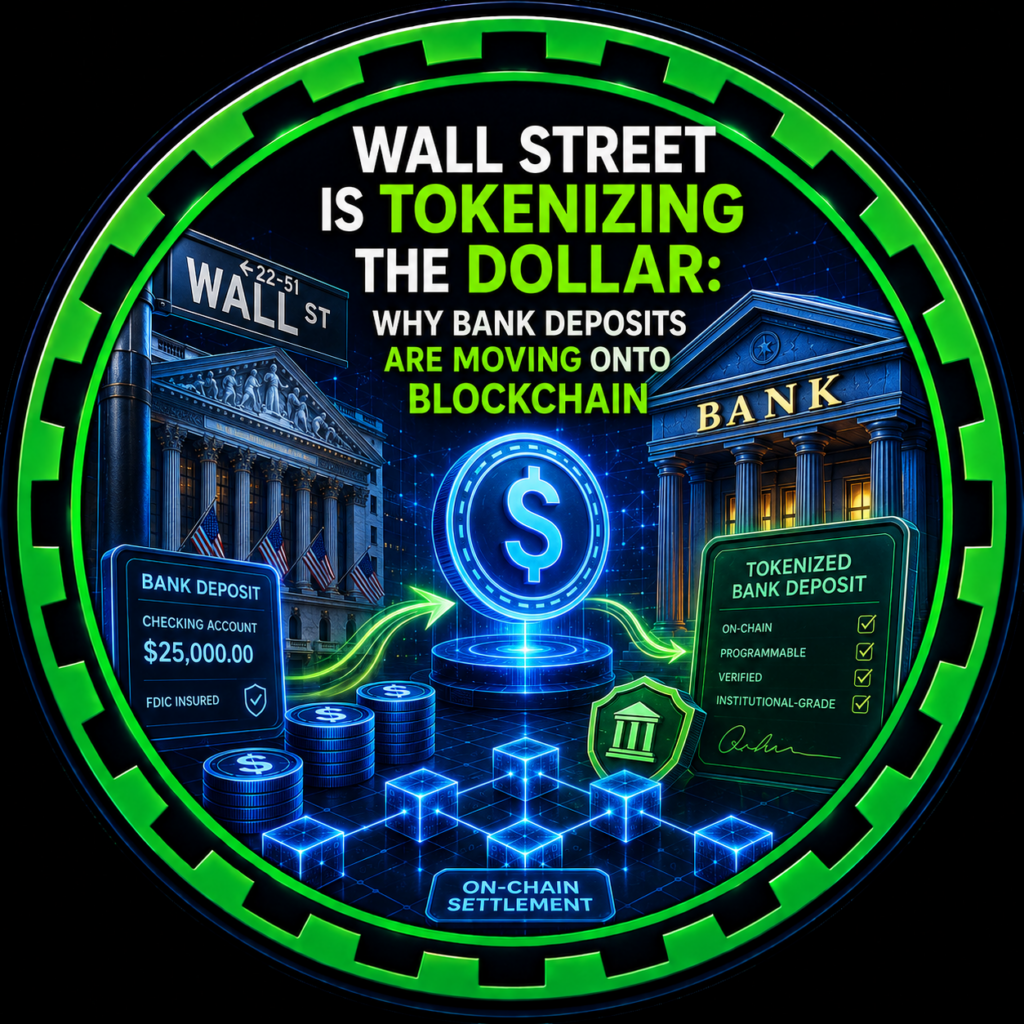
Stablecoins placed the dollar on blockchain. Wall Street is now placing the banking system’s own money there.
This is not a cosmetic technology upgrade.
Bank deposits are the foundation of payments, lending and corporate liquidity. Tokenizing them could change how money moves between banks, settles securities, secures financial obligations and responds to contractual events.
The largest institutions are already building the infrastructure.
JPMorgan operates a dollar deposit token for eligible institutional clients. Citi uses tokenized deposits for continuous liquidity transfers. HSBC has deployed tokenized-deposit services across several financial centers. Swift has prepared a blockchain-based ledger for live pilots involving 17 banks.
These projects do not attempt to replace the dollar. They attempt to change its operating system.
The result could be a regulated form of programmable money that moves continuously while remaining connected to commercial-bank accounts.
What Is a Tokenized Bank Deposit?
A tokenized deposit is a digital representation of money held at a commercial bank.
It remains a liability of the issuing bank. The token does not necessarily represent a new currency or a separate pool of reserves. It represents an existing bank claim in a form that can move through blockchain-based infrastructure.
An eligible corporate customer could use the tokenized balance to:
- Transfer liquidity;
- Pay counterparties;
- Settle tokenized securities;
- Satisfy collateral requirements;
- Execute conditional payments;
- Move funds outside conventional banking hours.
The economic relationship remains familiar: the customer holds a claim against the bank.
What changes is the deposit’s technical functionality.
Instead of remaining a passive balance inside one account system, it can become a programmable financial instrument.
Tokenized Deposits and Stablecoins Are Not the Same
Both products can represent dollar-denominated value, but their legal and economic structures differ.
A stablecoin is generally issued against a designated reserve portfolio containing assets such as cash, bank deposits and short-term government securities.
A tokenized deposit represents a liability of a commercial bank.
That difference determines who owes the money, how the product appears on a balance sheet and which regulatory framework applies.
Stablecoins are often designed to circulate broadly across public blockchain networks. Tokenized deposits are usually restricted to approved customers and controlled institutional environments.
Stablecoins can move outside a direct bank relationship. Deposit tokens preserve it.
The distinction also affects deposit insurance. An eligible tokenized deposit may retain coverage associated with the underlying bank account, but insurance must not be assumed merely because a bank issued the token.
Coverage depends on:
- Product structure;
- Account ownership;
- Bank records;
- Issuing entity;
- Jurisdiction;
- Applicable insurance limits.
Large institutional balances will often exceed insured limits regardless of whether they are tokenized.
A digital token can move faster than a conventional deposit, but it does not eliminate the issuing bank’s credit risk.
Why Wall Street Wants Deposits On-Chain
Stablecoins have demonstrated demand for money that is:
- Available continuously;
- Transferable across digital networks;
- Programmable;
- Compatible with tokenized assets;
- Less dependent on banking cutoffs.
For banks, that success creates both an opportunity and a threat.
If customers move substantial balances into stablecoins, commercial banks may lose deposits and payment activity. That matters because deposits are not merely stored customer funds. They help finance loans, credit cards, mortgages and other banking assets.
Tokenized deposits give banks a defensive response.
They can offer blockchain functionality without allowing the customer relationship—and potentially the funding—to migrate to an outside stablecoin issuer.
The strategy is straightforward:
Preserve the bank deposit, modernize how it moves.
This is why deposit tokens may become more important to Wall Street than consumer-facing cryptocurrencies.
JPMorgan Is Testing the Public-Blockchain Model
JPMorgan has developed one of the most mature institutional blockchain platforms among major banks.
Kinexys by J.P. Morgan supports programmable payments, asset tokenization, collateral management and near-real-time settlement.
Its JPM Coin deposit token represents a one-to-one claim on U.S. dollar deposits held at JPMorgan. It is available to eligible institutional clients for continuous settlement.
JPMorgan has also placed deposit-token infrastructure on public blockchain networks, including Base, while retaining permissioned access.
That combination is significant.
A public blockchain does not require anonymous access to the financial product operating on it. The network can be open while the bank-issued token remains limited to verified institutional customers.
This model attempts to combine:
- Public-network interoperability;
- Bank-controlled identity;
- Compliance screening;
- Institutional transaction controls;
- A direct claim against a regulated bank.
JPMorgan is not opening its deposit token to every crypto wallet. It is using public infrastructure to extend institutional bank money beyond a fully closed proprietary network.
Citi Is Focused on Corporate Liquidity
Citi Token Services uses private, permissioned blockchain infrastructure to tokenize deposits held within Citi’s global network.
The principal use case is not speculative trading. It is corporate cash management.
A multinational company may maintain balances in multiple countries because conventional payment systems do not always operate at the same time. Market holidays, time zones and banking cutoffs force treasury departments to keep additional liquidity in different locations.
That protects the company from missing payments but leaves capital sitting idle.
Citi’s system allows eligible clients to move tokenized liquidity between participating parts of its network on a continuous basis, subject to applicable limits and controls.
Citi has also integrated tokenized-deposit capabilities with its 24/7 U.S. dollar-clearing service.
This allows participating financial institutions and corporate clients to initiate certain dollar payments outside conventional operating windows.
The value is not simply faster payment. It is more efficient deployment of corporate cash.
HSBC Shows the Potential—and the Limitation
HSBC has launched tokenized-deposit services across markets including Hong Kong, Singapore, Luxembourg and the United Kingdom.
The services are designed to help institutional clients transfer funds and manage liquidity across participating markets continuously.
This demonstrates that tokenized deposits can function across currencies and financial centers.
It also exposes the industry’s central problem.
An HSBC tokenized deposit is most useful inside HSBC’s network. A Citi deposit token is most useful inside Citi. JPM Coin operates within JPMorgan’s institutional ecosystem.
Each bank can improve its own infrastructure while leaving the global system fragmented.
If tokenized deposits cannot move efficiently between institutions, Wall Street will have created faster internal networks—not a new form of globally usable bank money.
Swift Is Building the Interbank Layer
Swift is addressing the interoperability problem directly.
In July 2026, it announced that its blockchain-based ledger was ready for initial use. Seventeen financial institutions are preparing to pilot live cross-border transactions using tokenized deposits.
The participating banks include Citi, Wells Fargo, BNY, HSBC, UBS, Standard Chartered, BNP Paribas, MUFG and major institutions from Asia, Europe, the Middle East, Africa and the Americas.
Swift’s system does not require every bank to issue deposits on one ledger.
Participating institutions can maintain their own tokenized-deposit records. Swift provides a shared orchestration layer that records and coordinates payment commitments between the banks.
The initial design allows payments to be initiated during nights and weekends, while final interbank settlement can continue through existing central-bank and correspondent-banking infrastructure.
This limitation needs to be understood.
Swift is not yet replacing the entire settlement system with blockchain. It is separating payment execution from final settlement and improving coordination between participating institutions.
Its architecture is EVM-compatible and based on Hyperledger Besu. More importantly, it integrates existing Swift identity, messaging and compliance standards.
The project is designed to extend regulated banking—not bypass it.
Interoperability Determines Whether Deposit Tokens Become Money
Creating a digital representation of a deposit is technically manageable.
Making it transferable between unrelated banks is the difficult part.
Suppose a company holds a tokenized dollar issued by Bank A and wants to pay a supplier at Bank B.
Bank B must determine:
- Whether it will accept Bank A’s liability;
- How the customer was verified;
- Whether the transaction passed sanctions and fraud screening;
- When payment becomes legally final;
- How the token converts into a Bank B deposit;
- How the banks settle their obligations;
- Who is responsible if the transaction fails.
A dollar deposit at one bank is not legally the same liability as a dollar deposit at another.
Conventional payment infrastructure hides much of this complexity through clearing systems, deposit insurance, correspondent relationships and central-bank settlement.
Tokenized deposits need equivalent institutional mechanisms.
Without them, every bank creates its own digital money silo.
With them, tokenized deposits could become a new layer of interoperable commercial-bank money.
Why Corporate Treasurers Care
The strongest early market for tokenized deposits is institutional cash management.
A multinational business may hold money across many banks, currencies, subsidiaries and jurisdictions. It must ensure that payroll, taxes, suppliers, debt payments and collateral obligations are funded at the correct time.
Because financial systems operate on different schedules, companies often maintain excess balances as protection.
That creates an economic cost.
Cash held in the wrong location cannot be used efficiently elsewhere. A company may need short-term financing in one market while holding surplus liquidity in another.
Tokenized deposits could allow treasury departments to:
- Move funds continuously;
- Reduce prefunding;
- Consolidate idle balances;
- Automate internal liquidity transfers;
- Improve cash visibility;
- React faster to market events;
- Pay counterparties outside local banking hours.
The benefit is not that blockchain makes every transfer instantaneous.
The benefit is that better coordination can reduce the amount of capital trapped by fragmented settlement schedules.
Programmability Turns Money Into an Automated Contract
A conventional bank transfer follows a payment instruction.
A programmable deposit can execute when predefined conditions are satisfied.
Funds could be released when:
- A shipment reaches its destination;
- A buyer approves an invoice;
- Ownership of a security transfers;
- Collateral falls below a required threshold;
- A contractual milestone is verified;
- Both sides of a foreign-exchange transaction are ready.
This could be particularly useful in trade finance, where buyers, sellers, carriers, insurers and banks often maintain separate records.
Payment could be connected to verified commercial events rather than waiting for documents to pass manually between institutions.
But programmability does not eliminate contractual disputes.
A sensor may provide incorrect data. Goods may arrive damaged. A document may be authentic but incomplete. A smart contract may execute correctly according to its code while producing the wrong commercial outcome.
Bank-grade programmable money therefore requires:
- Trusted data sources;
- Clearly defined legal agreements;
- Transaction limits;
- Human review;
- Emergency suspension;
- Dispute procedures;
- Complete audit records.
Automation should reduce predictable administrative work—not remove accountability.
Tokenized Securities Need Tokenized Cash
Wall Street is already moving bonds, funds, collateral and private-market assets onto blockchain infrastructure.
Those assets need a compatible settlement instrument.
If a tokenized security trades on-chain but payment still moves through a separate banking process, the transaction retains much of its existing friction.
Tokenized deposits can supply the cash side.
A digital security and the payment used to purchase it can exchange in a coordinated transaction:
- The asset moves only if the money moves;
- The money moves only if the asset is delivered.
This is delivery-versus-payment settlement.
It reduces the period during which one party has delivered value while waiting for the other. It can also reduce failed trades and reconciliation work.
Stablecoins can perform this function, but banks have a strong incentive to use their own deposit liabilities.
The institution controlling the settlement asset can retain deposits, payment data, transaction fees and the client relationship.
Collateral Could Become More Efficient
Collateral management may become one of tokenization’s most valuable institutional applications.
Banks and asset managers pledge securities and cash to secure loans, derivatives and trading exposures. These assets may be held with different custodians and governed by different legal agreements.
Tokenized collateral can carry verified information about:
- Ownership;
- Custody;
- Valuation;
- Eligibility;
- Restrictions;
- Existing claims.
A programmable system could identify eligible assets and execute collateral substitutions when agreed thresholds are reached.
JPMorgan’s Tokenized Collateral Network is designed around this use case. Kinexys also supports tokenized money-market funds that may be used in continuous liquidity and collateral workflows.
The potential advantage is not merely digitization.
It is the ability to use an asset operationally without first converting it through several separate systems.
The legal claim remains essential. A blockchain record has value only if it corresponds to enforceable ownership and recognized custody arrangements.
Faster Settlement Is Not Automatically Better
Reducing settlement time can lower counterparty risk, but immediate settlement creates its own liquidity demands.
Traditional financial systems often batch and net transactions. Instead of settling every obligation individually, institutions calculate the net amount owed after offsetting incoming and outgoing payments.
This reduces the liquidity required.
If transactions settle one by one in real time, banks may need more cash or collateral available at every moment.
Continuous banking also requires continuous:
- Fraud monitoring;
- Sanctions screening;
- Liquidity management;
- Cybersecurity;
- Technical support;
- Incident response.
A payment interface cannot become 24/7 while the risk organization continues operating on a weekday schedule.
Tokenization may reduce some forms of operational risk while creating new ones.
Software Risk Becomes Financial Risk
Programmable deposits depend on code controlling access, conditions and transaction execution.
A defect could release money too early, prevent a legitimate transfer or repeat the same incorrect action across many transactions.
External data introduces another risk.
If a smart contract relies on a shipping database, market price or compliance status, the accuracy of that information becomes part of the payment system.
Banks will need controls that go far beyond standard blockchain deployment:
- Independent code audits;
- Segregated administrative permissions;
- Controlled upgrades;
- Recovery procedures;
- Transaction caps;
- Emergency freezes;
- Legal reversal mechanisms;
- Human intervention.
The idea that “code is law” is incompatible with regulated deposits.
Code must operate within law—and remain subject to correction when its execution conflicts with legal rights.
Public and Private Blockchains Will Coexist
There is no evidence that Wall Street will select a single universal blockchain.
Private networks provide stronger control, privacy and predictable governance.
Public networks provide broader interoperability, existing liquidity and access to external digital assets.
JPMorgan’s approach shows that these models can overlap. A bank can issue a permissioned product on a public network.
The likely architecture will combine:
- Private bank ledgers;
- Public blockchains;
- Tokenized deposits;
- Stablecoins;
- Central-bank settlement;
- Interoperability networks such as Swift.
The winning system will not necessarily be the most decentralized.
It will be the one that can move regulated value reliably between institutions, jurisdictions and technical networks.
Stablecoins Will Remain Important
Tokenized deposits are not a universal replacement for stablecoins.
Stablecoins currently offer advantages in:
- Public blockchain markets;
- Cross-platform transfers;
- Digital-asset trading;
- Wallet portability;
- Global online commerce;
- Integration with decentralized applications.
Tokenized deposits are better positioned for:
- Corporate treasury;
- Institutional payments;
- Bank-to-bank transfers;
- Tokenized-security settlement;
- Regulated collateral management.
Stablecoins are designed to circulate beyond one bank.
Deposit tokens are designed to extend the bank account into programmable infrastructure.
The two models will coexist, but they will compete for the most valuable role: becoming the cash used to settle tokenized financial assets.
Retail Customers May Never See the Blockchain
Current tokenized-deposit projects primarily serve institutions.
Retail customers may eventually benefit without holding visible blockchain tokens.
A bank could use tokenized infrastructure underneath its existing application. The customer would see:
- Faster international transfers;
- Weekend settlement;
- Immediate movement between financial products;
- Conditional payments;
- Better integration with investments.
The underlying ledger may remain invisible.
That is how infrastructure reaches maturity.
Consumers do not need to understand clearing networks to use a card. They may not need to understand tokenized deposits to use programmable money.
Final Analysis: Wall Street Is Rebuilding the Dollar’s Operating System
The dollar is already digital.
Most dollars exist as entries in bank databases rather than physical currency.
Tokenization does not make the dollar digital for the first time. It changes what digital dollars can do.
A tokenized bank deposit can potentially:
- Move continuously;
- Interact with financial assets;
- Respond to contractual conditions;
- Settle across programmable networks;
- Serve as collateral;
- Remain connected to a regulated bank.
The technology has moved beyond theoretical research. Major banks now operate tokenized-deposit services, and Swift is preparing interbank pilots.
But the hardest problems remain unresolved.
The industry still needs consistent rules for interoperability, legal finality, privacy, liquidity and deposit protection. It must also prevent every bank from creating another isolated digital network.
If those problems are solved, the result will be more important than another stablecoin.
Commercial-bank money will become programmable infrastructure.
Deposits will no longer remain passive balances locked inside individual institutions. They will be able to interact directly with payments, securities, collateral and contracts.
Stablecoins placed dollars on blockchain.
Tokenized deposits could place regulated banking there.
Wall Street is not replacing the dollar.
It is rebuilding the system through which the dollar moves.
Key Facts
- Tokenized deposits represent claims against commercial banks.
- They are structurally different from reserve-backed stablecoins.
- JPM Coin is available to eligible institutional clients as a bank-backed U.S. dollar deposit token.
- JPMorgan has deployed permissioned deposit-token infrastructure on public blockchain networks.
- Citi Token Services supports continuous institutional liquidity transfers using private blockchain infrastructure.
- HSBC has launched tokenized-deposit capabilities in multiple financial markets.
- Swift has prepared a blockchain ledger for pilots involving 17 financial institutions.
- Tokenized deposits do not automatically eliminate issuing-bank credit risk.
- Deposit insurance depends on the product’s legal structure, ownership records and applicable limits.
- Faster settlement may increase intraday and weekend liquidity requirements.
- Tokenized deposits and stablecoins are likely to coexist.
Editorial Disclosure
This article contains independent editorial analysis. REVOLD Blog has not received compensation from JPMorgan Chase, Citi, HSBC, Swift or another institution mentioned in this publication.
Product availability, legal treatment, deposit-insurance eligibility and blockchain support vary by institution and jurisdiction. Potential benefits should not be interpreted as guaranteed outcomes.
This material is provided solely for informational and educational purposes. It does not constitute financial, investment, legal, tax or banking advice.
Sources
- J.P. Morgan: JPM Coin Deposit Token
- J.P. Morgan: USD Deposit Token on a Public Blockchain
- J.P. Morgan: Tokenized Collateral Network
- Citi Digital Assets and Token Services
- Citi: Token Services and 24/7 USD Clearing
- Swift: Blockchain Ledger Ready for Tokenized-Deposit Pilots
- Swift: Building the Digital Payment Stack of the Future
- Swift and HSBC: Blockchain and 24/7 Payments
- Swift: Interoperability and Tokenized Deposits
Information reviewed and updated: August 24, 2026.
Author: Roman Kravchina
Published by: REVOLD Blog
Powered by: AIR RISE INC & REVOLD AI