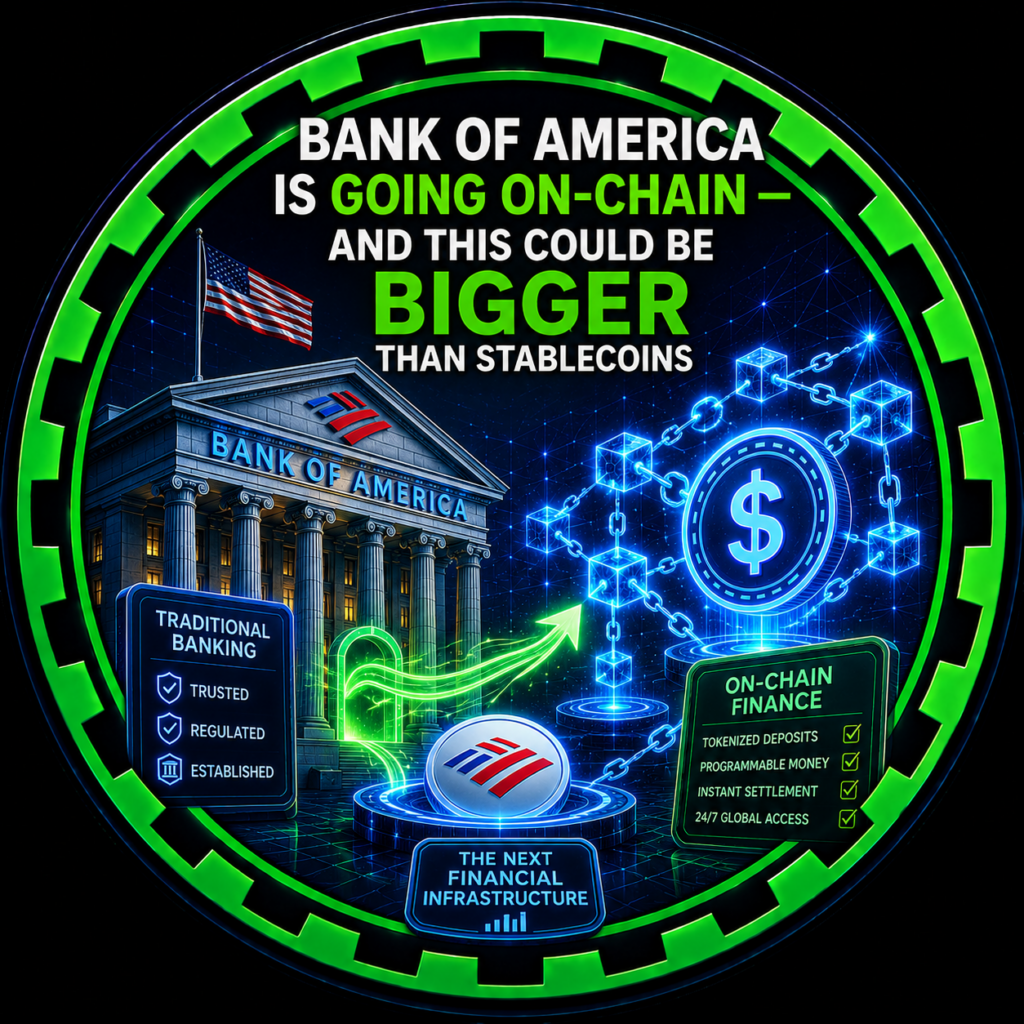
Bank of America is not trying to become a cryptocurrency company. It is preparing for a financial system in which deposits, payments and securities can move across programmable networks.
That distinction is the key to understanding the bank’s digital-asset strategy.
Most headlines focus on one question: Will Bank of America launch a stablecoin?
The answer matters, but it does not capture the full opportunity.
A bank-supported digital dollar could enable faster payments, continuous settlement and more direct competition with USDC, PYUSD, RLUSD and other blockchain-based forms of money. Yet a stablecoin would be only one component of a much larger financial system.
The deeper transformation is tokenization: representing deposits, securities, collateral and contractual claims as programmable digital assets capable of moving across interconnected financial networks.
If that infrastructure reaches institutional scale, Bank of America could do more than issue another dollar token.
It could help define how regulated money operates on-chain.
What Bank of America Has Actually Confirmed
Bank of America has not launched a publicly available stablecoin or announced that customer deposits are moving onto a blockchain.
The bank has, however, confirmed that it has completed substantial preparatory work.
During Bank of America’s July 2025 earnings call, Chief Executive Brian Moynihan said the institution had done “a lot of work” on stablecoin-related capabilities. He indicated that Bank of America expected to participate when customer demand, regulation and market structure justified a commercial launch.
Moynihan did not provide a launch date. He also suggested that the bank could proceed through partnerships rather than build an isolated product.
That caution is strategically rational.
A stablecoin is useful only when customers, merchants, financial institutions and markets are prepared to accept it. Issuing a token is technically achievable. Creating sufficient liquidity, distribution and interoperability is much harder.
Bank of America subsequently joined nine other major institutions in exploring a one-to-one reserve-backed form of digital money focused on G7 currencies.
The group also includes:
- Banco Santander;
- Barclays;
- BNP Paribas;
- Citi;
- Deutsche Bank;
- Goldman Sachs;
- MUFG Bank;
- TD Bank;
- UBS.
The initiative is evaluating whether an industry-wide payment asset could operate on public blockchains while complying with banking regulation and established risk-management standards.
This is confirmed institutional exploration—not a completed launch.
The difference is important. Bank of America is preparing to enter blockchain-based finance, but it has not yet disclosed the final product, network, operating model or release schedule.
The Stablecoin Is the Visible Product, Not the Full Strategy
Stablecoins receive attention because they are easy to understand.
A dollar-backed stablecoin is designed to represent one U.S. dollar in tokenized form. It can move between supported wallets and platforms without relying on conventional banking hours.
For Bank of America, a stablecoin could support:
- Cross-border payments;
- Corporate treasury operations;
- Merchant settlement;
- Institutional digital-asset markets;
- Transfers outside banking hours;
- Settlement of tokenized securities;
- Movement of liquidity between financial platforms.
But the token itself is not the strategic prize.
The real value lies in the network connecting the token to deposits, securities, corporate accounts, custody systems and regulated counterparties.
A stablecoin without distribution is merely a technical asset.
A stablecoin connected to one of the world’s largest banking franchises becomes financial infrastructure.
“Going On-Chain” Does Not Mean Becoming a Crypto Exchange
The phrase “on-chain” is often associated with cryptocurrency trading, speculative tokens and decentralized finance.
For Bank of America, it is likely to mean something more institutional.
A bank can use blockchain infrastructure without asking customers to trade Bitcoin or manage private keys. It can represent conventional financial claims as digital assets while preserving compliance, customer identification and legal accountability.
Those assets could include:
- Bank deposits;
- Treasury securities;
- Corporate bonds;
- Investment funds;
- Loans;
- Repurchase agreements;
- Collateral;
- Foreign-exchange positions;
- Trade-finance documents.
The legal claim does not necessarily change because its record moves onto a distributed ledger.
A tokenized bond remains debt issued under a legal contract. A tokenized deposit remains a liability of the bank. A tokenized Treasury security remains a claim connected to a government obligation.
What changes is how the asset is recorded, transferred and settled.
This is why Bank of America’s blockchain strategy should not be judged by the size of its cryptocurrency business. The more important test is whether tokenization can improve the movement of regulated financial value.
Why Tokenized Deposits May Be More Important Than Stablecoins
Stablecoins and tokenized deposits can both represent dollar value, but they are structurally different.
A reserve-backed stablecoin is generally issued against a separate portfolio of cash, short-term government securities or other permitted reserve assets.
A tokenized deposit represents money already held as a deposit at a commercial bank. The digital token remains connected to the bank’s balance sheet and represents a claim against that institution.
This distinction affects:
- Deposit insurance;
- Banking regulation;
- Interest payments;
- Credit creation;
- Liquidity management;
- Customer rights;
- Monetary-policy transmission;
- Legal treatment during insolvency.
Banks have a strong economic reason to favor tokenized deposits.
Deposits are a core source of funding. They support mortgages, corporate loans, credit cards and other lending activities.
If customers move substantial balances from banks into stablecoins issued by nonbank companies, part of the deposit base could migrate into reserve structures concentrated in cash and government securities.
For banks, this is not simply a payments issue. It is a balance-sheet issue.
Tokenized deposits offer a way to provide many of the functional benefits of blockchain-based money without surrendering the deposit relationship.
Customers could potentially receive continuous settlement and programmability while their money remains a liability of the regulated bank.
Bank of America Is Defending the Deposit Franchise
The stablecoin debate is often presented as a competition between traditional finance and cryptocurrency companies.
The more precise conflict is between different issuers of digital money.
Crypto-native companies want customers to hold stablecoins.
Payment platforms want digital dollars circulating inside their applications.
Banks want customers to retain deposits.
Public blockchain networks want financial transactions to occur on their infrastructure.
Each participant is competing for control over liquidity, distribution and the customer relationship.
Bank of America’s response cannot be limited to launching a token that imitates existing stablecoins. It needs a structure that preserves the economic value of deposits while making those deposits usable in a programmable environment.
That may involve:
- A bank-issued stablecoin;
- A consortium-issued payment token;
- Tokenized commercial-bank deposits;
- Connections to third-party stablecoins;
- Interoperability between public and permissioned networks.
These approaches are not mutually exclusive.
Bank of America could eventually support several forms of digital money for different customers and transactions.
Why a Consortium May Be Smarter Than a Proprietary Coin
A digital currency becomes more useful as the number of institutions willing to accept it increases.
If every bank issues a separate token, the market could fragment into incompatible pools of digital liquidity.
A Bank of America token might work efficiently between Bank of America clients but still require conversion when interacting with another institution. The result would be a modern version of the fragmentation already present in correspondent banking.
A shared token supported by several global banks could offer:
- Broader acceptance;
- Deeper liquidity;
- Common compliance standards;
- Shared technical infrastructure;
- Greater geographic reach;
- More efficient currency conversion;
- Reduced dependence on one institution.
The ten-bank initiative exploring reserve-backed digital money for G7 currencies is therefore more important than a conventional product announcement.
Its goal is not merely to create another stablecoin. It is to determine whether major banks can establish shared digital-money infrastructure capable of operating across public blockchains.
The consortium approach also distributes risk and development cost. But it introduces a different challenge: governance.
The participating institutions must agree on issuance, reserves, redemption, compliance, technical standards and responsibility during a failure.
A shared network is more useful than an isolated product only if its members can establish common operating rules.
The Bigger Opportunity Is Tokenized Settlement
Stablecoins improve the movement of money.
Tokenization can change the movement of both money and assets.
That is the larger opportunity.
Financial markets currently use separate systems for trade execution, clearing, custody, ownership records, payments and regulatory reporting.
A transaction may be agreed upon almost instantly but take additional time to settle. Cash and securities may move through different institutions. Multiple parties maintain their own records and later reconcile the differences.
Tokenized infrastructure can coordinate these steps.
A tokenized security and the digital money used to purchase it could exchange simultaneously. The asset would transfer only when payment was available, and the payment would complete only when the asset was delivered.
This structure is known as delivery versus payment.
Its value is not theoretical elegance. It can reduce:
- Settlement failures;
- Counterparty exposure;
- Reconciliation work;
- Operational delays;
- Capital trapped during settlement;
- Dependence on multiple intermediaries.
A stablecoin can provide the cash side of the transaction. The greater value emerges when cash, deposits, securities and collateral can interact within the same coordinated financial environment.
From Banking Hours to Continuous Finance
Traditional financial systems operate according to schedules.
Banks have cutoff times. Securities markets close. Some settlement systems do not operate continuously. Cross-border transfers may pass through several institutions in different time zones.
Blockchain-based networks can operate around the clock.
For consumers, this may look like a faster transfer.
For corporations and financial institutions, the consequences are broader.
Continuous financial infrastructure could enable:
- Payments during nights and weekends;
- Real-time movement of collateral;
- Faster cross-border liquidity;
- Continuous treasury management;
- More immediate margin transfers;
- Shorter securities-settlement cycles;
- Reduced reliance on prefunded foreign accounts.
The strategic benefit is not simply speed.
A company that can move money on Saturday may not need to maintain the same cash buffer until Monday. A bank that receives collateral immediately may reduce its exposure to a counterparty. An asset manager that settles a transaction sooner may release capital for another use.
At institutional scale, even small improvements in liquidity efficiency can have substantial economic value.
Programmable Money Can Connect Payment to Purpose
A conventional payment transfers value from one account to another.
A programmable payment can execute when specified conditions are satisfied.
Funds could be released when:
- A shipment reaches a verified destination;
- Ownership of an asset transfers;
- A contractual milestone is completed;
- An invoice reaches its due date;
- Collateral falls below an agreed threshold;
- Both sides of a foreign-exchange transaction are ready;
- Required compliance documentation has been approved.
The objective is not to remove every person from the process.
Financial institutions will still need authorization controls, fraud monitoring, sanctions screening, dispute mechanisms and emergency procedures.
The benefit is the ability to reduce manual steps between a verified economic event and its financial settlement.
This is especially relevant to Bank of America’s corporate and institutional clients.
Large companies do not primarily need another speculative asset. They need money that can interact more efficiently with contracts, invoices, securities and supply chains.
Tokenized Collateral Could Unlock More Value Than Payments
Collateral is one of the least visible but most important components of institutional finance.
Banks, brokerages, asset managers and corporations pledge securities and cash to secure loans, derivatives and trading obligations.
The process of identifying, valuing and moving collateral can be fragmented. Assets may sit with different custodians, operate under different legal agreements and settle through separate infrastructure.
Tokenization could make eligible collateral easier to track and transfer.
A properly structured digital asset could carry verified information about:
- Ownership;
- Valuation;
- Eligibility;
- Restrictions;
- Existing claims;
- Settlement history.
Automated rules could help institutions substitute collateral or satisfy margin requirements when predefined conditions are met.
The potential benefits include better liquidity management and lower operational risk.
But the legal structure remains decisive.
A blockchain record does not automatically establish enforceable ownership. The token must correspond to a valid legal claim, and courts, custodians and regulators must recognize that relationship.
Without legal certainty, tokenization produces a faster record—not necessarily a safer financial asset.
Public Blockchains Create Opportunity and Risk
The banking consortium involving Bank of America is specifically exploring reserve-backed digital money available on public blockchains.
That is significant.
Large banks have traditionally favored private or permissioned networks, where participation and access can be controlled.
Public blockchains offer:
- Global availability;
- Existing wallet infrastructure;
- Broader liquidity;
- Developer access;
- Integration with external applications;
- Continuous operation.
They also create risks that regulated banks cannot ignore:
- Transaction fees;
- Network congestion;
- Smart-contract vulnerabilities;
- Public transaction visibility;
- Dependence on external network governance;
- Sanctions-compliance complexity;
- Irreversible transfers;
- Activity beyond the bank’s direct control.
Permissioned networks offer stronger governance and privacy but may create closed systems with limited distribution.
Bank of America may ultimately need both.
Public networks could support assets intended for broad circulation. Permissioned networks could handle confidential institutional transactions requiring controlled access.
The critical capability will be interoperability: allowing regulated value to move between different networks without weakening compliance, privacy or settlement certainty.
The Industry Is Moving Toward Interoperability
Blockchain-based banking will not scale if every institution creates a disconnected network.
The financial system already suffers from fragmented ledgers, incompatible standards and multiple layers of reconciliation. Reproducing those problems on newer technology would provide limited improvement.
The emerging industry model is therefore focused on connecting bank-issued money rather than forcing every institution onto a single ledger.
In July 2026, Swift announced that its blockchain-based ledger was ready for initial use. Seventeen financial institutions are preparing to pilot live cross-border transactions using tokenized deposits.
The design allows participating banks to maintain their own deposit ledgers while using Swift’s network as an orchestration layer for continuous cross-border payments.
Bank of America is not listed among the 17 initial Swift pilot institutions. The project should therefore be treated as industry context, not as a Bank of America deployment.
Its relevance lies in what it demonstrates: regulated banks are moving beyond research papers toward practical infrastructure capable of connecting tokenized deposits across institutions.
Bank of America’s consortium initiative addresses a related challenge from another direction—creating reserve-backed digital money designed for use on public blockchains.
Both efforts point toward the same conclusion.
The future of digital banking will depend less on one dominant token than on the ability of multiple forms of money to interact.
Bank of America’s Existing Scale Is Its Advantage
A fintech company can build an innovative token without attracting meaningful liquidity.
Bank of America begins with customers, deposits and institutional relationships.
The bank already serves:
- Consumers;
- Small businesses;
- Large corporations;
- Governments;
- Asset managers;
- Institutional investors;
- Global-market participants.
It also operates across deposits, lending, cards, payments, cash management and capital markets.
That scale creates a distribution advantage.
A corporate treasurer may not want to open a crypto wallet, manage private keys or select between blockchain networks. The same customer may use tokenized deposits if the feature appears inside Bank of America’s existing treasury platform.
This is how blockchain is likely to reach mainstream banking.
Customers may not actively choose “crypto.” They may select faster settlement, continuous payments or programmable cash management—and the underlying system may use blockchain infrastructure.
Mature financial technology often becomes invisible.
The Commercial Logic for Bank of America
An on-chain strategy could create value for the bank in several areas.
Preserving deposits
Tokenized deposits could offer programmable functionality without encouraging customers to transfer funds to nonbank stablecoin issuers.
Retaining payment activity
Bank-supported digital money could help Bank of America compete with fintech platforms for domestic and cross-border transactions.
Expanding treasury services
Continuous payments and automated liquidity management could strengthen the bank’s relationship with corporate clients.
Settling tokenized assets
Bonds, funds and other securities issued on-chain require regulated money for settlement.
Reducing operational friction
Coordinated digital records could reduce reconciliation, manual processing and transaction failures.
Creating new products
Tokenization could support more flexible collateral, automated contracts and fractional access to certain financial assets.
The business case therefore extends beyond fees from a stablecoin.
The objective is to keep Bank of America central to financial activity as money and assets become programmable.
What Could Prevent the Strategy From Scaling
Blockchain does not eliminate the difficult parts of banking.
Bank of America must still solve:
- Regulatory approval;
- Legal classification;
- Deposit-insurance treatment;
- Anti-money-laundering compliance;
- Sanctions screening;
- Cybersecurity;
- Customer authentication;
- Transaction privacy;
- Smart-contract governance;
- Cross-border enforceability;
- Operational resilience;
- Accounting and tax treatment.
Privacy is a particularly difficult issue.
Public blockchains create persistent transaction records. Banks are required to protect confidential customer and corporate information.
Institutional systems will need to verify transactions without exposing sensitive balances, trading activity or commercial relationships.
Programmability also creates a new category of operational risk.
A manual error may affect one transaction. Defective automated logic can repeat an incorrect action across thousands of transactions.
Bank-grade smart contracts will require:
- Independent code review;
- Controlled software upgrades;
- Segregated permissions;
- Transaction limits;
- Emergency suspension procedures;
- Complete audit trails;
- Legal dispute mechanisms;
- Human intervention when necessary.
The principle that “code is law” is not sufficient for regulated banking.
Code must operate within enforceable law.
The Competitive Risk of Waiting
Bank of America has good reasons to move cautiously.
Launching too early could expose the bank to uncertain rules, immature technology and avoidable operational failures.
Moving too slowly carries a different risk.
PayPal is distributing PYUSD through an established consumer and merchant network.
Ripple is connecting RLUSD to payments, custody and tokenized markets.
Circle is expanding USDC across public blockchain ecosystems.
JPMorgan has developed institutional blockchain payment infrastructure.
Other banks are testing tokenized deposits and continuous cross-border settlement.
The immediate threat is not that these platforms will eliminate Bank of America.
The risk is that they will control the interface through which customers use digital money while banks become invisible providers of deposits, reserves and regulated settlement.
Bank of America’s strategy is therefore both offensive and defensive.
It wants access to new financial infrastructure, but it must also protect its existing control over deposits, payments and customer relationships.
What Has Not Yet Been Proven
The institutional direction is clear, but commercial success is not.
Bank of America has not yet demonstrated:
- A generally available stablecoin;
- A customer-facing tokenized-deposit product;
- Significant on-chain transaction volume;
- A final blockchain architecture;
- A launch schedule;
- Broad customer demand;
- Measurable cost savings from tokenization.
The bank’s current position is best described as advanced preparation and consortium-level exploration.
That is more substantial than speculation, but it is not the same as a deployed financial network.
The article’s title should therefore be understood strategically: Bank of America is moving toward on-chain finance, not transferring its entire banking operation onto blockchain today.
Final Analysis: The Stablecoin Is Not the Main Story
Bank of America may eventually launch or support a stablecoin.
That would be important, but it would not represent the full transformation.
The larger shift is the conversion of financial claims into programmable assets.
Deposits can become continuously transferable.
Securities can settle against digital cash.
Collateral can move when contractual conditions are met.
Corporate payments can operate across time zones without traditional cutoff periods.
Separate financial systems can coordinate through shared infrastructure.
This is where blockchain could meaningfully change institutional banking.
The future will probably not consist of every bank abandoning its internal systems for a single public blockchain.
A more realistic architecture will combine:
- Conventional bank ledgers;
- Tokenized deposits;
- Regulated stablecoins;
- Public blockchains;
- Permissioned networks;
- Existing payment systems;
- Interoperability platforms.
Bank of America’s challenge is to operate across these environments without losing control over compliance, liquidity or the customer relationship.
The bank does not need to become a crypto brand.
It needs to make its deposits and financial services usable inside a programmable economy.
If it succeeds, customers may eventually move tokenized dollars, settle digital securities and manage on-chain assets without leaving Bank of America’s platforms.
They may not describe the experience as cryptocurrency.
They may not know which ledger completed the transaction.
What they will notice is that money moves faster, remains available outside traditional banking hours and interacts more directly with financial assets and contracts.
That is why Bank of America’s on-chain strategy could become much bigger than a stablecoin launch.
The real objective is not to create another digital dollar.
It is to remain indispensable when dollars, deposits and financial assets become software.
Key Facts
- Bank of America has confirmed that it has conducted substantial stablecoin-related work.
- The bank has not announced a public launch date or released a broadly available stablecoin.
- Bank of America is participating in a ten-bank initiative exploring reserve-backed digital money for G7 currencies.
- The proposed asset is being evaluated for availability on public blockchain networks.
- The consortium initiative remains exploratory.
- A tokenized bank deposit is structurally different from a reserve-backed stablecoin.
- Tokenized deposits could provide programmable functionality while preserving the bank-depositor relationship.
- Institutional use cases include continuous payments, securities settlement, collateral management and corporate liquidity.
- Bank of America is not identified as one of the 17 initial institutions in Swift’s 2026 tokenized-deposit pilot.
- Blockchain infrastructure does not remove legal, privacy, compliance or cybersecurity risks.
- The bank’s strategy should be evaluated through deployed products and transaction volume—not exploratory announcements alone.
Editorial Disclosure
This article contains independent editorial analysis. REVOLD Blog has not received compensation from Bank of America, Swift, BNP Paribas or another institution mentioned in this publication.
The article distinguishes confirmed initiatives from analytical conclusions. References to potential products, benefits and market effects do not represent confirmed launch commitments or guaranteed outcomes.
This material is provided solely for informational and educational purposes. It does not constitute financial, investment, legal, tax or banking advice.
Sources
- Bank of America Institute: Crypto Goes Steady—Stablecoins
- BNP Paribas: Global Banks Explore Reserve-Backed Digital Money
- Bank of America Expects to Move Forward With Stablecoins
- Swift: Blockchain Ledger Ready for Tokenized-Deposit Pilots
- Swift: Building the Digital Payment Stack of the Future
Information reviewed and updated: August 24, 2026.
Author: Roman Kravchina
Published by: REVOLD Blog
Powered by: AIR RISE INC & REVOLD AI