
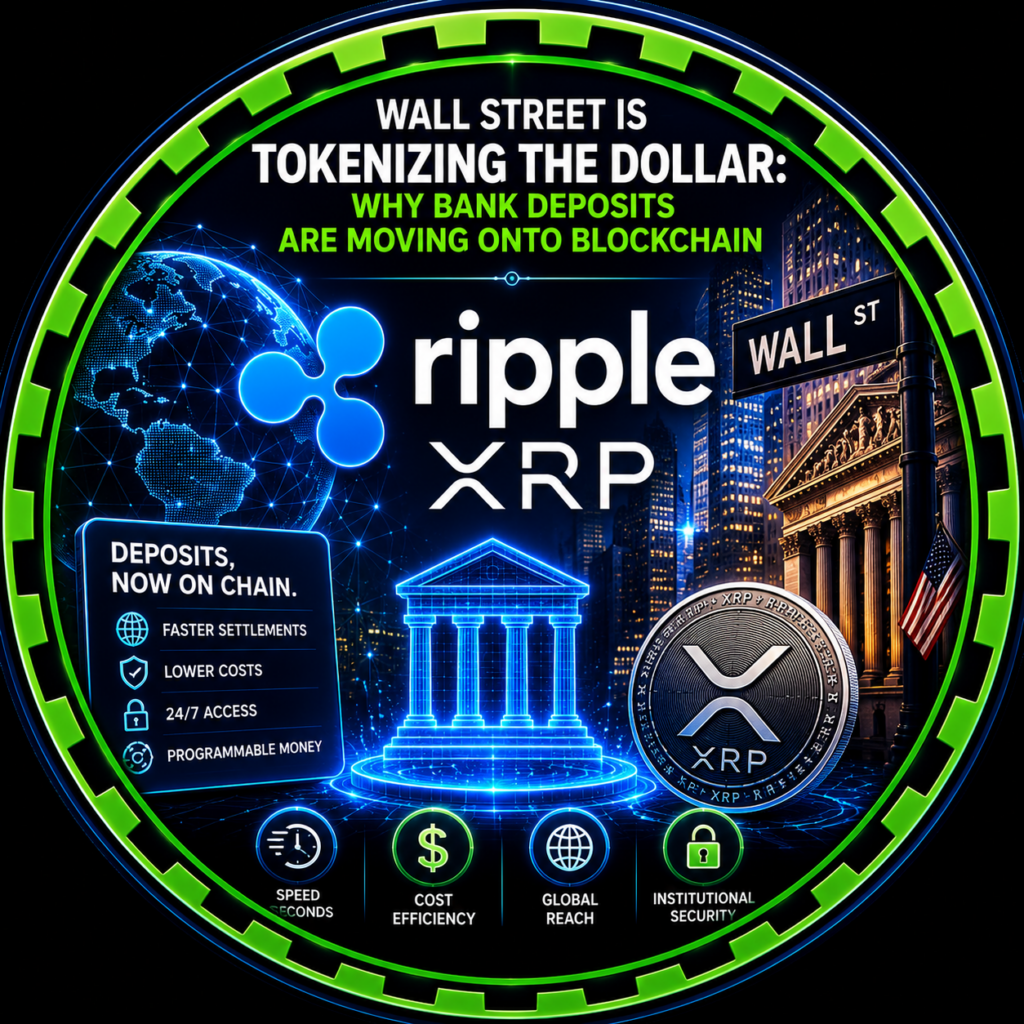
Ripple is not trying to become another Wall Street investment bank. It is trying to supply the infrastructure through which investment banks, asset managers, payment companies and corporate treasuries move money and settle assets.
The public usually sees the visible side of finance: trading applications, account balances, market prices and payment confirmations.
The more valuable infrastructure often sits underneath.
This includes:
- Custody;
- Clearing;
- Prime brokerage;
- Collateral;
- Credit;
- Transfer agency;
- Liquidity;
- Payment routing;
- Securities settlement.
These systems determine whether a trade can occur, who finances it, where the asset is held, when ownership changes and what happens if one party fails.
Ripple began by targeting international payments. It has since expanded into stablecoins, custody, prime brokerage, corporate treasury, tokenization and on-chain credit.
Its current strategy is not simply to move XRP faster.
It is to control more of the financial process surrounding an institutional transaction.
Payments Were the Entry Point
Ripple’s original business addressed inefficiencies in international money movement.
Traditional cross-border payments may involve several correspondent banks, foreign-exchange providers and local payout institutions. Payment companies often maintain prefunded accounts in destination countries to ensure that local liquidity is available.
This model can create:
- Settlement delays;
- Intermediary fees;
- Trapped working capital;
- Limited operating hours;
- Reconciliation problems;
- Poor transaction visibility.
Ripple Payments is designed to connect collection, currency conversion, digital settlement and local payout through one managed service.
The platform supports fiat currencies and multiple stablecoins, including RLUSD, USDC and USDT. Ripple states that the settlement layer is not dependent on one asset. Ripple Payments
This asset flexibility is commercially sensible.
A customer can select the settlement asset appropriate for the jurisdiction, liquidity and counterparty instead of rebuilding its payment infrastructure around every new stablecoin.
It also means that growth in Ripple Payments does not automatically translate into equivalent demand for XRP or RLUSD.
A Blockchain Transfer Is Not a Complete Payment
Moving a stablecoin between two wallets is easy compared with completing a regulated international payment.
The full transaction requires:
- Collecting the payer’s funds;
- Identifying the sender and recipient;
- Screening for sanctions and financial crime;
- Converting the source currency;
- Selecting the settlement route;
- Managing liquidity;
- Converting into the destination currency;
- Delivering the local payout;
- Reconciling the transaction.
Ripple Payments aims to coordinate this complete route.
In March 2026, Ripple reported more than $100 billion in cumulative processed payment volume and coverage across more than 60 major markets. Ripple’s 2026 Payments expansion
These are Ripple’s own figures. Processed volume should not be mistaken for revenue, profit or assets owned by the company.
The defensible conclusion is that Ripple Payments operates commercially at meaningful scale. The published figures do not independently establish its profitability or market share.
RLUSD Provides Digital Settlement Cash
Payments and capital markets require an asset with predictable value.
XRP can provide liquidity, but its market price changes. That creates risk for institutions that need a stable dollar value throughout a transaction.
RLUSD addresses this requirement.
Ripple USD is issued by Standard Custody & Trust Company, LLC, a Ripple subsidiary chartered as a New York limited-purpose trust company.
The stablecoin is designed to maintain a value of one U.S. dollar. Its reserves are held in segregated accounts and supported by recurring independent attestations. BNY serves as the primary reserve custodian.
RLUSD can potentially function as:
- Cross-border payment liquidity;
- Treasury cash;
- Trading collateral;
- Derivatives settlement;
- A bridge between fiat and blockchain markets;
- The cash side of tokenized securities transactions.
Ripple’s RLUSD product information
RLUSD is not an FDIC-insured deposit, and ordinary holders do not directly own the reserve assets.
Its strategic value comes from integration.
Ripple can connect RLUSD to payments, custody, prime brokerage, corporate treasury and tokenized markets. This gives it a built-in institutional distribution channel that a standalone stablecoin may not possess.
Ripple Prime Moves the Company Into Market Infrastructure
Ripple’s acquisition of Hidden Road created Ripple Prime, a multi-asset prime brokerage platform.
Prime brokers provide institutions with:
- Trade execution;
- Clearing;
- Financing;
- Margin;
- Collateral management;
- Market access;
- Risk controls.
Ripple Prime covers digital assets and conventional markets, including foreign exchange, precious metals, derivatives and fixed-income repo.
Ripple says the platform clears more than $3 trillion annually and serves more than 300 institutional customers. Ripple Prime
Clearing volume is not revenue. It measures the value of activity processed through the platform.
The strategic significance is still substantial.
Ripple is no longer involved only after a payment is initiated. It can now participate in financing trades, managing collateral and controlling institutional market access.
That places Ripple closer to the infrastructure underneath capital markets.
Prime Brokerage Connects Ripple’s Products
Ripple Prime gives the company a place where its other assets and services can interact.
RLUSD can serve as settlement cash or collateral.
XRP can be traded, financed or accepted as collateral subject to risk limits.
Tokenized funds can potentially become margin assets.
Ripple Custody can secure the underlying assets.
Ripple Payments can move fiat and stablecoin liquidity between markets.
Ripple Treasury can help corporate customers manage the resulting cash positions.
No single component is decisive.
The strategy becomes valuable if Ripple can make them operate as one institutional workflow.
Tokenization Alone Does Not Create a Market
Creating a blockchain token representing a fund, bond or Treasury security is only the beginning.
A functioning market also requires:
- Legal ownership;
- Investor verification;
- Custody;
- Pricing;
- Trading liquidity;
- Settlement;
- Collateral;
- Credit;
- Redemptions;
- Regulatory reporting.
An illiquid token with unclear legal rights is not an improved financial product.
It is merely a different recordkeeping format.
Ripple’s tokenization strategy focuses increasingly on what institutions can do after the token is issued:
- Buy and sell it;
- Settle it against digital cash;
- Use it as collateral;
- Borrow against it;
- Transfer it among eligible investors;
- Redeem it.
This is why Ripple is moving into credit, liquidity and transfer-agency infrastructure rather than stopping at token issuance.
Credit Is the Missing Layer
Real capital markets depend on credit.
A market maker needs financing to hold inventory.
A payment provider may need short-term liquidity while waiting for incoming settlement.
A corporate treasury may want to deploy idle cash.
An investor may want to borrow against a fund position instead of selling it.
Without credit, tokenized assets remain less useful than their traditional equivalents.
Ripple addresses this requirement through two different systems:
- Ripple Prime provides institutional financing and collateral management;
- The XRPL lending infrastructure attempts to move parts of the credit process on-chain.
How the XRPL Lending Model Works
The XRP Ledger lending model uses single-asset vaults and fixed-term loan structures.
Depositors contribute assets to a vault. A designated delegate evaluates borrowers and manages lending decisions. The ledger records the loan, funding, repayment and relevant asset movements.
Potential use cases include:
- Payment-provider liquidity;
- Market-maker financing;
- Treasury deployment;
- Structured institutional credit;
- Working-capital facilities.
Ripple’s XRPL Lending Protocol overview
The model is not anonymous or risk-free.
The blockchain does not decide whether a borrower is creditworthy. Underwriting and risk management remain off-chain.
The protocol can standardize funding and repayment. It cannot remove default risk.
On-Chain Credit Still Depends on Courts and Contracts
An institutional loan requires more than software.
The parties must determine:
- The borrower’s legal identity;
- The lender of record;
- The governing jurisdiction;
- The interest rate;
- The collateral;
- The priority of claims;
- The first-loss provider;
- The default procedure;
- The recovery process.
If a borrower defaults, the ledger can show that payment was missed.
It cannot independently seize an off-chain bank account, enforce a corporate guarantee or conduct bankruptcy proceedings.
Ripple’s lending strategy is therefore a hybrid model.
Blockchain provides a common financial record and automated transaction logic.
Financial institutions continue providing underwriting, servicing, risk allocation and legal enforcement.
This is less radical than replacing banks with decentralized credit.
It is also more realistic.
Tokenized Collateral Could Improve Capital Efficiency
One of the strongest tokenization use cases is collateral mobility.
Traditional collateral may sit inside a custodian or settlement system that cannot transfer it quickly between markets.
A tokenized fund can potentially be moved, pledged or released on programmable infrastructure.
This could allow institutions to:
- Post margin more quickly;
- Reduce idle collateral;
- Reuse eligible assets across approved facilities;
- Settle obligations outside conventional market hours;
- Improve visibility over encumbered assets.
But tokenization does not make every asset acceptable collateral.
A lender still needs to assess:
- Price stability;
- Liquidity;
- Legal ownership;
- Redemption;
- Custody;
- Concentration;
- Market stress behavior.
A token representing an illiquid asset remains illiquid.
The blockchain can improve transferability. It cannot manufacture credit quality.
Ripple’s Investments in ZILO and Licuido
In August 2026, Ripple announced investments in ZILO and Licuido as part of its digital capital-markets strategy.
ZILO develops digital transfer-agency infrastructure.
Licuido focuses on issuance liquidity and collateral mobility.
Ripple said the objective was to connect issuance, custody, multi-currency investment, collateral use and atomic settlement, with RLUSD functioning as the cash side of delivery-versus-payment. Ripple’s digital capital-markets announcement
These were strategic investments.
They should not be described as acquisitions or proof that the complete model is already operating across global capital markets.
They show which operational gaps Ripple believes must be solved.
Why Transfer Agency Cannot Be Ignored
A transfer agent maintains the official ownership records of a fund or security.
Its responsibilities may include:
- Investor onboarding;
- Subscriptions;
- Redemptions;
- Ownership changes;
- Distributions;
- Regulatory records.
A blockchain can show that a token moved from one address to another.
It does not independently determine whether that transfer legally changed ownership of a regulated security.
The transfer agent must confirm that:
- The receiving investor is eligible;
- Required checks were completed;
- Transfer restrictions were satisfied;
- The legal ownership register remains accurate.
Tokenization does not eliminate administration.
It creates an opportunity to automate parts of it.
ZILO’s relevance to Ripple lies in connecting on-chain movements with the official legal records behind investment products.
Liquidity Determines Whether Tokenization Matters
A tokenized asset can exist successfully on a blockchain and still be impossible to sell at a reasonable price.
Institutional liquidity requires:
- Buyers;
- Sellers;
- Market makers;
- Reliable valuation;
- Competitive spreads;
- Redemption mechanisms;
- Sufficient trading depth.
Without those elements, tokenization changes settlement technology but does not create a functioning market.
Licuido addresses this part of Ripple’s strategy.
Ripple needs tokenized assets not only to be issued on XRPL, but also to trade, settle and move as collateral.
That is much more difficult than creating the token.
RLUSD Can Connect Cash and Tokenized Funds
RLUSD can provide the dollar-denominated side of a tokenized transaction.
An eligible investor can exchange RLUSD for a tokenized fund.
If the transaction uses atomic delivery-versus-payment, the fund token and RLUSD transfer together. Either both sides complete or neither does.
This can reduce principal risk and simplify reconciliation.
The tokenized fund can later be:
- Redeemed;
- Traded;
- Posted as collateral;
- Used in a credit facility;
- Transferred among eligible investors.
Ripple’s intended operating model is clear:
The asset is issued under regulatory controls. Custody protects it. RLUSD pays for it. XRPL settles it. Prime brokerage finances it. Credit infrastructure makes it productive.
The logic is coherent.
The scale is not yet established.
DBS and Franklin Templeton Show the Intended Model
In September 2025, DBS, Franklin Templeton and Ripple signed a memorandum of understanding involving RLUSD and Franklin Templeton’s tokenized money-market fund.
The announced structure would allow eligible DBS Digital Exchange customers to trade between RLUSD and sgBENJI, a token representing the Franklin Onchain U.S. Dollar Short-Term Money Market Fund.
The parties also said they would explore using sgBENJI as collateral for credit. DBS, Franklin Templeton and Ripple announcement
This is a useful example because it combines:
- A regulated bank;
- An asset manager;
- A tokenized yield-bearing fund;
- A stablecoin;
- A possible lending product;
- Blockchain settlement.
It must still be described accurately.
A memorandum of understanding and an agreement to explore credit functionality are not the same as a fully operational lending market with sustained transaction volume.
The announcement demonstrates institutional interest, not completed adoption.
Ondo Provides a Live Tokenized-Treasury Example
Ondo Finance’s OUSG tokenized U.S. Treasury product is available on XRPL for eligible qualified purchasers.
Investors can use RLUSD for subscriptions and redemptions, subject to Ondo’s requirements. Ondo’s OUSG deployment on XRPL
This creates a practical connection between digital cash and a tokenized yield-bearing asset.
However, the underlying Treasury securities remain part of conventional legal, custody and asset-management structures.
XRPL improves the digital access and settlement layer around the product.
It does not move the entire U.S. Treasury market onto a blockchain.
Faster Settlement Is Not Always Better
Tokenized markets are frequently promoted through instant settlement.
Faster settlement can reduce counterparty exposure and free capital sooner.
It can also create new liquidity pressure.
Traditional settlement windows allow institutions time to:
- Arrange financing;
- Net obligations;
- Move collateral;
- Correct errors;
- Coordinate cash positions.
If every transaction settles immediately, institutions must maintain money and securities at the exact location where each trade occurs.
The better objective is programmable settlement.
Institutions should be able to select:
- Immediate delivery-versus-payment;
- Scheduled settlement;
- Conditional settlement;
- Net settlement;
- Collateralized settlement.
Ripple’s infrastructure will be useful only if it supports the actual needs of institutional markets rather than assuming that maximum speed is always optimal.
XRP’s Role Is Not Guaranteed
XRP remains the native asset of the XRP Ledger.
It can support:
- Network fees;
- Bridge liquidity;
- Trading pairs;
- Lending vaults;
- Collateral;
- Cross-chain markets.
But many transactions in Ripple’s emerging system can operate without substantial XRP usage.
A tokenized fund may trade directly against RLUSD.
A payment may settle in USDC.
A prime-brokerage client may post conventional collateral.
An XRPL transaction may require only a small amount of XRP for network fees.
The relevant question is whether XRP becomes economically necessary for liquidity, collateral or exchange.
That requires evidence from actual institutional volume—not assumptions based on Ripple partnerships.
Ripple’s Strategy Is Infrastructure Modernization
Ripple is not eliminating banks, asset managers, custodians, transfer agents, prime brokers or regulators.
It is acquiring, investing in and selling technology to them.
Tokenized funds still require asset managers.
Credit still requires underwriting.
Custody still requires governance.
Payments still require banking access.
Securities still require enforceable legal rights.
Ripple’s strategy is to place more of these activities onto shared, programmable infrastructure.
That can improve operations without removing the institutions responsible for the assets and obligations.
Why Institutions May Adopt the Model
Ripple’s combined infrastructure could provide:
- Longer settlement hours;
- Reduced reconciliation;
- More efficient collateral movement;
- Better liquidity visibility;
- Programmable compliance;
- Delivery-versus-payment;
- Reduced prefunding;
- Automated asset servicing.
The value must be measured after considering:
- Implementation costs;
- Regulatory compliance;
- Custody;
- Conversion fees;
- Liquidity;
- Cybersecurity;
- Vendor dependence.
Blockchain infrastructure is not automatically cheaper because it is faster.
Ripple must demonstrate a lower total operational cost or a meaningful improvement in capital efficiency.
The Principal Risks
Ripple’s strategy faces significant obstacles.
It must integrate payments, custody, stablecoins, prime brokerage and tokenization without recreating the same fragmentation it claims to solve.
Tokenized products require real liquidity and enforceable ownership rights.
On-chain credit remains exposed to default, weak underwriting and legal disputes.
Different countries regulate payments, stablecoins, lending and securities differently.
Ripple also competes against global banks, payment networks, custodians, prime brokers, treasury platforms and larger blockchain ecosystems.
Security risk grows as Ripple controls more critical infrastructure.
Institutional customers may also resist relying on one company for payments, custody, liquidity and collateral.
Finally, Ripple is privately held and does not provide public-company-level reporting on product revenue, margins and profitability.
What Ripple Must Prove
The strategy should be judged through production activity rather than the number of announcements.
Ripple must demonstrate:
- Sustained payment growth;
- Deep RLUSD liquidity;
- Real tokenized-fund trading;
- Production use of tokenized collateral;
- Institutional lending volume;
- Reliable default management;
- Competitive settlement economics;
- Integration with Ripple Prime;
- Security across the full system;
- Regulatory approval in major financial jurisdictions.
The decisive question is whether institutions continue using the infrastructure after pilot programs and promotional partnerships end.
Final Analysis: Ripple Wants the Infrastructure Under the Trade
Ripple’s strategy has moved beyond faster international payments.
The company is targeting the infrastructure beneath institutional finance.
Ripple Payments moves money.
RLUSD supplies digital settlement cash.
Ripple Custody controls the assets.
Ripple Prime provides financing, clearing and collateral management.
XRPL records and settles tokenized transactions.
The lending protocol attempts to add credit.
Investments in transfer agency and liquidity infrastructure address the legal administration and market depth tokenized funds require.
This does not make Ripple a replacement for Wall Street.
It makes Ripple a potential technology and infrastructure supplier to it.
That is a more credible ambition.
It is also difficult to execute.
Ripple must integrate several regulated businesses, build deep liquidity, manage credit risk and compete against institutions that already control global payments, custody and capital markets.
The company has assembled many of the components.
It has not proved that they will operate as one dominant system.
But its objective is now clear.
Ripple does not merely want to transfer digital assets.
It wants to provide the infrastructure through which money, credit, collateral and tokenized securities move.
Editorial Disclosure
This article contains independent editorial analysis. “Wall Street’s plumbing” describes Ripple’s infrastructure strategy; it does not mean Ripple controls or has replaced existing financial-market systems.
REVOLD Blog has not received compensation from Ripple, DBS, Franklin Templeton, Ondo Finance, ZILO, Licuido or another organization mentioned in this publication.
Company volumes and product descriptions are based on Ripple’s published materials unless otherwise stated. Strategic investments, memoranda of understanding and exploratory arrangements should not be treated as completed commercial deployments.
This material is provided solely for informational and educational purposes. It does not constitute financial, investment, legal, tax, accounting or cryptocurrency advice.
Official Sources
- Ripple — Payments Platform
- Ripple — 2026 Payments Expansion
- Ripple — RLUSD
- Ripple — Ripple Prime
- Ripple — XRPL Lending Protocol
- Ripple — Digital Capital-Markets Infrastructure
- Ripple — DBS and Franklin Templeton Initiative
- Ripple — Ondo Tokenized Treasuries on XRPL
- Ripple — Institutional Custody
- XRP Ledger — Official Documentation
Information reviewed and verified: August 24, 2026.
Author: Roman Kravchina
Published by: REVOLD Blog
Powered by: AIR RISE INC & REVOLD AI