
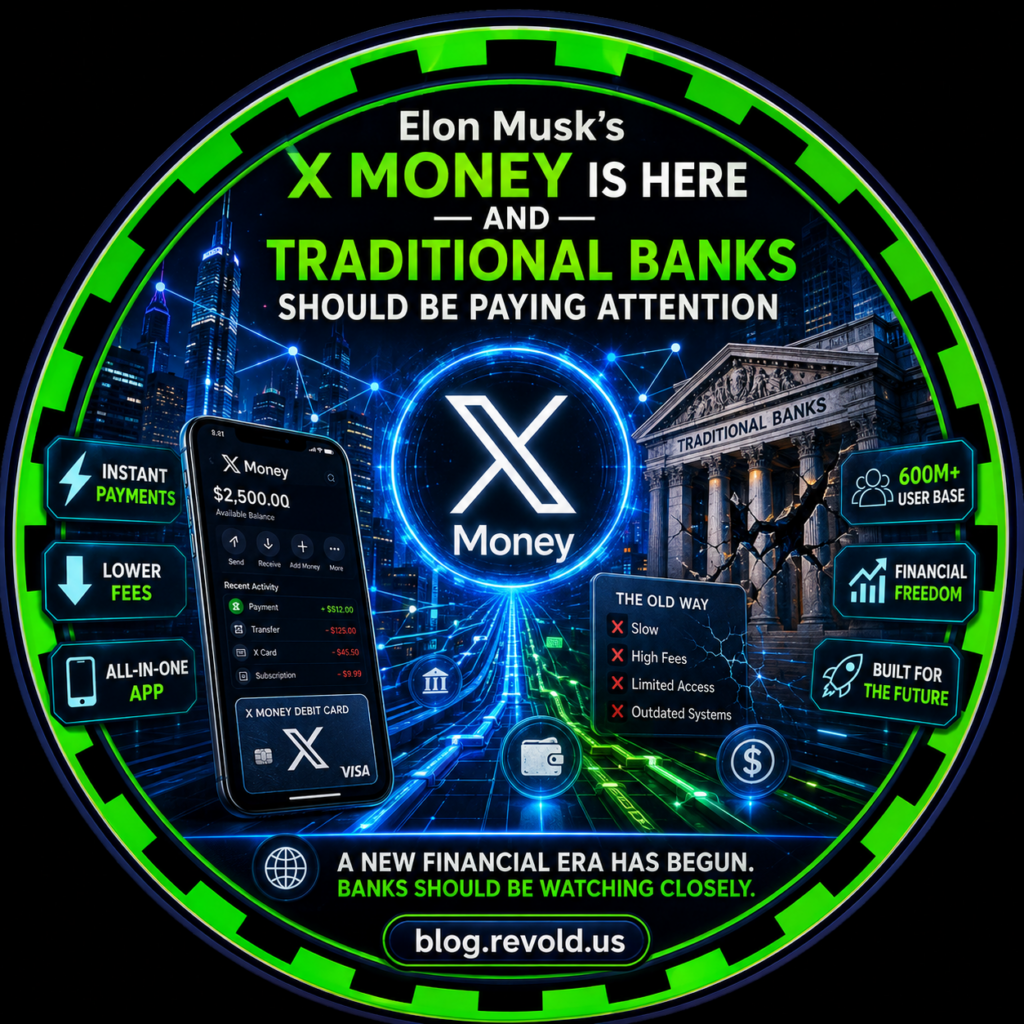
X Money is no longer just an ambitious line in Elon Musk’s “everything app” playbook. It is now rolling out to selected users in the United States with a remarkably aggressive proposition: up to 6.00% APY, 3% cash back on eligible purchases, real-time payments, early access to paychecks and an X-branded Visa debit card.
That combination deserves more than another fintech product announcement.
X is attempting to collapse the distance between communication and commerce. If the strategy works, a conversation, a creator payment, a product recommendation and a financial transaction could all occur on the same platform, under the same identity and without requiring the user to leave the application.
Traditional banks should be paying attention—not because X Money has already replaced them, but because it is attacking one of their most valuable assets: the customer’s primary financial relationship.
X Money Has Officially Entered the Market
As of August 2026, X says Money is rolling out to selected U.S. users aged 18 or older. It is not yet universally available, and access remains controlled while the company expands the service.
The initial offering is broader than a simple payment wallet.
According to X, Money currently includes:
- Up to 6.00% annual percentage yield on eligible balances;
- 3% cash back on eligible X Card purchases;
- Direct deposit with paycheck availability up to two days early;
- Instant transfers between users on X;
- Domestic wire transfers;
- Bill payments;
- Mailed checks;
- A virtual and physical Visa debit card;
- Reimbursement of ATM fees;
- No foreign transaction fee charged by X Money;
- Passkey protection and configurable transaction limits;
- FDIC insurance eligibility through partner banks and a cash sweep program.
The most important detail is also the easiest to miss: X Money is not a bank.
The service is operated by X Payments LLC. Deposit accounts and banking services are provided through Cross River Bank, a member of the Federal Deposit Insurance Corporation. X says eligible funds may be distributed across participating institutions through an IntraFi cash sweep arrangement, potentially providing up to $10 million in aggregate pass-through FDIC insurance coverage when all applicable conditions are satisfied.
This is a familiar fintech structure. The technology company owns the user experience and customer relationship, while regulated banking partners provide much of the financial infrastructure underneath it.
That distinction does not make X Money unimportant. It helps explain why it may be strategically dangerous to traditional banks.
The 6% APY Is an Acquisition Weapon
X Money’s most visible offer is its yield.
X states that Premium+ subscribers can earn 6.00% APY. Premium subscribers receive a standard 4.00% APY and may qualify for the boosted 6.00% rate after receiving at least $1,000 in qualifying deposits during a trailing 34-day period. Qualifying deposits include eligible payroll deposits and certain X creator payouts.
The rates were listed by X as effective July 27, 2026, and are variable. They may change at any time.
This means the advertised 6% rate should not be interpreted as a permanent guarantee. It is a conditional, variable offer linked to the customer’s X subscription or deposit activity.
But the strategic intent is clear.
A high rate gives users a reason to move money into the ecosystem. Direct deposit gives them a reason to keep it there. Cash back gives them a reason to spend it through the X Card. Instant transfers encourage them to invite other people into the network.
This is not simply a savings product. It is a carefully connected customer-acquisition loop.
Traditional banks often benefit from “sticky money”—balances that remain in low-yield checking and savings accounts because moving them is inconvenient or because customers rarely reconsider where their cash is held. X is trying to make that money less sticky.
It is offering users an incentive to move their paycheck, savings, payments and daily spending into one digital environment.
The Fine Print Still Matters
The headline rate is attractive, but customers should evaluate the total economics rather than looking at the APY in isolation.
Premium and Premium+ access may involve subscription costs. Those costs reduce the user’s effective return unless the subscription already provides enough independent value to justify its price.
For example, a customer should calculate:
- The expected annual interest earned;
- The cost of the required X subscription;
- The amount of eligible cash back realistically expected;
- Any fees associated with withdrawals, wires or replacement cards;
- The likelihood that the promotional rate will change.
X also specifies that the 3% cash-back offer applies only to eligible purchases. Its published exclusions include several financial transactions, securities-related purchases, rent paid under certain merchant classifications, tax payments, government services, gambling and other specified categories.
X reserves the ability to determine applicable reward percentages and whether a transaction qualifies. Therefore, “3% cash back” should not be read as a universal return on every dollar spent.
The product can still be competitive. But the real customer benefit will depend on behavior, subscription level, balance and spending patterns.
X Is Not Building Another Venmo
It would be easy to describe X Money as a competitor to PayPal, Venmo, Cash App or Zelle. That comparison is useful, but incomplete.
Those services largely began with a financial action and then tried to expand outward.
X is moving in the opposite direction.
It already owns an environment where users:
- Follow news and market developments;
- Communicate publicly and privately;
- Build audiences;
- Publish videos and live broadcasts;
- Promote businesses;
- Buy advertising;
- Receive creator payments;
- Discover products;
- Debate financial markets;
- Establish professional identities.
X Money adds a financial layer to that existing network.
The strategic possibility is that X could connect attention, identity and payments more tightly than a conventional banking application can. A user might eventually discover a product in a post, ask a question in a direct message, complete a purchase, send money to a creator and receive customer support without leaving X.
That is the architecture of a financial super-app, not merely a peer-to-peer payment feature.
Elon Musk Is Returning to His Original Financial Ambition
X Money also carries historical significance.
Before Tesla became a global electric-vehicle company and before SpaceX redefined private spaceflight, Musk co-founded X.com in 1999 as an online financial-services business. X.com later merged with Confinity, and the combined company eventually became PayPal.
Musk’s return to the X name was not accidental. Neither is his renewed interest in payments.
The modern X platform gives him something his original financial venture did not possess: a large, active social network capable of distributing a financial product directly to its own users.
This dramatically changes the economics of customer acquisition.
A conventional fintech company may spend heavily on advertisements, referral bonuses and banking partnerships to acquire each new account. X can advertise X Money inside its own platform, target existing subscribers and integrate enrollment directly into the user experience.
In other words, X does not need to build a financial audience from zero. It needs to convert part of its existing audience into financial customers.
That is a far more powerful starting position.
Why Traditional Banks Should Be Concerned
Banks are unlikely to lose their relevance overnight. They still possess major advantages:
- Regulatory experience;
- Established deposit relationships;
- Large lending businesses;
- Branch and ATM networks;
- Institutional trust;
- Fraud-management systems;
- Business banking products;
- Mortgages and credit facilities;
- Decades of customer financial history.
But X Money does not need to replace every banking service to disrupt the industry.
It only needs to capture the customer interface.
If consumers begin receiving their paychecks, holding savings, using debit cards and making daily payments through X, the traditional bank may become an invisible infrastructure provider behind another company’s brand.
That is a strategic loss even when the bank continues participating in the transaction.
The company controlling the interface can potentially control:
- Customer engagement;
- Product recommendations;
- Payment behavior;
- Transactional data;
- Loyalty programs;
- Merchant relationships;
- Future credit distribution;
- Cross-selling opportunities.
Banks have spent decades trying to become the customer’s primary financial institution. X is trying to become something broader: the customer’s primary digital environment, with finance embedded inside it.
The Social Graph Could Become a Payment Network
Financial networks become more useful as more people join them.
X already has a social graph: users follow one another, communicate, build reputations and form communities. X Money could turn parts of that social graph into a financial network.
Sending money may no longer require asking for a separate account name, phone number or payment handle. A user’s X identity can become the point through which a payment relationship begins.
This has potentially important applications for:
- Creators receiving audience support;
- Freelancers collecting payments;
- Small businesses selling through social content;
- Communities raising money;
- Friends splitting expenses;
- Subscribers paying for exclusive access;
- Advertisers converting engagement into purchases.
However, merging social identity and financial activity also creates serious privacy, fraud and security questions.
X says financial activity remains private and that accounts include passkeys, transaction limits and privacy controls. Those protections will need to perform reliably at scale. A platform that hosts public influence, private communication and financial accounts can become an exceptionally attractive target for scammers, impersonators and account-takeover attacks.
The same network effect that makes X Money powerful could amplify the consequences of a security failure.
Trust May Be X Money’s Hardest Problem
The biggest obstacle may not be technology. It may be trust.
Consumers tolerate occasional bugs in a social-media application. They are far less forgiving when a paycheck is delayed, a card is declined, an account is frozen or a fraudulent transaction appears.
Banking requires operational discipline:
- Accurate balances;
- Reliable settlement;
- Effective identity verification;
- Rapid fraud detection;
- Accessible customer support;
- Clear dispute procedures;
- Compliance with consumer-protection rules;
- Resilient cybersecurity;
- Predictable access to funds.
X says Money provides continuous support and allows disputes to be initiated inside the application. Its FAQ states that eligible disputes may receive provisional credit within 10 business days, while investigations may take between 30 and 45 days and, in some cases, as long as 120 days.
These are not glamorous parts of banking, but they determine whether users will trust the platform with meaningful balances.
An attractive interest rate can persuade someone to open an account. Only reliability will persuade that person to deposit a paycheck.
X Money Could Strengthen the Entire X Ecosystem
The value of X Money may extend beyond financial-service revenue.
A successful payment system could reinforce multiple parts of the X business:
Creator economics
Creators could receive payouts and audience payments directly into Money, earn interest on balances and spend through the X Card.
Subscription retention
Higher yields and financial benefits could make Premium memberships more difficult to cancel.
Commerce
Businesses could move from advertising products on X to completing transactions inside the same ecosystem.
Identity
Payment verification may encourage stronger identity controls, although it also creates privacy concerns.
Data
Financial activity could improve personalization and risk assessment, subject to applicable laws, consent requirements and internal data-separation policies.
Future financial products
Once users establish direct deposit and transaction histories, X could eventually explore additional services through regulated partners, potentially including credit, merchant services, investment access or international payments.
Not all of these possibilities have been officially announced. They are strategic extensions that become more plausible if X Money gains adoption.
Banks Still Have Time to Respond
X Money’s current rollout is limited. It is not yet a universally available replacement for a full-service bank, and its most aggressive benefits are conditional.
Traditional institutions should not dismiss it, but neither should they assume the outcome is predetermined.
Banks can respond by improving the areas where many legacy products remain weak:
- Paying competitive interest automatically;
- Delivering real-time payments without unnecessary fees;
- Simplifying account opening;
- Making direct deposit and bill payment easier;
- Providing transparent rewards;
- Improving mobile support;
- Reducing transfer delays;
- Giving customers better privacy and security controls;
- Integrating business, personal and investment services more coherently.
The real competitive threat from X Money is not that every customer will immediately abandon a bank. It is that users may begin expecting every financial service to feel as immediate and integrated as a social application.
Once customer expectations change, the industry must follow.
The Bigger Battle Is Over the Financial Relationship
X Money arrives at a moment when money is increasingly becoming a software function.
Consumers no longer choose financial providers solely by asking which institution has the closest branch. They increasingly ask:
- Which application pays the best rate?
- Which service moves money fastest?
- Which card provides the best rewards?
- Which platform already contains the people and businesses I pay?
- Which experience requires the fewest steps?
X Money is designed around those questions.
Its most important asset may not be the 6% APY, the cash-back offer or even the Visa card. Those features can be matched or changed.
Its most important asset is distribution: the ability to place financial services directly inside an existing global conversation network.
That is why traditional banks should be paying attention.
X Money has not yet proven that it can become America’s dominant financial super-app. It still faces significant questions about scale, regulation, consumer protection, privacy, security and long-term economics.
But the strategic direction is unmistakable.
Elon Musk is not merely adding payments to X. He is attempting to make money itself a native feature of the platform.
And if consumers begin treating a social network as the place where they communicate, earn, save, spend and transfer money, banks will no longer be competing only against other banks.
They will be competing against software ecosystems for control of the customer’s financial life.
Key Facts
- X Money is currently rolling out to selected users in the United States.
- X Payments LLC is a financial-technology company, not an FDIC-insured bank.
- Deposit accounts are held through Cross River Bank, Member FDIC.
- Premium+ users may qualify for 6.00% APY.
- Premium users receive a listed standard rate of 4.00% APY and may qualify for 6.00% after meeting qualifying-deposit requirements.
- Rates are variable and subject to change.
- The X Card offers 3% cash back on eligible purchases.
- X says eligible deposits may receive up to $10 million in aggregate pass-through FDIC coverage through its cash sweep program, subject to program rules and insurance conditions.
- Availability, rates, rewards, limits and fees may change.
Editorial Disclosure
This article is independent editorial analysis. REVOLD Blog has not received compensation from X Corp., X Payments LLC, Cross River Bank or Visa for this publication. It does not constitute financial, investment, legal or banking advice. Product terms, interest rates, fees, eligibility and availability may change. Readers should review the official terms before opening or funding an account.
Sources
- X Money Official Product Page
- X Money Stored Value Account Rates
- X Money Frequently Asked Questions
- X Money Cashback Rewards Terms
- Reuters: X Money Early Public Access Announcement
- Visa Direct
Information verified: August 23, 2026.
blog.revold.us — Powered by AIR RISE INC & REVOLD AI
Author: Roman Kravchina
Related Reading
- Can X Replace Your Bank? The Real Strategy Behind Elon Musk’s X Money
- 6% APY, 3% Cash Back and One Super-App: Why X Money Could Change Digital Banking
- Elon Musk Wants Your Paycheck: Inside X Money’s Plan to Become America’s Financial Super-App
- X Money vs PayPal: Elon Musk Returns to the Financial Battlefield He Helped Create
- Morning Star: A Powerful Three-Candle Reversal Pattern Every Trader Should Know
- Piercing Line: A Key Bullish Reversal Candlestick Pattern Every Trader Should Know
- Tweezer Bottom: A Powerful Bullish Reversal Pattern Every Trader Should Know
- Three White Soldiers: A Powerful Bullish Reversal Pattern Every Trader Should Know
- Bearish Reversal Patterns: Essential Candlestick Signals Every Trader Should Know
- PayPal Is Turning PYUSD Into Working Money — Why 4% Rewards Could Change the Stablecoin Market
- Stablecoins vs Tokenized Bank Deposits: The Battle That Could Decide the Future of Money
- America Is Building a New Generation of Crypto Banks — And Wall Street Is Joining the Race
- Dollar-Cost Averaging (DCA): A Simple Yet Powerful Investment Strategy
- Crypto Market Insights: Bitcoin Nears $90K, Ripple-Cardano Collaboration, and DeFi’s Latest Challenges
- Analysis of the JPMorgan Chase Situation in Russia and Its Impact on Cryptocurrency Investments
- How to Buy Dogecoin in 5 Parts to Average Down Your Cost
- Financial Workshop: Tax Secrets and Business Strategies 2023–2024