A deep look at the strangest tech power struggle of the decade
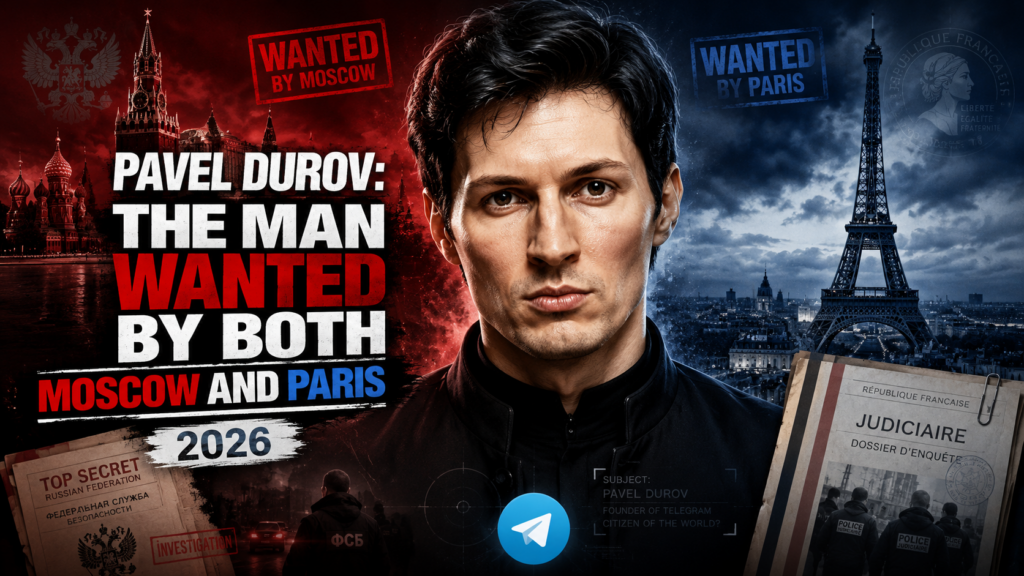
In August 2024, the world watched a rare scene unfold. The founder of one of the planet’s most popular messaging apps was arrested minutes after his private jet touched down at Paris–Le Bourget Airport. Nearly two years later, in the summer of 2026, Russian authorities placed the same man on an international wanted list and added him to their official roster of terrorists and extremists. Pavel Durov now occupies a position almost no tech billionaire has ever held: he is being pursued simultaneously by two systems that usually stand on opposite sides of the geopolitical divide.
This is not a coincidence. It is the logical, almost inevitable outcome of a path Durov chose back in 2014 — the path of a man who refused, on principle, to turn his platform into an instrument of any government. Now that this path has led to criminal cases in two jurisdictions, it is worth examining carefully and without the usual partisan noise: who Pavel Durov actually is, what happened over these years, why it was predictable, and what it means for the future of independent digital platforms.
Who Is Pavel Durov — and Why He Matters
Pavel Valeryevich Durov was born on October 10, 1984, in Leningrad. His father, Valery Durov, is a doctor of philology who for years headed the Department of Classical Philology at St. Petersburg State University. His older brother, Nikolai, is a mathematical prodigy and international olympiad winner who would later become the technical architect of nearly all of Pavel’s major projects. The family was academic, intellectually rigorous, and steeped in a culture of independent thinking.
In 2006, while still a student, Pavel launched VKontakte. On the surface the idea was straightforward: a Russian equivalent of Facebook, better adapted to local habits and culture. Within a few years VK had become the dominant social network across the Russian-speaking world. By the early 2010s Durov was one of the country’s most visible tech entrepreneurs. The press freely called him “Russia’s Mark Zuckerberg.” The company scaled rapidly; its audience reached tens of millions and its influence was enormous.
That success made him a target. In December 2011, after mass protests against alleged fraud in the State Duma elections, the FSB demanded that he shut down opposition groups. He refused. That episode marked his first serious public confrontation with the security services. In 2014 the pressure intensified: authorities wanted personal data on organizers of groups linked to Ukraine’s Euromaidan movement. Durov refused again. The outcome is well known. Allies of oligarch Alisher Usmanov gradually acquired the shares, Durov was removed as CEO, he sold his remaining stake for roughly $300 million, and he left Russia. He later said plainly that he preferred to lose the company rather than turn it into a surveillance tool.
Already in 2013, while still running VK, the Durov brothers had launched Telegram. At first it was a private tool for secure communication among themselves and a small circle. It quickly became clear that a messenger emphasizing privacy, minimal moderation, and a refusal to hand user data to intelligence services would find an audience — especially in countries where people do not fully trust their governments or large American technology companies.
By March 2025 Telegram had crossed one billion monthly active users and ranked as the world’s second-most-popular messaging app (after WhatsApp, excluding China’s WeChat). The company turned sustainably profitable for the first time; 2024 revenue exceeded $1 billion. Durov retained near-total control of the platform — a rarity at that scale. And that very independence eventually became his greatest vulnerability.
A Detailed Timeline: How Durov Became an Enemy of Two Systems – 2014–2017. Exile, Citizenships, and Early Growth
After leaving Russia, Durov obtained citizenship of Saint Kitts and Nevis through investment, later adding UAE and French citizenship (naturalized in 2021). He lived as a digital nomad, spending much of his time in Dubai. Telegram grew at a breakneck pace. After other messaging apps were blocked in Iran, Brazil, and elsewhere, users migrated to it in large numbers. In 2015 Durov spoke at TechCrunch Disrupt in San Francisco and already presented himself as someone who would not submit to governments or surrender user data.
2018–2020. The First Major War with Russia and the Collapse of TON
In 2018 Russian authorities issued an ultimatum: Telegram must hand over its encryption keys. Durov publicly refused. Roskomnadzor launched an attempt to block the app entirely. The ban lasted nearly two years and proved a technical failure. Telegram continued to function through proxies, VPNs, and its own circumvention tools, while its popularity inside Russia only increased. Users treated the blockade as confirmation that the messenger was genuinely independent. In June 2020 the authorities effectively capitulated and unblocked the service, citing some arrangement on terrorist content.
At the same time one of the era’s highest-profile crypto stories was unfolding. In 2018 Durov and his team announced TON (Telegram Open Network) and the Gram token. Two private pre-sale rounds raised approximately $1.7 billion — then one of the largest token sales ever. The U.S. Securities and Exchange Commission sued, arguing that Gram was an unregistered security. A federal court sided with the SEC. In 2020 Durov agreed to return $1.2 billion to investors and pay an $18.5 million penalty. Telegram formally exited the TON project. The blockchain continued under community governance; in 2026 Durov would again tighten Telegram’s influence over the network.
August 2024. The Paris Arrest — a Turning Point
On August 24, 2024, Durov’s private jet landed at Le Bourget Airport outside Paris on a flight from Baku. French police were waiting. The arrest was part of a preliminary investigation opened on July 8. The charges were broad and severe: complicity in running an online platform that enabled illegal transactions by organized groups; distribution of child sexual abuse material; drug trafficking; fraud; money laundering; providing cryptology services without required declarations; and refusal to supply information requested by authorities.
In essence the French position was this: Telegram had become a convenient venue for serious crime precisely because its administrators rarely responded to law-enforcement requests and did not adequately moderate public content. Four days later, on August 28, Durov was released on €5 million bail. He was barred from leaving France, required to check in with police regularly, and had his passports seized. The investigation continued. His brother Nikolai also came under French scrutiny.
The reaction was immediate and sharply polarized. Elon Musk quickly launched the hashtag #FreePavel and called the arrest an attack on free speech in Europe. In Russia some lawmakers and officials condemned it as an example of “Western hypocrisy.” Telegram and Durov himself called the accusations absurd: a platform owner cannot be held criminally responsible for crimes committed by users. Many legal and tech observers noted that it was one of the hardest cases of personal liability imposed on a tech CEO in Europe in recent years.
2025. A Breather, Return to Dubai, and Unusual Revelations
Throughout 2025 the French restrictions gradually eased. In March Durov received permission for a temporary departure and flew straight to Dubai, where Telegram’s headquarters are located and where he has effectively lived for years. In November 2025 the travel ban was lifted entirely. The investigation itself was not dropped; Durov sat for additional questioning on several occasions.
During this period he gave lengthy interviews, described pressure from various intelligence services (including, he claimed, attempts to use his legal vulnerability to influence the information space in other countries), and made one of the most unusual public statements of his career. Durov said that through sperm donation he had more than one hundred biological children in twelve countries and that he intended to include them among the heirs to his fortune. He also spoke of covering IVF costs for certain categories of women. The remarks generated enormous attention and further cemented his image as a man living by his own, highly unconventional rules.
2026. Russia Declares War
In February 2026 Russian authorities opened a criminal case against Durov under Article 205.1 of the Criminal Code — facilitation of terrorist activity. On July 29 the FSB formally charged him and announced he was being placed on an international wanted list. The next day, July 30, Rosfinmonitoring added Pavel Durov to its list of terrorists and extremists. That designation automatically triggers serious restrictions: account freezes, limits on financial transactions, and constraints on public activity.
The official reason given by the security services was that Telegram’s administration had failed to remove numerous channels, chats, and bots that, according to the investigation, were used by Ukrainian intelligence and extremist groups to recruit Russian citizens — including minors — for sabotage, arson, and other crimes inside Russia. A popular dating bot known as “DaiVinchik” (also called Leo) was frequently cited. The FSB claimed dozens of people aged 12 to 22 had been drawn into such activities through these tools.
Durov responded in characteristic fashion. He posted a photograph of himself raising a middle finger and wrote that Russia had labeled him a “terrorist” for refusing demands for mass surveillance and censorship. He added, with characteristic sarcasm, that under Russian law he was now banned from “publishing information on the Internet,” and that Russian officials appeared confused about who has the authority to ban whom.
Why This Happened: An Independent Analysis
Strip away the emotion, the propaganda, and the mutual accusations, and the picture becomes reasonably clear — and in retrospect almost predictable.
From the beginning Durov built Telegram as a platform that would not serve as an extension of any state apparatus. He refused to hand data to Russian or Western intelligence services. He deliberately minimized moderation. He stated publicly and repeatedly that he would not censor political content at the request of governments. In a world where nearly every major platform — Meta, Google, even Apple to a significant degree — cooperates with governments and complies with content-removal and data requests, that stance looked, and still looks, radical.
For a time the strategy worked brilliantly. Telegram grew precisely because a large share of users saw it as a space relatively free of state control and corporate censorship. That mattered especially in authoritarian and semi-authoritarian countries, and among people skeptical of American tech giants. But the larger the audience became, the greater the irritation of states. A platform with hundreds of millions (and later a billion) of users that refuses to play by the rules ceases to be a convenient tool and becomes a systemic problem.
The Russian logic is simple, consistent, and hard. In 2011–2014 Durov had already demonstrated that he would not submit. In 2018 he again refused to surrender encryption keys. By 2025–2026 Telegram had grown too large and too autonomous as a communication channel inside Russia. The authorities themselves used it extensively — for messaging, mobilization, work with the regions, and spreading preferred narratives. At the same time they could not fully control it. Ahead of the 2026 State Duma elections that ambiguity became unacceptable. Hence the gradual throttling of the service, restrictions on calls, efforts to migrate users to the state-backed messenger Max, the criminal case, and finally the international wanted notice and terrorist listing.
The French and broader European logic differs in form but moves in the same direction in substance. Through the Digital Services Act and national laws, Europe has steadily raised the bar for active moderation of illegal content and real cooperation with law enforcement. Telegram systematically ignored or responded only reluctantly and with long delays to official requests. French investigators saw this not as a principled philosophical stance but as practical complicity in serious crime. The 2024 arrest was a way to break that model and force the platform to operate under European rules. Even after the travel ban was lifted, the case remained open — a continuing lever of pressure.
The most important observation is this: both Moscow and Paris ultimately reached for the same instrument — personal criminal liability of the platform owner. The wording differs. In one case it is “facilitation of terrorist activity.” In the other it is “complicity in operating a platform that enables organized crime” and refusal to cooperate with investigators. The core idea is identical: if you do not control your platform the way we require, we will hold you personally and criminally responsible.
Historical Parallels: How States Have Pressured Platforms Before
To see why Durov’s situation is not an aberration but a logical development, it helps to look at earlier episodes of pressure on social networks and messaging apps.
Russia: A Long Record of Subordination
In 2011–2012, after protests against alleged fraud in the State Duma elections, the authorities first truly feared the power of social media. Systematic pressure on VK began then. Durov was still resisting, but it was already clear that the state would not tolerate a fully independent mass platform inside the country. After his departure in 2014, VK gradually became a fully compliant resource. By 2026 the holding’s apps had been removed from the App Store and Google Play, the company was under EU sanctions, the primary domain had shifted to vk.ru, and the platform itself was actively used to promote the state messenger Max and for political mobilization.
Telegram survived an attempted full blockade in 2018–2020 and effectively won that round. In 2021, under combined pressure (including from Apple and Google), the “Smart Voting” bot associated with Alexei Navalny’s team was blocked — one of the few instances in which Telegram removed a political tool. From August 2025 a new tightening began: restrictions on voice and video calls, throttling, and infrastructure preparation for possible displacement of the app. The wanted notice and terrorist listing of Durov in July 2026 form a logical continuation of that line, especially against the backdrop of the approaching State Duma elections.
France and Europe: From Soft Pressure to Hard Measures
After the November 2015 Paris attacks, Telegram itself, under intense public and political pressure, removed dozens of public channels linked to ISIS. That was a moment when even a principled platform made concessions. In 2023 the French government barred ministers and officials from using WhatsApp, Signal, and Telegram, switching them to domestic solutions (Olvid and Tchap) on security grounds. The same year a revealing technical incident occurred: police sent providers an overly broad request, and for several hours nearly all t.me links were blocked.
Durov’s 2024 arrest remains the hardest expression of the European approach to platform responsibility. Later Durov publicly claimed that French services (through intermediaries) tried to exploit his legal vulnerability to secure the removal of certain channels ahead of elections in Moldova and Romania. French authorities flatly denied the allegations. Yet the very fact of the claims and the denials illustrates a broader reality: even in democratic countries, large platforms are treated as instruments that can and should be managed when politically sensitive moments arise.
The common conclusion from these parallels is simple and uncomfortable: both authoritarian and liberal-democratic states ultimately want the same thing — the maximum feasible control over large digital spaces. The methods differ. The legal language differs. The degree of harshness differs. But the outcome for a platform that insists on genuine independence ends up looking remarkably similar.
What It All Means: Final Conclusions
Pavel Durov has conducted what may be the longest and most consistent experiment in modern technology history. He tried to build and preserve a global platform that is not an extension of any state and does not submit to intelligence-service demands. By the summer of 2026 the interim results of that experiment look like this:
- The platform survived and reached enormous scale. Telegram passed one billion users, became profitable, and remains one of the world’s most influential messengers. That is a real and impressive achievement.
- The founder became a target of two powerful systems at once. Russia has labeled him a terrorist and placed him on an international wanted list. France has maintained an open criminal case against him since 2024. Freedom of movement and the ability to live without constant legal pressure have effectively been lost.
- The model of full technological independence is under severe strain. States are no longer willing to tolerate large digital spaces they cannot adequately control. Personal criminal liability for platform owners is rapidly becoming a new standard rather than an exception.
- VK and Telegram are two sides of the same coin. One path (the one VK took after Durov’s departure) is full integration into the state system, loss of independence, but retention of legal status and audience access. The other path (the one Telegram continues to follow) is an attempt to preserve principled independence at the cost of fighting on multiple fronts at once.
- The window of opportunity for such projects is narrowing. What still seemed possible and even romantic ten or fifteen years ago — a global neutral messenger answerable to no one — now looks practically fragile and difficult to sustain over the long term.
Durov has not surrendered. He continues to defend his position publicly, answers criminal cases with memes and sharp statements, and refuses to become an instrument. He may be one of the last major players in the technology industry still openly and consistently fighting this fight. But the price he has already paid, and continues to pay, is very high.
The central question that remains after this examination is straightforward: how much longer can a stance like his survive in a world where states on both sides of the political divide have decided that digital space must be under their effective control? We will likely learn the answer in the next few years. For now, the story of Pavel Durov stands as the clearest, most consistent, and most unsettling example of the collision between technological libertarianism and the hard realities of state power in the twenty-first century.
Present by REVOLD Blog – by AIR RISE INC