
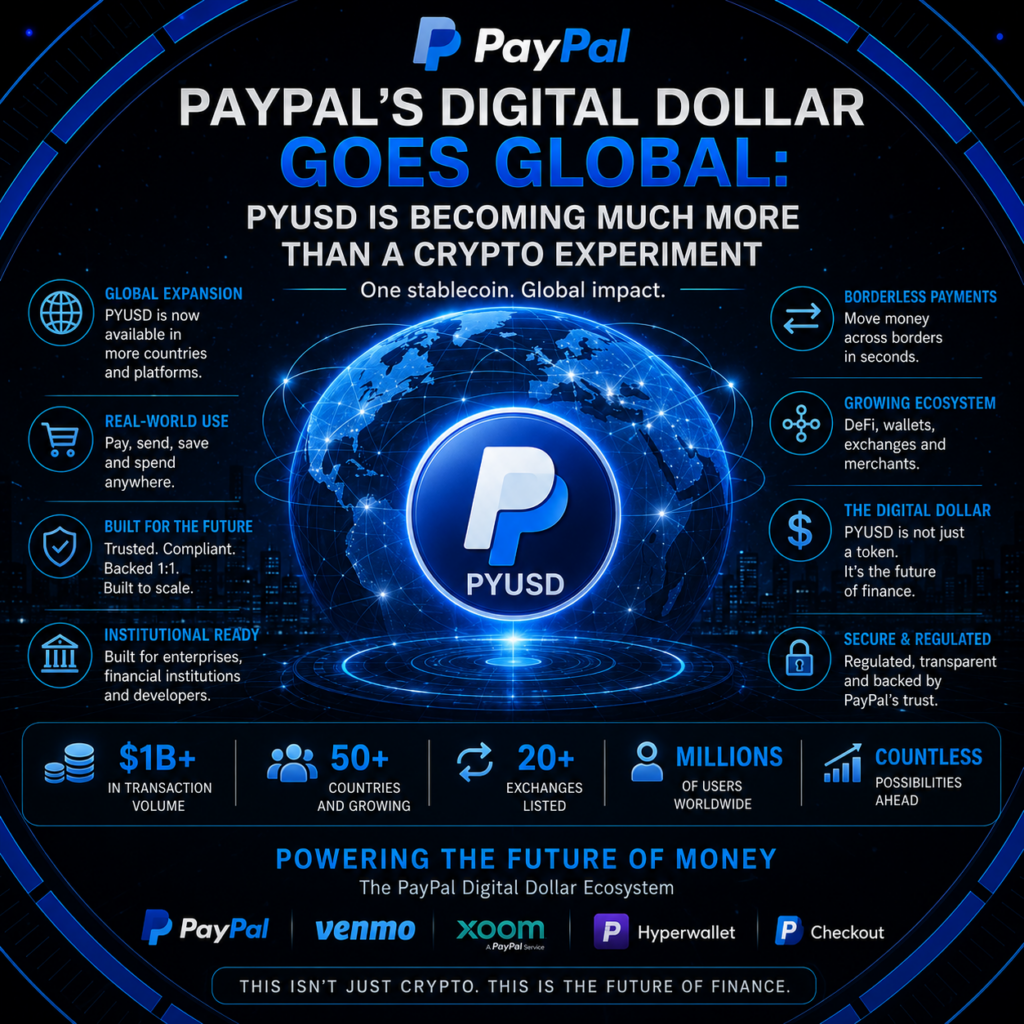
PayPal did not create PYUSD merely to place another cryptocurrency inside its wallet. It is building a dollar that can travel across payment platforms, public blockchains and national borders.
When PayPal USD launched in August 2023, it was easy to interpret the product as a cautious experiment.
PayPal had already introduced cryptocurrency trading to eligible customers. A proprietary stablecoin appeared to be the next logical feature: useful for moving value within PayPal and Venmo, but unlikely to challenge the stablecoins already dominating global crypto markets.
That interpretation is no longer sufficient.
PYUSD has expanded from its original Ethereum deployment to four supported blockchain networks:
- Ethereum;
- Solana;
- Arbitrum;
- Stellar.
At the same time, PayPal has been connecting the stablecoin to a much broader financial system:
- Consumer transfers;
- Merchant checkout;
- Automated business settlement;
- Cross-border payouts;
- Freelancer and vendor payments;
- PayPal and Venmo;
- External wallets;
- Stablecoin rewards;
- Programmable blockchain applications.
The strategy is becoming clear.
PayPal is not trying to make PYUSD relevant only to crypto traders. It is trying to make PYUSD useful wherever dollar-denominated value needs to move.
That is a far more consequential ambition.
If PayPal succeeds, PYUSD could become a bridge between hundreds of millions of PayPal users, global merchants, enterprise payment systems, public blockchains and local financial networks.
The product would no longer be simply a stablecoin offered by PayPal.
It would become PayPal’s programmable distribution layer for the U.S. dollar.
What PYUSD Actually Is
PayPal USD is a U.S. dollar-denominated stablecoin issued by Paxos Trust Company, N.A.
It is designed to maintain a value of one U.S. dollar per token.
According to Paxos, PYUSD reserves consist entirely of:
- U.S. dollar deposits;
- U.S. Treasury instruments;
- Cash equivalents.
Paxos publishes monthly reserve reports and independent attestations covering the assets supporting PYUSD. Eligible holders can redeem PYUSD through supported PayPal and Paxos channels at a one-to-one rate, subject to account eligibility, applicable terms and regulatory restrictions. Paxos describes PYUSD as a fully backed stablecoin designed for payments.
PYUSD is not:
- A Federal Reserve central bank digital currency;
- U.S. government-issued legal tender;
- A conventional bank deposit;
- An FDIC-insured savings account;
- A SIPC-protected security;
- A direct financial obligation issued by PayPal.
It is a privately issued, reserve-backed representation of the U.S. dollar operating through regulated financial infrastructure and public blockchain networks.
That distinction is important.
PYUSD can deliver some of the utility of digital cash without possessing all the legal characteristics or protections of money held at an insured bank.
The Evolution of PYUSD
PYUSD’s development can be understood in four stages.
Stage One: Issue a regulated digital dollar
PayPal launched a reserve-backed stablecoin through Paxos and made it available to eligible U.S. customers.
Stage Two: Expand distribution
PYUSD became available through PayPal, Venmo, external wallets, exchanges and custody platforms.
Stage Three: Expand the networks
PayPal deployed PYUSD across Ethereum, Solana, Arbitrum and Stellar, selecting networks with different strengths.
Stage Four: Integrate it into commerce
PYUSD is now being connected to merchant settlement, contractor payouts, global disbursements, rewards and cross-border payments.
This is the critical transition.
A token becomes financially important not when it exists, but when it becomes integrated into recurring economic activity.
From One Blockchain to Four
PYUSD originally launched on Ethereum, the dominant smart-contract ecosystem for institutional blockchain development.
But no single blockchain is ideal for every financial use case.
Ethereum provides liquidity and developer infrastructure. Solana offers high-speed, lower-cost transactions. Arbitrum provides a scalable extension of Ethereum. Stellar focuses on payments, remittances and connections to real-world financial systems.
| Network | Strategic role for PYUSD |
|---|---|
| Ethereum | Institutional liquidity, custody and Web3 integration |
| Solana | High-speed, lower-cost consumer transactions |
| Arbitrum | Scalable Ethereum-compatible applications |
| Stellar | Cross-border payments, remittances and local financial access |
PayPal’s current U.S. cryptocurrency terms identify all four as supported PYUSD blockchains. PayPal Cryptocurrency Terms
This multi-network structure is more than technical diversification.
It allows PayPal to place its digital dollar inside several distinct financial ecosystems instead of depending on a single blockchain’s cost, speed and developer community.
Ethereum Provides the Institutional Foundation
Ethereum gives PYUSD access to one of the largest ecosystems in digital finance.
It connects the stablecoin to:
- Institutional custody providers;
- Cryptocurrency exchanges;
- Decentralized applications;
- Smart contracts;
- Tokenized assets;
- Developer infrastructure;
- On-chain liquidity.
Ethereum remains strategically important because many financial institutions and developers use its token standards when building blockchain-based products.
The weakness is cost.
During periods of heavy activity, Ethereum transaction fees can rise enough to make small transfers impractical. A network suitable for large financial applications is not automatically ideal for everyday retail payments.
PayPal therefore needed additional transaction environments.
Solana Makes Small Payments More Practical
PYUSD expanded to Solana in 2024.
Solana offers high throughput and generally lower transaction costs than Ethereum’s main network. These characteristics make it better suited to:
- Retail payments;
- Small transfers;
- Micropayments;
- Digital commerce;
- High-volume financial applications;
- Consumer wallet transactions.
Paxos said the Solana expansion was intended to make PYUSD faster and less expensive to use. Paxos announcement on PYUSD’s Solana deployment
That expansion addressed a basic economic problem.
A payment instrument cannot become globally useful if the cost of moving it is occasionally greater than the payment itself.
Arbitrum Connects Scale With Ethereum Compatibility
In July 2025, PayPal expanded PYUSD to Arbitrum.
Arbitrum is an Ethereum Layer 2 network. It processes transactions more efficiently while remaining connected to Ethereum’s broader technical and financial ecosystem.
For developers, this can provide:
- Ethereum-compatible tooling;
- Lower transaction costs;
- Higher processing capacity;
- Faster confirmation;
- Access to existing smart-contract applications.
PayPal described Arbitrum as PYUSD’s first Layer 2 deployment and emphasized its usefulness for lower-cost, high-throughput applications. PayPal’s official Arbitrum announcement
Arbitrum gives PayPal a middle path.
PYUSD can retain access to the Ethereum economy without requiring every transaction to settle directly on Ethereum’s more expensive base layer.
Stellar Could Give PYUSD Its Global Reach
The Stellar deployment may be the most strategically important expansion for PYUSD’s international ambitions.
Stellar was built around financial use cases such as:
- Cross-border transfers;
- Remittances;
- Low-cost payments;
- Currency conversion;
- Local cash access;
- Financial inclusion;
- Merchant settlement.
PYUSD became available on Stellar in September 2025 after the required regulatory process.
Stellar connects digital wallets, fintech platforms, local payment systems and cash networks across multiple regions. This can make PYUSD more practical in markets where conventional access to dollars is limited, expensive or slow.
Potential use cases include:
- International payroll;
- Freelancer payments;
- Family remittances;
- Small-business working capital;
- Marketplace payouts;
- Merchant settlement;
- Wallet-to-wallet transfers;
- Local cash-in and cash-out;
- Microfinance.
Stellar confirmed that PYUSD went live on its network in September 2025.
This is where the idea of a “global digital dollar” begins to move from marketing language toward financial infrastructure.
PYUSD can circulate beyond the PayPal application through wallets and services designed for real-world payment activity.
Global Infrastructure Is Not the Same as Universal Availability
The headline requires an important qualification.
PYUSD can move globally through public blockchains and supported payment platforms. That does not mean every person in every country can open PayPal, purchase PYUSD and receive the same features available to an eligible U.S. customer.
Access depends on:
- Country of residence;
- Local cryptocurrency regulations;
- PayPal account eligibility;
- Identity verification;
- Paxos requirements;
- Supported wallets;
- Local payment partners;
- Sanctions and compliance rules;
- Available conversion channels.
A person may be able to receive PYUSD through an external wallet while lacking access to PayPal’s complete cryptocurrency service.
Another user may hold PYUSD but have no convenient way to convert it into local currency.
The accurate conclusion is:
PYUSD has global technical reach, but regulated product access remains jurisdiction-specific.
That distinction matters because blockchain availability alone does not create a complete global banking service.
PayPal’s Greatest Advantage Is Distribution
The most valuable asset behind PYUSD is not a blockchain.
It is PayPal’s existing payment network.
At the end of 2025, PayPal reported:
- 439 million active accounts;
- $1.79 trillion in annual total payment volume;
- 25.4 billion annual payment transactions.
PayPal operates across more than 200 markets and maintains relationships with consumers, merchants, financial institutions and enterprise platforms. PayPal’s 2025 Form 10-K
Most stablecoin companies must persuade customers to discover a new application, create an exchange account or learn how blockchain wallets work.
PayPal can introduce PYUSD where financial activity already exists.
Its customers already:
- Receive payments;
- Shop online;
- Transfer money;
- Operate businesses;
- Pay contractors;
- Use Venmo;
- Maintain PayPal balances;
- Make international transactions.
PayPal does not need to turn all these people into crypto enthusiasts.
It needs to make blockchain infrastructure invisible enough that customers can use PYUSD without needing to think like blockchain users.
The Objective Is Payments, Not Speculation
PYUSD was not designed primarily as an investment asset.
Its price is intended to remain close to one U.S. dollar. That removes the appreciation narrative that attracts retail traders to Bitcoin, Ether and other volatile cryptocurrencies.
But price stability is not a weakness for a payment instrument.
Useful money requires:
- Predictable value;
- Reliable settlement;
- Low transaction costs;
- Liquidity;
- Merchant acceptance;
- Regulatory credibility;
- Convenient redemption.
PYUSD does not need to become the most speculative asset in the market.
It needs to become a digital dollar people and businesses are willing to receive.
That is a different measure of success.
Cross-Border Payments Are the Largest Opportunity
Traditional cross-border transactions can involve several intermediaries.
A single payment may pass through:
- The sender’s bank;
- A payment processor;
- One or more correspondent banks;
- A foreign-exchange provider;
- The recipient’s financial institution.
Each layer can introduce:
- Fees;
- Conversion spreads;
- Processing delays;
- Compliance reviews;
- Limited operating hours;
- Uncertain settlement times.
Blockchain-based stablecoins can simplify part of this structure.
PYUSD can move directly between compatible wallets, including outside conventional banking hours. The blockchain records settlement without requiring several institutions to update separate ledgers sequentially.
PayPal’s developer materials describe PYUSD as a tool for direct, lower-cost global transfers and near-instant blockchain settlement. PayPal Developer Community: PYUSD for cross-border payments
Potential uses include:
- Paying international freelancers;
- Marketplace disbursements;
- Creator payouts;
- Supplier payments;
- Business-to-business settlement;
- Family remittances;
- International commerce.
However, “near-instant blockchain settlement” should not be confused with instant access to spendable local currency.
The recipient may still need to:
- Pass identity verification;
- Transfer PYUSD to a supported service;
- Convert it into local currency;
- Pay conversion or withdrawal fees;
- Wait for local-bank settlement.
PYUSD can accelerate the digital portion of a cross-border payment without eliminating every step at its edges.
Hyperwallet Could Become PYUSD’s Enterprise Distribution Engine
PayPal owns Hyperwallet, a payout platform used by marketplaces, enterprises and digital platforms.
Hyperwallet advertises payouts across:
- More than 200 markets;
- More than 50 currencies;
- Multiple payment methods.
PayPal now includes PYUSD among the platform’s alternative payout options. PayPal Hyperwallet global payout solutions
Current Hyperwallet terms also provide for PYUSD payouts through PayPal Digital. Hyperwallet Service Terms
This could be more important than encouraging individual customers to buy stablecoins.
A marketplace can potentially distribute PYUSD to:
- Freelancers;
- Creators;
- Drivers;
- Sellers;
- Contractors;
- Service providers;
- International suppliers.
The recipient does not necessarily need to make an investment decision or visit a cryptocurrency exchange.
PYUSD can arrive as payment for real work.
That is a much stronger adoption mechanism than speculation.
Merchant Payments Remove the Crypto Burden
PayPal has also introduced Pay with Crypto for eligible U.S. merchants.
The service allows customers to pay using supported digital assets while PayPal manages the payment experience and merchant settlement.
This addresses a major obstacle to cryptocurrency commerce.
Most merchants do not want to:
- Price products in volatile tokens;
- Manage several cryptocurrencies;
- Protect private keys;
- Operate blockchain wallets;
- Calculate exchange rates;
- Assume token-price risk;
- Reconcile complex on-chain transactions.
PayPal can stand between the customer’s digital asset and the merchant’s preferred form of settlement.
PYUSD is particularly suitable for this model because it is designed to maintain dollar-denominated value.
PayPal says Pay with Crypto can help U.S. merchants accept digital-asset payments, reach global customers and send payments to freelancers or vendors using PYUSD. PayPal’s Pay with Crypto announcement
The customer can spend crypto.
The merchant can receive usable value.
PayPal controls the interface, conversion and settlement experience.
PYUSD Is Becoming Business Infrastructure
The strategy extends beyond checkout.
Eligible U.S. merchants can automatically convert part of their PayPal balance into PYUSD.
The business can select:
- The percentage converted;
- The conversion schedule;
- When to modify the allocation;
- When to stop automated settlement.
Eligible PYUSD balances may also receive the current variable 4% annual reward.
This creates a potential operating cycle:
The same digital asset can potentially serve as:
- Settlement money;
- Short-term liquidity;
- A payout instrument;
- A cross-border payment asset;
- A programmable business balance.
That is more strategically important than simply allowing a customer to purchase a stablecoin.
It places PYUSD inside the financial operations of a business.
Four Percent Rewards Create a Reason to Hold PYUSD
PYUSD’s global expansion would have limited value if users converted or redeemed every token immediately.
PayPal’s current rewards program changes that behavior.
Eligible customers and merchants can receive a variable 4% annual reward on qualifying PYUSD held within PayPal.
This gives users three reasons to maintain a balance:
- It can remain relatively stable against the dollar;
- It can be transferred or used for supported payments;
- It can generate rewards while waiting for its next use.
The reward transforms PYUSD from money in transit into working liquidity.
However, it is not equivalent to interest from an insured savings account.
PYUSD:
- Is not an FDIC-insured deposit;
- Is not protected by SIPC;
- Remains subject to custody and issuer risk;
- May lose access to PayPal rewards when transferred externally;
- Has a variable reward rate;
- Can involve transfer and conversion fees.
The reward strengthens the product’s usefulness, but it does not remove its risks.
Public Blockchains Take PYUSD Beyond PayPal
PYUSD operates inside PayPal, but it is not entirely confined to PayPal.
Because it exists on public blockchain networks, compatible third parties can integrate the asset into:
- Wallets;
- Exchanges;
- Payment services;
- Custody platforms;
- Merchant applications;
- Tokenized-asset systems;
- Lending products;
- Financial software.
This makes PYUSD different from a conventional PayPal balance.
A PayPal balance primarily exists inside PayPal’s internal ledger.
PYUSD can leave that environment and continue circulating through compatible networks.
That portability is one of the asset’s most important characteristics.
But leaving PayPal can change the customer’s protections and economics:
- PayPal rewards may stop;
- External-transfer fees may apply;
- Network fees may apply;
- Blockchain transactions can be irreversible;
- Destination platforms impose their own terms;
- Incorrect transfers may be unrecoverable;
- Smart-contract and wallet risks may arise.
Open infrastructure creates freedom of movement—not universal protection.
A Multi-Chain Dollar Also Creates New Complexity
Operating across four blockchains expands utility, but it creates risks that ordinary payment users may not understand.
A customer must correctly identify:
- The blockchain network;
- The destination wallet;
- The supported token version;
- Any required bridge;
- Network fees;
- Destination-platform compatibility.
Sending PYUSD through the wrong network can result in delayed access or permanent loss.
Multi-chain liquidity can also become fragmented. PYUSD on Ethereum, Solana, Arbitrum and Stellar may have different levels of:
- Exchange support;
- Wallet compatibility;
- Transaction cost;
- Merchant acceptance;
- Market liquidity.
PayPal’s challenge is to make this complexity invisible to mainstream customers without hiding important risks.
The winning payment interface will not ask ordinary users to understand blockchain architecture before sending money.
Why Programmability Matters
A digital currency becomes more valuable when software can interact with it directly.
Developers can integrate PYUSD into automated financial processes such as:
- Contractor payouts;
- International payroll;
- Marketplace settlement;
- Subscription payments;
- Escrow arrangements;
- Conditional transfers;
- Tokenized invoices;
- Supply-chain payments;
- Machine-to-machine commerce;
- AI-agent transactions.
A traditional bank transfer generally requires interaction with closed financial systems, operating schedules and institution-specific APIs.
A blockchain token can move according to software instructions whenever network and compliance requirements are satisfied.
This makes PYUSD potentially relevant to the emerging machine economy.
In the future, software agents may need to:
- Purchase data;
- Pay for computing capacity;
- Compensate contractors;
- Settle API usage;
- Execute small commercial transactions automatically.
A programmable, dollar-denominated token could become useful infrastructure for those activities.
That future is not fully developed, but PayPal is positioning PYUSD to participate in it.
PayPal Can Bridge Two Financial Systems
PayPal already controls substantial conventional payment infrastructure:
- Consumer accounts;
- Linked bank accounts;
- Debit and credit cards;
- Merchant checkout;
- Currency conversion;
- International transfers;
- Venmo;
- Enterprise payouts;
- Fraud prevention;
- Compliance systems.
PYUSD adds:
- Blockchain portability;
- Programmability;
- External-wallet compatibility;
- Continuous settlement;
- Digital-dollar liquidity.
PayPal can therefore connect traditional and blockchain-based finance.
| Conventional PayPal infrastructure | PYUSD infrastructure |
|---|---|
| Linked bank accounts | Public blockchain wallets |
| Merchant checkout | On-chain payments |
| Fiat settlement | Stablecoin settlement |
| Conventional payouts | PYUSD payouts |
| Platform balances | Portable digital dollars |
| Banking-hour transfers | Continuous blockchain settlement |
PayPal does not need to replace banks or conventional payment networks.
It can make them one side of a larger financial bridge.
The Dollar Is the Real Global Product
PYUSD’s international opportunity is supported by global demand for U.S. dollars.
Individuals and businesses use dollar-denominated value for:
- International trade;
- Savings;
- Business reserves;
- Remittances;
- Commodity purchases;
- Cross-border contracts;
- Protection against local-currency instability.
In some markets, access to conventional dollar accounts is expensive, restricted or unavailable.
A stablecoin can provide digital exposure to dollar-denominated value without requiring the holder to possess physical U.S. currency or maintain a traditional American bank account.
That does not eliminate:
- Local laws;
- Tax obligations;
- Sanctions rules;
- Identity verification;
- Redemption risk;
- Local conversion costs.
But it changes how dollar value can be distributed.
The dollar can move through wallets and software instead of exclusively through banks and correspondent-payment networks.
PYUSD’s Biggest Strategic Advantages
PayPal distribution
The stablecoin can be introduced to existing consumers and merchants.
Paxos issuance
Paxos provides regulated issuance, reserve management and redemption infrastructure.
Multi-chain reach
PYUSD can move through networks optimized for different use cases.
Commerce integration
PayPal can connect PYUSD directly to merchant activity.
Enterprise payouts
Hyperwallet can distribute PYUSD through business and marketplace relationships.
Dollar convertibility
The asset is designed to remain redeemable at one U.S. dollar through supported channels.
Programmability
Developers can build automated financial applications around the token.
Holding incentives
Variable rewards can encourage customers to retain PYUSD between transactions.
Few stablecoin competitors combine all these advantages inside one corporate ecosystem.
The Obstacles PayPal Still Must Overcome
PYUSD’s global strategy is credible, but success is not guaranteed.
Regulation
Stablecoin rules differ substantially across jurisdictions.
Local liquidity
Recipients need affordable methods to convert PYUSD into useful local money.
Competition
USDT and USDC have larger circulation, deeper liquidity and broader existing adoption.
User complexity
Wallet addresses, networks and irreversible transactions remain unfamiliar to mainstream users.
Fee economics
Platform, network, transfer and currency-conversion charges can reduce the advantage over traditional payments.
Privacy
Public blockchains create transaction transparency, while PayPal collects extensive account and financial information.
Account access
Verification reviews, compliance investigations or platform restrictions may affect access to funds.
Fragmented liquidity
Each supported blockchain may have different liquidity and wallet support.
Merchant adoption
Businesses need predictable costs, accounting treatment and customer support before changing settlement systems.
Operational trust
Payroll, remittances and business payments require years of demonstrated reliability.
Global technical capability is easier to build than global financial trust.
PYUSD Is Not a Government Digital Dollar
The phrase “digital dollar” can create confusion.
PYUSD is not issued by the Federal Reserve. It is not a central bank digital currency and does not carry the same legal status as physical U.S. currency.
Its operation depends on:
- Paxos;
- Reserve quality;
- Regulatory supervision;
- Redemption procedures;
- PayPal’s systems;
- Custody arrangements;
- Supported blockchains.
PYUSD does not need to replace cash or bank deposits to become successful.
It can create substantial value by becoming a common digital format for dollar-denominated payments and settlement.
Why PYUSD Is No Longer an Experiment
An experiment is isolated, temporary and disconnected from essential business systems.
PYUSD is increasingly embedded across PayPal’s commercial infrastructure.
It now connects:
- Four blockchain networks;
- PayPal consumer accounts;
- Venmo;
- Merchant checkout;
- Automated business settlement;
- Stablecoin rewards;
- Enterprise payouts;
- External wallets;
- Global payment applications.
The number of ways PYUSD can enter circulation is also expanding:
- Customers can purchase it;
- Users can receive it from another person;
- Merchants can settle into it;
- Businesses can pay vendors with it;
- Platforms can distribute it through Hyperwallet;
- External wallets can support it;
- Developers can integrate it into applications.
This does not prove that PYUSD will dominate the stablecoin market.
It does demonstrate that PayPal is no longer treating the asset as a limited crypto feature.
PYUSD is becoming part of PayPal’s broader payment architecture.
Final Analysis: PayPal Is Building a Global Distribution System for the Dollar
PayPal’s first great achievement was helping move commerce online.
Its next ambition may be moving dollar-denominated value onto programmable global infrastructure.
PYUSD began as a stablecoin offered inside a familiar payment application.
It is becoming something more substantial:
- A consumer payment asset;
- A merchant settlement instrument;
- A cross-border payout option;
- A reward-bearing digital balance;
- A blockchain-native dollar;
- A programmable financial tool;
- A bridge between PayPal and open networks.
Ethereum provides institutional liquidity and developer infrastructure.
Solana provides faster, lower-cost consumer transactions.
Arbitrum provides scalable access to the Ethereum ecosystem.
Stellar provides connections to remittances, global payments and local financial services.
Paxos provides issuance and reserve management.
PayPal provides distribution.
Together, these components form a potential digital-dollar network extending far beyond cryptocurrency trading.
PYUSD is still smaller than the largest stablecoins.
Its direct availability remains jurisdiction-specific.
Its rewards can change.
Its transactions can carry fees.
Its multi-chain architecture introduces complexity.
Its global success is not guaranteed.
But the strategic direction is increasingly difficult to dismiss.
PayPal is placing PYUSD inside merchant payments, global payouts, business settlement and programmable commerce.
The real stablecoin competition is no longer simply about which token has the largest market capitalization.
It is about which digital dollar can connect to the greatest number of useful financial activities.
PayPal already has the accounts, merchants, transaction volume and international relationships.
PYUSD gives it a dollar capable of moving beyond the boundaries of PayPal’s conventional platform.
That is why PYUSD is becoming much more than a crypto experiment.
It is becoming PayPal’s attempt to build a global, programmable distribution system for the U.S. dollar.
Key Facts
- PYUSD is issued by Paxos Trust Company, N.A.
- It is designed to maintain a one-to-one value with the U.S. dollar.
- Paxos states that PYUSD is backed by U.S. dollar deposits, U.S. Treasuries and cash equivalents.
- Paxos publishes monthly reserve reports and attestations.
- PayPal currently identifies Ethereum, Solana, Arbitrum and Stellar as supported PYUSD networks.
- PYUSD originally launched on Ethereum in 2023.
- It expanded to Solana in 2024.
- Arbitrum support launched in 2025.
- PYUSD went live on Stellar in September 2025.
- Eligible PayPal users can buy, sell, hold and transfer PYUSD.
- Eligible U.S. merchants can automate settlement of part of their PayPal balances into PYUSD.
- Qualifying balances may receive variable PYUSD rewards.
- Hyperwallet supports PYUSD as an enterprise payout option.
- PYUSD can be transferred to compatible external wallets.
- Transfer, network and conversion fees may apply.
- Product access depends on jurisdiction, account status and regulatory requirements.
- Global blockchain reach does not mean universal PayPal availability.
- PYUSD is not a bank deposit, government-issued legal tender, FDIC-insured asset or Federal Reserve digital currency.
Editorial Disclosure
This article contains independent editorial analysis. REVOLD Blog has not received compensation from PayPal Holdings, PayPal Digital, Paxos, Ethereum, Solana, Offchain Labs, the Stellar Development Foundation or another organization mentioned in this publication.
Product availability, rewards, supported networks, fees and regulatory requirements may change. International transactions can involve platform charges, blockchain fees, currency-conversion costs and tax or reporting obligations.
This material is provided solely for informational and educational purposes. It does not constitute financial, investment, legal, tax, accounting or cryptocurrency advice.
Official Sources
- PayPal — Official PYUSD Product Page
- PayPal — Cryptocurrency Terms and Supported Networks
- PayPal — PYUSD Expansion to Arbitrum
- PayPal — PYUSD and Stellar
- Stellar — PYUSD Launch on Stellar
- Paxos — Official PYUSD Page
- Paxos — PYUSD on Solana
- PayPal — Hyperwallet Global Payouts
- PayPal — Pay with Crypto
- SEC — PayPal 2025 Annual Report
blog.revold.us — Powered by AIR RISE INC & REVOLD AI
Author: Roman Kravchina