
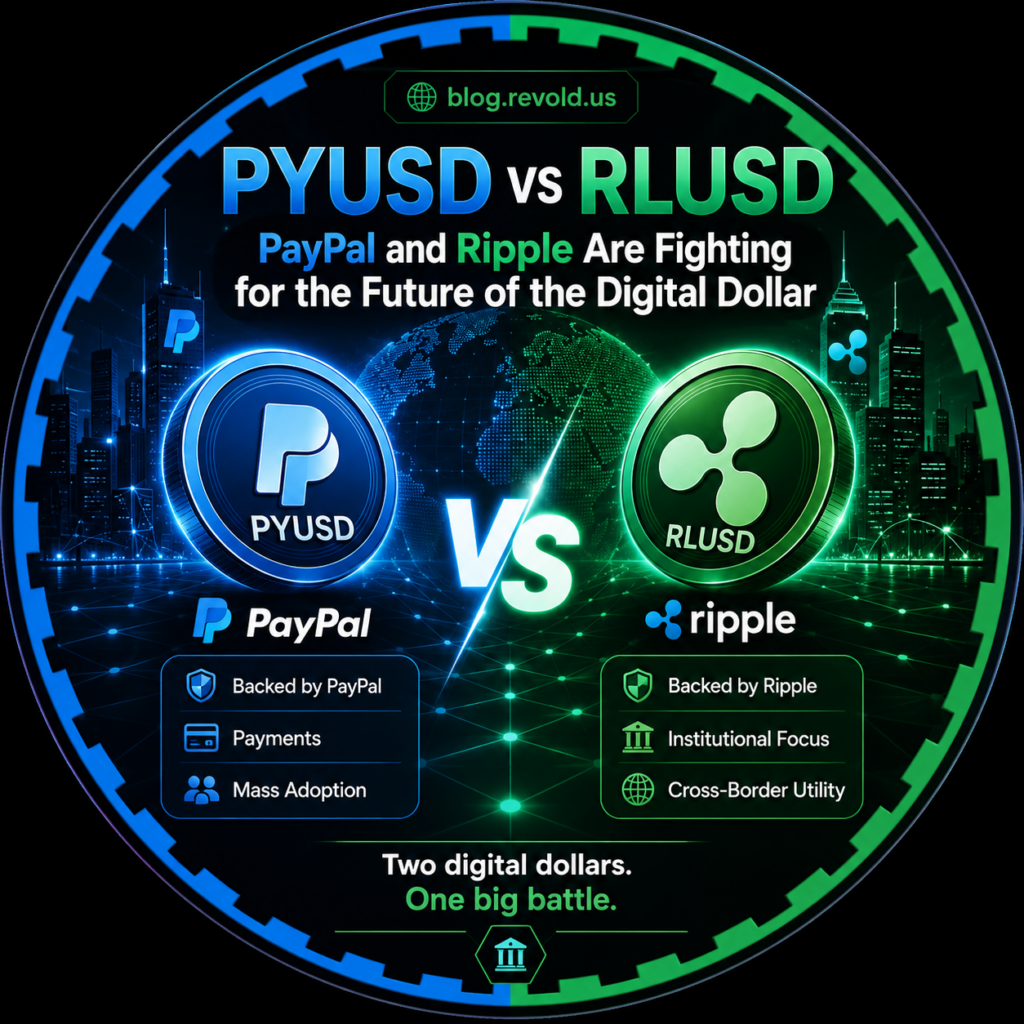
PayPal wants the wallet. Ripple wants the financial rails. Their stablecoins may look similar, but they represent two fundamentally different visions for the future of money.
PayPal USD and Ripple USD are both digital representations of the U.S. dollar.
Each is designed to maintain a value of one dollar. Each is supported by reserves intended to enable one-to-one redemption. Each operates on public blockchain networks and is connected to a company with extensive experience moving money.
That is where the easy comparison ends.
PYUSD is being built around consumers, merchants, online checkout, wallets, rewards and global payouts.
RLUSD is being built around financial institutions, cross-border settlement, custody, treasury operations, prime brokerage and tokenized capital markets.
PayPal begins with the customer.
Ripple begins with the institution.
PayPal is asking whether a stablecoin can become part of everyday commercial life.
Ripple is asking whether a stablecoin can become part of the machinery running global finance.
Neither company has publicly declared a direct war against the other. But strategically, they are competing for something enormously valuable:
The right to define how digital dollars are held, transferred, settled and integrated into the global economy.
This is not merely a contest between two tokens.
It is a contest between the financial interface and the financial infrastructure underneath it.
PYUSD vs RLUSD at a Glance
| Feature | PYUSD | RLUSD |
|---|---|---|
| Full name | PayPal USD | Ripple USD |
| Launch | August 2023 | December 2024 |
| Issuer | Paxos Trust Company, N.A. | Standard Custody & Trust Company, LLC |
| Core ecosystem | PayPal and Venmo | Ripple financial infrastructure |
| Primary market | Consumers and merchants | Institutions and enterprises |
| Main strategy | Commerce, balances and payouts | Settlement, liquidity and tokenized finance |
| Reserve assets | Dollar deposits, U.S. Treasuries and cash equivalents | Dollar deposits, short-term Treasuries and qualifying liquid assets |
| Reserve reporting | Monthly reports and attestations | Monthly reports and independent CPA attestations |
| Named primary reserve custodian | Managed through Paxos reserve infrastructure | BNY |
| Holder rewards | Eligible PayPal balances may receive variable 4% rewards | No general holder-reward program |
| Consumer wallet integration | Strong | Limited compared with PayPal |
| Institutional infrastructure | Developing | Payments, custody, treasury and prime brokerage |
| FDIC-insured deposit | No | No |
The most important difference is not technical.
It is strategic.
PYUSD is designed to make stablecoins familiar. RLUSD is designed to make stablecoins institutionally usable.
What Is PYUSD?
PayPal USD is a U.S. dollar-denominated stablecoin issued by Paxos Trust Company, N.A.
According to Paxos, every PYUSD is supported by reserve assets consisting of:
- U.S. dollar deposits;
- U.S. Treasury instruments;
- Cash equivalents.
Paxos publishes monthly reserve reports and attestations covering the assets supporting PYUSD. Eligible holders can convert PYUSD at a one-to-one rate through supported PayPal and Paxos channels, subject to account eligibility and applicable terms. Paxos describes PYUSD as a fully backed stablecoin designed for payments.
PYUSD is deeply connected to PayPal’s consumer and merchant ecosystem.
Eligible customers can:
- Buy, sell and hold PYUSD;
- Send it to other eligible users;
- Transfer it to compatible blockchain wallets;
- Use it through supported checkout functions;
- Receive variable rewards on qualifying PayPal balances.
Eligible merchants can:
- Accept supported crypto-funded payments;
- Automatically convert part of their PayPal balance into PYUSD;
- Hold PYUSD as short-term operating liquidity;
- Receive the current variable reward on eligible balances;
- Use PYUSD for supported contractor or vendor payments.
PYUSD’s central advantage is therefore not simply that it exists on a blockchain.
It exists inside a commercial platform already used by hundreds of millions of accounts.
What Is RLUSD?
Ripple USD is a U.S. dollar-denominated stablecoin issued by Standard Custody & Trust Company, LLC, a Ripple subsidiary chartered as a New York limited-purpose trust company.
Under the published RLUSD terms, qualifying reserves may include:
- U.S. dollar deposit accounts;
- Short-term U.S. Treasury bills;
- Overnight repurchase agreements backed by U.S. government securities;
- U.S. government money-market funds;
- Other permitted liquid assets.
The reserves are maintained in segregated accounts and are intended to equal or exceed the value of outstanding RLUSD.
Ripple publishes monthly reserve reports supported by independent CPA attestations. Its transparency reporting covers both circulating RLUSD and the assets held in reserve. Ripple’s official RLUSD transparency reports
In July 2025, Ripple selected BNY as the primary custodian of RLUSD reserves. Ripple and BNY reserve-custody announcement
RLUSD is positioned as an institutional settlement asset for:
- Cross-border payments;
- Treasury operations;
- Business-to-business transactions;
- Trading collateral;
- Tokenized assets;
- Exchange liquidity;
- Prime brokerage;
- Institutional settlement.
RLUSD can be accessed through supported exchanges and platforms, but its strategic center is not the retail wallet.
It is the institutional balance sheet.
PayPal Wants to Own the Interface
PayPal’s most valuable advantage is its direct relationship with consumers and merchants.
At the end of 2025, PayPal reported:
- 439 million active accounts;
- $1.79 trillion in annual payment volume;
- 25.4 billion annual payment transactions.
That distribution gives PYUSD access to financial behavior that already exists.
PayPal customers already:
- Send money;
- Receive business revenue;
- Shop online;
- Use Venmo;
- Pay merchants;
- Manage PayPal balances;
- Pay international contractors;
- Operate digital businesses.
PayPal does not need to persuade every customer to become a cryptocurrency investor.
It needs to make PYUSD useful without requiring customers to think about blockchain infrastructure.
The customer may see only:
- Dollars;
- A PayPal balance;
- A reward rate;
- A send button;
- A merchant checkout;
- A transfer confirmation.
The blockchain can remain underneath the interface.
This gives PayPal influence over:
- Which digital dollar the customer holds;
- Where the balance remains;
- Which rewards are displayed;
- Which payment method is selected;
- How the asset is converted;
- Where the customer can spend it.
If PayPal succeeds, PYUSD could become a mainstream stablecoin because the customer experience does not feel like cryptocurrency.
Ripple Wants to Own the Infrastructure
Ripple approaches the market from the opposite direction.
Its core customers include:
- Banks;
- Fintech companies;
- Payment providers;
- Institutional trading firms;
- Custodians;
- Corporate treasury departments;
- Tokenization platforms.
Ripple’s wider infrastructure now includes:
- Ripple Payments;
- Ripple Custody;
- Ripple Prime;
- Treasury-management technology;
- Tokenization infrastructure;
- XRP Ledger;
- RLUSD.
Ripple Payments is designed to move value across borders using stablecoins, digital assets and local currencies while connecting institutional customers to payout markets and on- and off-ramps. Ripple Payments
Ripple also transformed its acquisition of Hidden Road into Ripple Prime, a global multi-asset prime brokerage platform.
Ripple reports that the platform:
- Clears more than $3 trillion annually;
- Serves more than 300 institutional customers;
- Supports digital assets, foreign exchange, precious metals, derivatives and fixed-income markets.
This gives RLUSD a path into financial activity far beyond conventional stablecoin transfers.
It can potentially serve as:
- Settlement cash;
- Trading collateral;
- Margin collateral;
- Treasury liquidity;
- A bridge between fiat and tokenized assets;
- A funding asset within institutional markets.
Ripple does not need every consumer to recognize RLUSD.
It needs institutions to trust it.
The Essential Strategic Difference
The two models can be reduced to one contrast.
PYUSD
PayPal places the digital dollar where consumers and merchants already conduct commerce.
RLUSD
Ripple places the digital dollar where institutions already move, finance, custody and settle assets.
That produces two different adoption paths.
PYUSD can grow through millions of smaller commercial relationships.
RLUSD can grow through fewer but substantially larger institutional flows.
PayPal provides breadth.
Ripple is seeking depth.
Reserve Structure and Transparency
Both PYUSD and RLUSD are designed to be fully supported by high-quality liquid reserves.
But the reserve itself is only part of the evaluation.
A serious comparison should examine:
- Who issues the token;
- Where the reserves are held;
- Which assets are permitted;
- Whether the reserves are segregated;
- How often reports are published;
- Who performs the attestation;
- Who can redeem directly;
- What happens during suspension or termination.
PYUSD
Paxos publishes monthly transparency reports covering PYUSD reserves. The reported assets include dollar deposits, U.S. Treasury instruments and cash equivalents. PYUSD transparency reports
RLUSD
Standard Custody maintains RLUSD reserves in segregated accounts. Ripple publishes monthly reports supported by independent CPA attestations. BNY serves as the primary reserve custodian.
Neither stablecoin is equivalent to an FDIC-insured savings account.
Reserve backing and deposit insurance provide different protections:
- Reserve backing supports the token’s redemption value.
- FDIC insurance protects eligible bank deposits if an insured bank fails.
PYUSD and RLUSD are stablecoins, not insured deposits.
Which Stablecoin Has Better Reserves?
The available public information does not justify declaring an absolute winner.
Both products describe:
- High-quality liquid assets;
- One-to-one backing;
- Monthly reporting;
- Independent attestations;
- Regulated issuers;
- Redemption mechanisms.
RLUSD provides a particularly explicit institutional presentation through segregated accounts, detailed permitted asset classes and BNY’s named custody role.
PYUSD benefits from Paxos’s established history issuing and managing regulated stablecoins.
The appropriate conclusion is not that one reserve is unquestionably safer.
It is that both structures should be evaluated through their current monthly reports rather than marketing claims alone.
Regulation Is Central to Both Strategies
PYUSD regulatory structure
Paxos issues PYUSD under its regulated trust framework and manages the token’s reserve and redemption infrastructure.
PayPal provides the consumer, merchant and payment distribution.
RLUSD regulatory structure
Standard Custody issues RLUSD under a New York limited-purpose trust charter.
Ripple has also pursued regulatory recognition for RLUSD in jurisdictions including:
- Dubai;
- Abu Dhabi;
- Japan.
This international compliance strategy supports Ripple’s institutional positioning.
Banks and enterprise customers generally require:
- Clear issuer status;
- Reserve rules;
- Anti-money-laundering controls;
- Redemption rights;
- Approved custody;
- Legal certainty.
Ripple is attempting to make RLUSD compatible with those requirements from the beginning.
Blockchain Network Comparison
Both stablecoins now operate across multiple networks.
PYUSD networks
PayPal’s terms identify:
- Ethereum;
- Solana;
- Arbitrum;
- Stellar.
These networks give PYUSD access to:
- Ethereum liquidity;
- Lower-cost consumer transactions;
- Layer 2 scalability;
- Cross-border payment infrastructure.
RLUSD networks
Ripple’s current technical documentation lists:
- XRP Ledger;
- Ethereum;
- Base;
- Ink;
- Optimism;
- Unichain;
- XRPL EVM sidechain.
RLUSD’s multi-network expansion broadens access to Ethereum Layer 2 liquidity while preserving native integration with the XRP Ledger.
The number of blockchains alone does not determine the stronger asset.
What matters is whether each network provides:
- Real liquidity;
- Reliable wallets;
- Exchange support;
- Affordable transfers;
- Institutional counterparties;
- Merchant acceptance;
- Practical applications.
A token can exist on many networks without becoming economically important on any of them.
Why the XRP Ledger Matters
RLUSD’s native presence on the XRP Ledger gives Ripple a specialized advantage.
The XRP Ledger was designed around payments, token exchange and rapid settlement. It includes native functionality for exchanging issued assets.
This can support interaction among:
- RLUSD;
- XRP;
- Tokenized financial assets;
- Other currencies issued on XRPL.
RLUSD and XRP should not be treated as interchangeable.
| Asset | Primary function |
|---|---|
| RLUSD | Stable dollar-denominated settlement |
| XRP | Liquidity, exchange and network utility |
RLUSD does not automatically make XRP unnecessary.
Ripple can use different assets for different transaction requirements.
An institution seeking predictable dollar value may prefer RLUSD.
A cross-currency payment requiring bridge liquidity may use XRP.
Ripple’s larger strategy is not necessarily RLUSD against XRP. It is the coordinated use of stablecoins, XRP and institutional infrastructure.
PYUSD’s Reward Advantage
PayPal currently offers eligible customers and U.S. merchants a variable 4% annual reward on qualifying PYUSD balances held within PayPal.
The rewards:
- Accrue daily;
- Are generally paid monthly;
- Are paid in PYUSD;
- Do not compound while pending;
- Can change or be discontinued.
RLUSD does not offer an equivalent general holder-reward program.
Its published terms state that RLUSD is intended as a payment mechanism rather than an asset designed to generate returns. The issuer may retain reserve income not required to maintain full backing under the applicable terms. RLUSD User Terms
This gives PayPal a clear consumer advantage.
PYUSD provides a reason not only to acquire the stablecoin, but also to leave it inside PayPal.
That can turn PYUSD into “sticky” digital liquidity.
RLUSD’s value proposition is different. Institutions may hold it because it improves settlement, collateral or treasury efficiency—not because it pays them a promotional reward.
PYUSD Is Designed to Be Seen
PYUSD can appear directly in the customer experience.
A user may encounter it while:
- Holding a PayPal balance;
- Receiving rewards;
- Sending money;
- Paying a merchant;
- Moving funds to a wallet;
- Using Venmo;
- Managing a business account.
Its success may depend on:
- Active customers;
- Merchant adoption;
- Reward-bearing balances;
- Payment volume;
- Checkout activity;
- International access.
PayPal wants PYUSD to become a recognizable financial product.
That visibility is valuable, but it creates demanding consumer obligations.
PayPal must deliver reliable:
- Account recovery;
- Customer service;
- Fraud handling;
- Transaction explanations;
- Error resolution;
- Access to funds.
A stablecoin used for rent, food or payroll cannot rely on the support standards of an experimental crypto feature.
RLUSD Is Designed to Work Behind the Scenes
RLUSD may succeed even when the final customer never sees it.
Consider a simplified institutional payment:
- A business sends U.S. dollars to a payment provider;
- The provider converts the value into RLUSD;
- RLUSD settles across blockchain infrastructure;
- A receiving institution converts it into local currency;
- The recipient receives funds through a bank account or wallet.
The sender and recipient may never hold RLUSD directly.
Yet the stablecoin can still improve:
- Settlement speed;
- Transaction visibility;
- Capital efficiency;
- After-hours availability;
- Treasury management.
This resembles card-network infrastructure.
Consumers do not need to understand interbank settlement to use a Visa card.
Likewise, they may not need to understand RLUSD for it to become important financial infrastructure.
The Cross-Border Payments Battle
Cross-border payments are one of the largest opportunities for both products.
Traditional international payments can require:
- Correspondent banks;
- Prefunded accounts;
- Foreign-exchange intermediaries;
- Multiple compliance systems;
- Limited settlement hours;
- Several days of processing.
Stablecoins can move dollar-denominated value across blockchain networks at any time.
But PayPal and Ripple approach the opportunity from opposite directions.
PayPal’s model
PYUSD can connect to:
- PayPal customers;
- Venmo;
- Merchant checkout;
- Hyperwallet payouts;
- External wallets;
- Contractor payments;
- Local cash-out channels.
PayPal extends an existing payment platform onto blockchain infrastructure.
Ripple’s model
RLUSD can connect to:
- Ripple Payments;
- Banks;
- Fintech companies;
- Treasury operations;
- Institutional liquidity;
- Global payout partners;
- On- and off-ramps.
Ripple extends blockchain settlement into conventional financial institutions.
PayPal starts with distribution and adds the blockchain.
Ripple starts with the blockchain and adds institutional distribution.
Merchant Commerce vs Institutional Treasury
The products naturally serve different primary customers.
| PYUSD’s natural customer | RLUSD’s natural customer |
|---|---|
| Consumer | Bank |
| Online merchant | Payment provider |
| Freelancer | Institutional trader |
| Creator | Corporate treasury |
| PayPal business account | Custodian |
| Venmo user | Tokenization platform |
| Marketplace participant | Prime brokerage client |
PYUSD is closer to checkout.
RLUSD is closer to final settlement.
One is attempting to become digital money inside commerce.
The other is attempting to become digital cash inside institutional balance sheets.
Tokenization Could Become RLUSD’s Largest Opportunity
Financial institutions are beginning to place traditional assets on blockchain networks, including:
- Treasury securities;
- Money-market funds;
- Bonds;
- Private credit;
- Investment funds;
- Commodities;
- Real estate interests.
These assets require a stable form of digital cash for settlement.
A tokenized bond transaction needs a dollar-denominated payment asset.
A blockchain trading platform needs collateral.
A tokenized fund needs liquidity for subscriptions and redemptions.
RLUSD can potentially serve as the cash side of those transactions.
Ripple can connect it to:
- XRP Ledger tokenization;
- Ripple Custody;
- Ripple Prime;
- Institutional liquidity;
- Treasury-management systems.
This gives RLUSD a credible path into capital markets where transaction values can be enormous even if the number of users remains relatively small.
PYUSD can also participate in tokenized finance through supported networks, but PayPal’s strongest current advantage remains commerce and customer distribution.
Why Ripple Prime Could Matter
Prime brokers sit at the center of institutional markets.
They provide:
- Trade execution;
- Financing;
- Clearing;
- Margin;
- Collateral management;
- Market access;
- Risk controls.
Inside Ripple Prime, RLUSD could potentially function as:
- Trading collateral;
- Settlement cash;
- Margin collateral;
- Short-term liquidity;
- A bridge between fiat and digital markets.
This could generate institutional demand unrelated to consumer payments.
PayPal might create millions of comparatively small PYUSD balances.
Ripple could create fewer but substantially larger RLUSD balances through trading, financing and settlement.
That is the difference between retail breadth and institutional depth.
The Battle for Stablecoin Economics
Stablecoin issuers can earn income from reserve assets.
The key strategic question is how that economic value is used.
PayPal’s approach
PayPal shares part of the value with eligible holders through variable PYUSD rewards.
This can:
- Attract balances;
- Reduce redemption;
- Increase customer retention;
- Encourage merchant settlement;
- Deepen PYUSD liquidity inside PayPal.
Ripple’s approach
RLUSD’s reserve income is not generally distributed to ordinary holders. Ripple instead uses the stablecoin as infrastructure supporting:
- Payments;
- Liquidity;
- Institutional settlement;
- Custody;
- Prime brokerage;
- Tokenized assets.
PayPal uses stablecoin economics to attract the holder.
Ripple uses stablecoin utility to attract the institution.
Risks Shared by Both Stablecoins
Issuer risk
Each stablecoin depends on its issuer’s reserve management and operational controls.
Custody risk
Customers holding tokens through intermediaries depend on those platforms for access and security.
Redemption risk
Direct redemption is subject to eligibility, compliance procedures and applicable terms.
Blockchain risk
Network congestion, technical failures and incorrect transfers can affect users.
Regulatory risk
Stablecoin laws continue to evolve across jurisdictions.
Liquidity risk
Secondary-market prices can temporarily deviate from one dollar.
Account-restriction risk
Transactions may be frozen, delayed or rejected for legal, sanctions, compliance or fraud reasons.
Multi-network complexity
Different blockchain versions may have unequal liquidity and support.
No deposit insurance
Neither token is an FDIC-insured bank deposit.
PYUSD-Specific Risks
- PayPal account restrictions can affect access;
- The 4% reward can change or disappear;
- External transfer fees can reduce reward value;
- Direct availability remains jurisdiction-specific;
- Consumers may mistake rewards for insured bank interest;
- Merchant settlement features remain relatively new;
- Combining payment, identity and transaction data creates privacy questions.
RLUSD-Specific Risks
- Institutional adoption can take years;
- Payment corridors require reliable local liquidity;
- The product depends heavily on Ripple’s enterprise ecosystem;
- Tokenized capital markets remain early;
- Multiple networks can fragment liquidity;
- International approvals remain jurisdiction-specific;
- RLUSD has a shorter operating history than PYUSD;
- Concentrating payments, custody, brokerage and settlement around Ripple creates provider-dependency risk.
Which Is Better for Consumers?
For eligible users already using PayPal, PYUSD has the stronger consumer proposition.
Advantages include:
- Familiar PayPal access;
- Venmo integration;
- Direct transfers;
- Merchant-payment functionality;
- Variable rewards;
- External-wallet support.
RLUSD is available through supported exchanges and platforms, but it does not provide the same integrated consumer environment.
Winner for consumers: PYUSD.
Which Is Better for Merchants?
A PayPal merchant may prefer PYUSD because it connects directly to:
- PayPal checkout;
- Business balances;
- Automated settlement;
- Rewards;
- Contractor payments.
A multinational enterprise may prefer RLUSD when it is integrated through Ripple Payments and institutional counterparties.
Winner for retail and online merchants: PYUSD.
Winner for institutional cross-border settlement: RLUSD.
Which Is Better for Banks and Capital Markets?
RLUSD has the stronger institutional architecture.
Ripple can connect the stablecoin to:
- Payments;
- Custody;
- Prime brokerage;
- Treasury operations;
- Tokenization;
- XRP Ledger settlement.
PYUSD has regulated issuance and immense consumer distribution, but PayPal has not yet assembled the same breadth of institutional digital-asset infrastructure.
Winner for institutional finance: RLUSD.
Could Both Stablecoins Win?
Yes—and that may be the most likely outcome.
The digital-dollar market is unlikely to be controlled by a single stablecoin.
Different assets may dominate different environments:
| Stablecoin or digital money | Potential strategic stronghold |
|---|---|
| PYUSD | PayPal commerce, wallets and merchant balances |
| RLUSD | Institutional settlement and tokenized markets |
| USDT | Global crypto trading and dollar access |
| USDC | Exchanges, developers and regulated digital finance |
| Tokenized bank deposits | Closed banking and corporate ecosystems |
The future may depend more on interoperability than total dominance.
A merchant may receive PYUSD.
A bank may settle with RLUSD.
An exchange may use USDC.
A customer may never know which digital asset moved underneath the transaction.
Final Verdict
| Category | Stronger position |
|---|---|
| Consumer distribution | PYUSD |
| Merchant checkout | PYUSD |
| Direct holder rewards | PYUSD |
| PayPal and Venmo integration | PYUSD |
| Enterprise payments | RLUSD |
| Institutional custody | RLUSD |
| Prime brokerage | RLUSD |
| Tokenized capital markets | RLUSD |
| Retail familiarity | PYUSD |
| Institutional infrastructure | RLUSD |
| Reserve reporting | Both |
| FDIC insurance | Neither |
| Universal winner | None |
Final Analysis: PayPal Wants the Wallet—Ripple Wants the Rails
PYUSD and RLUSD represent two different answers to the same question:
How should the U.S. dollar operate in a programmable, always-on financial system?
PayPal’s answer begins with people and merchants.
It wants PYUSD to become a digital dollar that customers can hold, reward, send and spend through familiar applications.
Ripple’s answer begins with institutions.
It wants RLUSD to become a digital dollar that banks, payment firms and capital markets can use for settlement, collateral, liquidity and tokenized assets.
PYUSD is designed to be visible.
RLUSD may be most powerful when it is invisible.
PayPal’s network can create millions of customer relationships.
Ripple’s infrastructure can create fewer but much larger institutional flows.
PayPal is fighting for the customer interface.
Ripple is fighting for the settlement layer.
PayPal wants the wallet.
Ripple wants the rails.
The winner may not be the stablecoin with the largest market capitalization.
It may be the stablecoin that becomes indispensable inside its chosen financial system.
If PYUSD becomes a routine part of PayPal commerce, it could become one of the most recognizable digital dollars in the world.
If RLUSD becomes embedded in payments, custody, collateral and tokenized capital markets, it could become one of the most important digital dollars that ordinary users rarely see.
Both outcomes can happen simultaneously.
That is the deeper lesson of the PYUSD–RLUSD competition.
The future of money will not be decided only by who issues the digital dollar.
It will be decided by who controls the interface, infrastructure and economic relationships surrounding it.
Frequently Asked Questions
Is PYUSD better than RLUSD?
PYUSD currently offers stronger consumer distribution, PayPal integration and direct rewards. RLUSD offers stronger institutional infrastructure through Ripple Payments, custody, prime brokerage and tokenization. The better choice depends on the intended use.
Are PYUSD and RLUSD backed by U.S. dollars?
Both issuers state that the stablecoins are backed one-to-one by reserves containing dollar deposits and qualifying liquid assets such as short-term U.S. Treasury instruments.
Are PYUSD and RLUSD FDIC insured?
No. Neither stablecoin is itself an FDIC-insured bank deposit.
Does RLUSD replace XRP?
No. RLUSD is designed for dollar stability, while XRP can serve liquidity, exchange and network functions. Ripple can use both assets within its ecosystem.
Does RLUSD pay interest or rewards?
RLUSD does not currently provide a general direct holder-reward program comparable to PayPal’s variable PYUSD rewards.
Which stablecoin is better for cross-border payments?
PYUSD has advantages through PayPal, Venmo and Hyperwallet distribution. RLUSD has advantages through Ripple Payments and institutional payment corridors. The answer depends on whether the transaction is consumer-facing or institutionally managed.
Editorial Disclosure
This article contains independent editorial analysis. REVOLD Blog has not received compensation from PayPal Holdings, PayPal Digital, Paxos, Ripple, Standard Custody, BNY or another company mentioned in this publication.
The companies have not necessarily characterized their strategies as a direct competition. The comparison and “battle” framing represent REVOLD Blog’s editorial analysis based on the markets, products and infrastructure each company is pursuing.
Stablecoin availability, reserves, networks, fees, rewards and regulatory permissions can change. Readers should review current issuer terms and reserve reports before acquiring or using either asset.
This material is provided solely for informational and educational purposes. It does not constitute financial, investment, legal, tax, accounting or cryptocurrency advice.
Official Sources
- PayPal — Official PYUSD Product Page
- PayPal — PYUSD Product Information
- PayPal — PYUSD Merchant Settlement
- Paxos — Official PYUSD Page
- Paxos — PYUSD Transparency Reports
- Ripple — Official RLUSD Page
- Ripple — RLUSD Transparency Reports
- Ripple — RLUSD User Terms
- Ripple — RLUSD Network Documentation
- Ripple — Cross-Border Payments
- Ripple — Prime Brokerage
- Ripple — BNY Reserve Custody
- SEC — PayPal 2025 Annual Report
blog.revold.us — Powered by AIR RISE INC & REVOLD AI
Author: Roman Kravchina