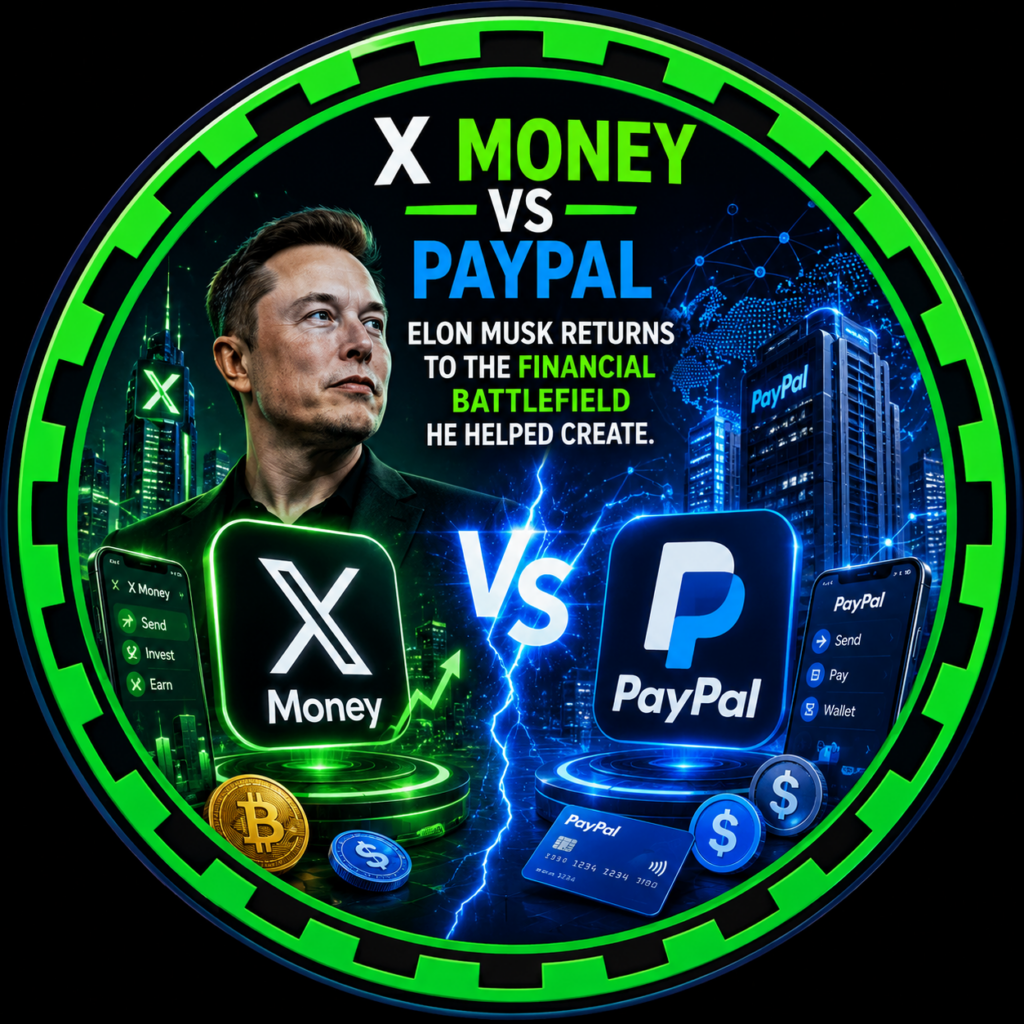
More than 25 years after Elon Musk launched X.com to challenge conventional banking, the original idea has returned—this time inside a social platform with a built-in audience, an interest-bearing account and an X-branded Visa card.
The historical symmetry is irresistible.
In 1999, Musk helped launch X.com as an ambitious internet financial-services company. In 2000, X.com merged with Confinity, the company behind a rapidly growing payment product called PayPal. The combined business eventually adopted the PayPal name, went public and was acquired by eBay.
PayPal became one of the defining financial companies of the internet era.
Musk moved on to SpaceX, Tesla and a collection of businesses that reshaped transportation, energy, satellites and artificial intelligence. But the original X.com vision—a unified digital platform for managing money—never entirely disappeared.
Now it has returned as X Money.
The new service combines direct deposit, interest-bearing balances, instant peer-to-peer payments, bill payment, domestic wires, mailed checks, an X-branded Visa debit card and 3% cash back on eligible purchases. Selected U.S. users may earn up to 6.00% APY, subject to subscription and deposit requirements.
It is tempting to describe this as a rematch between Musk and PayPal.
That description is emotionally compelling but strategically incomplete.
PayPal is a mature global payment network with 439 million active consumer and merchant accounts. In 2025, it processed approximately $1.79 trillion in total payment volume across 25.4 billion transactions.
X Money is an early-stage financial product still rolling out to selected American users.
Today, they are not equals.
But X Money is dangerous for a different reason: it begins with something PayPal had to spend decades building around—an existing network of identities, audiences, creators, businesses and real-time conversations.
This is not simply a competition over who can move money.
It is a competition over who controls the moment before, during and after a financial transaction.
The Real Story of X.com and PayPal
The simplified version of Silicon Valley history often says that Elon Musk founded PayPal.
The real history is more complicated—and more interesting.
PayPal emerged from the merger of two separate companies with different ambitions.
Confinity created the PayPal product
Confinity was incorporated in December 1998. Its founders included Peter Thiel and Max Levchin. The company initially experimented with security software and payments between handheld devices before developing a web-based money-transfer service.
That product was called PayPal.
Its appeal was direct and understandable: users could send money electronically without relying on checks or conventional bank transfers.
X.com pursued a broader financial vision
X.com was incorporated in March 1999. Musk and his collaborators envisioned an online financial institution that could offer more than individual payments.
The company pursued internet banking and financial services at a time when most consumers were still deeply cautious about managing money online.
The companies merged
On March 30, 2000, X.com merged with Confinity. The combined company initially retained the X.com corporate name, but PayPal became its dominant consumer product.
In 2001, the company officially adopted the PayPal name.
This history is documented in PayPal’s original filings with the U.S. Securities and Exchange Commission. Those filings describe PayPal Inc. as the company resulting from the merger of Confinity and X.com.
Musk was therefore central to one side of the merger and became a major shareholder of the combined business. But the PayPal payment product originated inside Confinity.
This distinction makes the arrival of X Money even more significant.
Modern PayPal represents the evolution of the payment product that won.
X Money represents Musk’s attempt to revive the broader financial-platform vision that X.com originally pursued.
The Original X.com Was Built for a World That Did Not Yet Exist
The first X.com was not merely early. It was early in almost every technological category required to make its vision practical.
There were no smartphones.
There were no mobile applications.
Social networks had not accumulated hundreds of millions of verified relationships.
Online commerce was still developing. Many consumers remained uncomfortable entering a credit-card number on a website, much less treating the internet as their primary financial environment.
X.com nevertheless pursued ideas that have since become standard:
- Opening financial accounts online;
- Sending money through an internet identity;
- Reducing dependence on physical branches;
- Managing financial services through software;
- Treating money as digital information.
The market rewarded the more focused PayPal product because it solved an urgent and visible problem: strangers needed a practical way to pay one another online.
PayPal’s growth was accelerated by eBay, where buyers and sellers needed a trusted alternative to mailing checks and money orders.
The expansive online-bank ambition was temporarily overtaken by a payment button.
Twenty-five years later, the environment has changed.
Consumers carry financial applications in their pockets. Digital wallets are familiar. Direct deposit is standard. Real-time payments are increasingly expected. Creators earn income inside online platforms. Social networks influence purchasing decisions before consumers ever reach a checkout page.
The world may finally be ready for a much larger version of the original X.com idea.
This Is Not Yet a Fair Fight
Any serious comparison must begin with scale.
PayPal reported the following results for 2025:
- 439 million active consumer and merchant accounts;
- $1.79 trillion in total payment volume;
- 25.4 billion payment transactions.
PayPal is connected to consumers, merchants, applications, payment processors and financial institutions across numerous markets. Its services are embedded in online commerce and business infrastructure around the world.
X Money is still rolling out to selected users in the United States.
That makes the present competition asymmetric.
PayPal is defending an established financial network. X Money is trying to prove that its social network can be converted into one.
PayPal has transaction history.
X has attention.
PayPal has merchant acceptance.
X has conversations and creators.
PayPal knows what customers purchase.
X may know what they discuss, follow, recommend and intend to purchase—subject to applicable privacy rules and user permissions.
The strategic question is not whether X Money can immediately match PayPal’s payment volume.
It cannot.
The more important question is whether X can use its distribution advantage to build a different kind of financial network faster than a conventional fintech company could.
X Money and PayPal Begin at Opposite Ends of the Transaction
PayPal starts with the payment.
Its core question is:
How can we make it easier and safer for a consumer to pay a merchant or another person?
X begins with the interaction that may eventually produce the payment.
Its question is:
What happens if conversation, product discovery, identity and payment all exist inside the same platform?
Consider a typical online purchase.
A user sees a recommendation, researches the product, reads comments, communicates with the seller and eventually reaches checkout.
PayPal traditionally enters near the end of that journey.
X may already control several steps before it:
- The initial post;
- The recommendation;
- The influencer;
- The discussion;
- The direct message;
- The merchant’s public profile;
- The customer relationship.
X Money gives the platform an opportunity to capture the transaction as well.
This creates the fundamental difference between the two companies:
PayPal wants to own the checkout. X wants to own the environment in which the decision to buy is made.
If X can connect those layers securely, it could compress the distance between attention and commerce.
X Money vs PayPal: Current Product Comparison
As of August 2026, the platforms offer overlapping but materially different financial ecosystems.
| Feature | X Money | PayPal |
|---|---|---|
| Market maturity | Early rollout | Established global platform |
| Reported active accounts | Not publicly established at PayPal scale | 439 million at year-end 2025 |
| Core network | Social identities and content | Consumers, merchants and checkout |
| Company is itself a bank | No | No |
| Deposit partner | Cross River Bank | Varies by product |
| Savings provider | Cross River and sweep-program banks | Synchrony Bank |
| Published yield | Up to 6.00% APY | 3.30% PayPal Savings APY |
| Direct deposit | Yes | Yes |
| Early paycheck access | Up to two days early | Up to two days early |
| Peer-to-peer payments | Native payments between eligible X users | PayPal and Venmo |
| Debit-card network | Visa | Mastercard |
| Debit rewards | 3% on eligible purchases | Category- and offer-based rewards |
| Dedicated credit products | Not currently central | Credit card, PayPal Credit and BNPL |
| Merchant checkout | Early-stage opportunity | Major established advantage |
| Buyer protection | Product-specific protections | Established for eligible purchases |
| Business tools | Developing | Extensive merchant infrastructure |
| Stablecoin | No confirmed X stablecoin | PYUSD |
| Cryptocurrency services | Not a confirmed core feature | Supported through PayPal Digital |
| Creator integration | Native strategic opportunity | Payment tools without an equivalent content network |
| International presence | Initially U.S.-focused | Established multinational reach |
| Social graph | Major advantage | Limited |
| Merchant graph | Limited | Major advantage |
Rates, rewards and product terms are variable. Availability and eligibility may differ among users and jurisdictions.
The table makes the strategic reality clear:
X Money currently has the more aggressive deposit proposition.
PayPal has the much deeper financial and commercial infrastructure.
X Money’s First Weapon Is the 6% APY
X Money’s most visible acquisition tool is yield.
Premium+ users are currently eligible for 6.00% APY. Premium users receive a listed standard rate of 4.00% and may qualify for the boosted 6.00% rate after receiving at least $1,000 in qualifying deposits within a trailing 34-day period.
Eligible deposits include qualifying payroll deposits and certain X creator payouts.
The rates are variable and can change.
PayPal Savings currently advertises 3.30% APY. The account is provided through Synchrony Bank, Member FDIC, and has no advertised minimum balance or monthly savings-account fee.
On the headline number, X Money wins.
But a responsible comparison must account for X subscription costs.
The correct calculation is:
Gross interest + cash-back rewards − subscription cost − applicable fees − taxes
A person already paying for X Premium or Premium+ may receive the higher yield as an incremental membership benefit.
A person subscribing solely for the APY must determine whether the additional interest exceeds the membership cost and the yield available from competing savings products.
At a constant 6% APY, simplified gross annual interest would be approximately:
| Average eligible balance | Approximate gross annual interest |
| $1,000 | $60 |
| $5,000 | $300 |
| $10,000 | $600 |
| $25,000 | $1,500 |
| $50,000 | $3,000 |
Actual earnings will differ because balances change, interest compounds, rates may be adjusted and eligibility requirements apply.
The strategic purpose of the rate is more important than the calculation.
X is paying users to move money—and ideally paychecks—into its ecosystem.
PayPal’s Strongest Weapon Is Not Its Savings Rate
PayPal does not need to beat X Money solely through APY.
Its most important competitive asset is its commercial network.
PayPal is recognized by consumers at checkout. It is integrated into merchant websites, applications and business systems. Companies use it to accept payments, issue invoices, manage subscriptions and transact internationally.
This creates a powerful two-sided network:
- Consumers use PayPal because merchants accept it;
- Merchants accept PayPal because consumers use it.
X Money’s Visa card can be used wherever Visa is accepted, but card acceptance is not the same as owning the merchant checkout relationship.
When someone uses the X Card, the card network and merchant processor remain central.
When someone selects PayPal at checkout, PayPal controls the branded payment experience and can potentially present:
- Stored payment methods;
- Rewards;
- Buyer protection;
- PayPal Credit;
- Buy Now, Pay Later;
- Merchant offers;
- PYUSD;
- Account balances.
PayPal is not merely moving money.
It is occupying a valuable position between the buyer and seller.
Recreating that position would require X to build merchant tools, dispute systems, developer integrations, seller protections and commercial trust at enormous scale.
X’s Strongest Weapon Is the Social Graph
PayPal has a merchant graph. X has a social graph.
X users already:
- Follow one another;
- Communicate publicly and privately;
- Build reputations;
- Create audiences;
- Promote businesses;
- Discuss markets;
- Recommend products;
- Publish advertisements;
- Receive creator income.
X Money could turn these existing relationships into financial connections.
A creator would not need to redirect followers to a separate payment platform. A small business could potentially move from product discovery to conversation and payment inside one environment. Friends could send money using identities they already know.
This gives X an extraordinary distribution advantage.
A new fintech company typically spends heavily on advertising and referral bonuses to acquire users. X can promote Money directly inside its own platform.
It can introduce the service:
- When a creator receives a payout;
- When users discuss splitting an expense;
- When a business promotes a product;
- Inside Premium subscription settings;
- Through the Money tab;
- During account verification;
- At the moment a user sends or requests funds.
The existing network reduces the distance between awareness and enrollment.
PayPal had to build financial relationships one transaction at a time.
X can begin with relationships that already exist.
PayPal Has 439 Million Accounts—but X May Control More Attention
PayPal’s 439 million active accounts provide extraordinary scale, but active financial accounts and active social users represent different types of power.
PayPal engagement is usually transactional. A user opens the service to pay, transfer money, review activity or manage an account.
X engagement can begin without a financial intention. Users visit to consume news, participate in discussions, follow markets, communicate and build audiences.
This gives X more opportunities to create demand before presenting a financial product.
In commercial terms:
- PayPal is powerful when a customer is ready to pay;
- X may be powerful while the customer is still deciding what to buy.
If X Money can connect those moments, it can potentially influence both demand and payment.
However, this advantage creates heightened privacy concerns.
Combining social behavior, advertising data, artificial intelligence and financial activity can produce an extraordinarily detailed user profile. X will need clear boundaries explaining whether transaction data can influence advertising, recommendations, credit decisions or content visibility.
The power of the combined dataset is precisely why transparency will matter.
PayPal’s Stablecoin Gives It a Second Financial Network
PayPal possesses another advantage that X Money does not currently match: PYUSD.
PayPal USD is a U.S. dollar-denominated stablecoin designed for digital payments and blockchain-based transfers. PayPal currently advertises 4% annual rewards for eligible PYUSD held through its platform, with rewards paid monthly in PYUSD.
Users can convert eligible U.S. dollar balances into PYUSD on PayPal and transfer the stablecoin to supported external wallets and networks.
This gives PayPal access to two parallel financial systems:
- Traditional bank and card rails;
- Blockchain-based settlement.
PYUSD can potentially support:
- Continuous 24/7 transfers;
- Cross-border payments;
- Wallet-to-wallet settlement;
- Digital commerce;
- Programmable financial applications;
- On-chain liquidity;
- Merchant settlement.
X Money currently relies primarily on conventional dollar accounts, ACH transfers, wires and card networks. It has not announced an equivalent stablecoin.
That may change in the future, but it should not be assumed.
X hosts a large and influential cryptocurrency community. That gives it a natural audience for digital assets, but an interested audience is not the same as a regulated stablecoin product.
As of today:
- PayPal has the stronger blockchain infrastructure;
- X has the stronger crypto-oriented conversation network.
The company that eventually connects both could gain a powerful advantage.
PayPal Is a Financial Operating System for Commerce
Reducing PayPal to peer-to-peer payments overlooks much of its business.
The PayPal ecosystem includes:
- Branded online checkout;
- Merchant processing;
- Business accounts;
- Invoicing;
- Subscription payments;
- International transfers;
- Venmo;
- PayPal Debit Card;
- PayPal Cashback Mastercard;
- PayPal Savings;
- PayPal Credit;
- Buy Now, Pay Later;
- Rewards and merchant offers;
- Cryptocurrency services;
- PYUSD;
- Buyer and seller protections for eligible transactions;
- Braintree and other business infrastructure.
This breadth is the product of decades of integrations, acquisitions, compliance work and merchant relationships.
PayPal processed $1.79 trillion in payment volume during 2025 because it is embedded across a large portion of digital commerce—not simply because people send money to friends.
X Money’s product is currently more concentrated around personal banking and payments.
That can make it easier to understand and more aggressive in consumer acquisition, but it also means X has substantial infrastructure left to build if it wants to compete across PayPal’s entire business.
X Money Is Trying to Become a Financial Operating System for Identity
X approaches the market from the opposite direction.
It begins with a user identity and attempts to add financial functions around it:
- Receive a paycheck;
- Receive creator earnings;
- Earn interest;
- Send money to another identity;
- Pay bills;
- Spend through the X Card;
- Manage transactions;
- Participate in commerce.
The long-term opportunity is to make the X handle financially useful.
A username could represent:
- A public identity;
- A communication address;
- A creator brand;
- A customer-service channel;
- A payment destination;
- A business profile;
- A financial account connection.
This is closer to the architecture of a super-app than a conventional payment wallet.
But it also concentrates risk.
If a single identity controls communication, audience access and financial services, account suspension or compromise becomes far more consequential.
X must clearly explain how financial access is protected when:
- A social account is restricted;
- A user loses access to a passkey;
- An account is compromised;
- A moderation dispute is pending;
- A customer changes a username;
- A business account changes ownership.
A social identity can be blocked or abandoned. A financial identity requires due process, recordkeeping and dependable recovery.
Neither Company Is a Bank
Despite providing bank-like services, neither PayPal nor X Payments is itself an FDIC-insured bank.
X Money structure
- X Payments LLC operates the financial platform;
- Cross River Bank provides deposit accounts;
- Cross River issues the X Card under a Visa license;
- IntraFi’s cash sweep service may distribute eligible deposits across participating banks.
X says eligible funds may receive standard FDIC protection at Cross River Bank and potentially as much as $10 million in aggregate pass-through coverage through its sweep arrangement, subject to applicable requirements and aggregation limits.
PayPal structure
- PayPal operates the financial-technology platform;
- Synchrony Bank provides PayPal Savings;
- The Bancorp Bank issues the PayPal Debit Card under a Mastercard license;
- Other regulated partners support additional PayPal products.
Eligible PayPal Savings funds may receive FDIC insurance through Synchrony Bank up to applicable limits.
In both cases, FDIC insurance protects qualifying deposits if an insured bank fails. It does not mean the technology company itself is federally insured.
It does not automatically protect users from:
- Fraudulent transactions;
- Identity theft;
- Account restrictions;
- Merchant disputes;
- Stablecoin price or issuer risks;
- Investment losses;
- Platform outages;
- Amounts exceeding applicable deposit-insurance limits.
Consumers should always identify the legal institution holding the funds, not merely the brand presenting the account.
Trust Is PayPal’s Defensive Moat—and Its Vulnerability
PayPal has more than two decades of financial operating history.
That provides experience in:
- Fraud detection;
- Identity verification;
- Merchant disputes;
- Regulatory compliance;
- Cross-border transactions;
- Account recovery;
- Buyer and seller protection;
- Payment settlement.
This history creates familiarity and trust.
It also creates baggage.
PayPal has faced longstanding customer criticism involving account limitations, payment holds, dispute outcomes and access to customer support. Mature financial platforms accumulate both institutional competence and customer frustration.
X Money can use those frustrations as an opening.
A simpler interface, higher yield and faster social payments may appeal to customers who view PayPal as complex or impersonal.
But X must prove that it can handle the same difficult financial problems at scale.
A successful financial service is not measured only when transactions work correctly. It is measured when something goes wrong:
- A paycheck fails to arrive;
- A transfer is unauthorized;
- A card is stolen;
- A merchant disappears;
- An identity is compromised;
- A customer needs immediate access to funds.
X says Money provides passkeys, transaction limits, dispute tools and continuous support.
Those claims must be validated through real-world performance.
An attractive card can be designed in months. Financial trust is built over years.
The Economics of the Competition
X Money and PayPal also have different economic incentives.
X Money
X can use financial rewards to strengthen the broader X ecosystem.
A 6% APY or 3% cash-back offer may support:
- Premium subscription growth;
- Subscriber retention;
- Creator loyalty;
- Increased daily engagement;
- More commerce inside X;
- Greater value for advertisers;
- Future financial cross-selling.
X Money does not necessarily need to maximize immediate profit as an isolated product if it increases the value of the wider platform.
PayPal
PayPal’s economics are more directly tied to payment activity, merchant processing, transaction margins, credit products and value-added services.
Its objective is to increase:
- Checkout usage;
- Payment volume;
- merchant adoption;
- Venmo monetization;
- Transaction margin;
- PYUSD circulation;
- Financial-product engagement.
This difference matters.
X may be willing to subsidize an unusually attractive financial offer because it is acquiring subscribers and strengthening a broader media ecosystem.
PayPal must defend profitability across an enormous payment network while continuing to innovate.
What X Money Must Build to Become a Real PayPal Competitor
X Money can attract consumers with yield and cash back. Challenging PayPal’s full ecosystem requires much more.
X would need:
- Broad and stable U.S. availability;
- Reliable direct deposit and account servicing;
- Strong fraud protection;
- Clear separation between financial access and social moderation;
- Human customer support for complex cases;
- Merchant checkout tools;
- Business accounts and invoicing;
- Buyer and seller protection;
- Developer APIs and integrations;
- International payment capabilities;
- Transparent privacy governance;
- Sustainable rewards;
- Regulatory credibility;
- A compelling merchant-adoption strategy.
The hardest element may be the merchant network.
Consumers can be acquired with incentives. Merchants adopt payment systems when those systems reliably increase sales, reduce friction and manage disputes.
PayPal has spent decades proving that value.
What PayPal Must Do to Defend Its Position
PayPal’s size does not guarantee future dominance.
The company’s own 2025 results acknowledged that execution in branded checkout was not where management wanted it to be. That matters because branded checkout is one of PayPal’s most strategically valuable assets.
To defend its position, PayPal must:
- Make checkout faster and more personalized;
- Improve the competitiveness of PayPal Savings;
- Connect PayPal and Venmo more effectively;
- Expand PYUSD utility beyond crypto-native users;
- Strengthen rewards without creating unnecessary complexity;
- Improve customer support and dispute transparency;
- Build better financial tools for creators;
- Use transaction data responsibly for merchant offers;
- Reduce transfer friction;
- Demonstrate why customers should remain inside PayPal after checkout.
PayPal cannot compete with X by attempting to become another social network.
It must make its commerce and financial graph more valuable than X’s social graph.
Who Has the Advantage?
There is no single answer because the companies dominate different layers.
| Competitive dimension | Current advantage |
| Savings headline rate | X Money |
| Merchant checkout | PayPal |
| Social distribution | X Money |
| Payment operating history | PayPal |
| Creator ecosystem | X Money |
| Global reach | PayPal |
| Blockchain payments | PayPal |
| Paid subscription integration | X Money |
| Business tools | PayPal |
| Product novelty | X Money |
| Reported financial scale | PayPal |
| Future social-commerce potential | X Money |
| Established consumer-payment trust | PayPal |
X Money has the more disruptive architecture.
PayPal has the stronger operating position.
Musk Is Rebuilding the Version of X.com That Never Fully Existed
The deeper story is not that Musk has returned to compete with his former company.
It is that modern technology has finally made his original idea more plausible.
The first X.com attempted to build online finance before smartphones, social graphs and embedded banking infrastructure were mature.
The new X has:
- An established consumer application;
- A network of public identities;
- Private messaging;
- Creators and subscribers;
- Business promotion;
- Advertising infrastructure;
- Artificial intelligence;
- Banking-as-a-service partners;
- Modern card networks;
- Digital identity verification.
X Money can therefore begin where the original X.com wanted to end: as a financial layer embedded inside a broader digital platform.
PayPal became successful by narrowing the problem.
Modern X is trying to expand it again.
Final Analysis: The Payment Network vs the Attention Network
X Money is not currently large enough to threaten PayPal’s overall business.
PayPal processed $1.79 trillion in 2025. X Money is still building its first meaningful customer base.
But scale is not the only measure of strategic danger.
PayPal controls a mature payment and merchant network.
X controls an attention and identity network that could become financial.
PayPal often enters when the customer is ready to complete a transaction.
X may influence the conversation, recommendation and decision that caused the transaction.
PayPal can see what consumers bought.
X may see what they discussed before buying it.
The future winner may be the platform that connects both forms of intelligence without destroying customer trust.
PayPal’s challenge is to transform its immense payment infrastructure into a more compelling financial ecosystem.
X’s challenge is to prove that a social platform can operate financial services with the reliability, privacy and discipline expected from a primary account.
More than 25 years ago, X.com and Confinity merged because each possessed something the other needed.
X.com had the broader financial ambition.
Confinity had the payment product customers were actually using.
Today, those ideas have separated again.
PayPal represents the payment network that won the first era of internet finance.
X Money represents Musk’s attempt to build the larger platform he originally imagined.
This time, he returns with something the first X.com never had:
A social network capable of turning attention into transactions, creators into financial customers and digital identities into payment addresses.
PayPal owns one of the most valuable positions in online commerce.
X wants to own everything that happens before and after it.
That is why this is not merely a rematch.
It is a battle to determine what the next financial platform will be built around:
The checkout—or the entire digital life surrounding it.
Key Facts
- X.com Corporation was incorporated in March 1999 to pursue internet banking and financial services.
- Confinity was incorporated in December 1998 and developed the original PayPal payment product.
- X.com and Confinity merged on March 30, 2000.
- The combined company later adopted the PayPal name.
- PayPal reported 439 million active consumer and merchant accounts at year-end 2025.
- PayPal processed approximately $1.79 trillion in total payment volume and 25.4 billion transactions during 2025.
- X Money is currently rolling out to selected users in the United States.
- X Money currently advertises up to 6.00% APY, subject to subscription and eligibility requirements.
- PayPal Savings advertised 3.30% APY as of June 16, 2026.
- PayPal currently advertises 4% annual rewards for eligible PYUSD balances.
- X Payments LLC and PayPal are financial-technology companies, not FDIC-insured banks.
- X Money deposit services are provided through Cross River Bank.
- PayPal Savings is provided through Synchrony Bank.
- All referenced interest and reward rates are variable and may change.
Editorial Disclosure
This article contains independent editorial analysis. REVOLD Blog has not received compensation from X Corp., X Payments LLC, PayPal Holdings, Cross River Bank, Synchrony Bank, Paxos, Visa, Mastercard or another company mentioned in this publication.
This material is provided solely for informational and educational purposes. It does not constitute financial, investment, tax, legal or banking advice. Product availability, rates, subscription prices, fees, rewards and eligibility requirements can change. Readers should review current official terms before opening or funding any account.
Sources
- SMore than 25 years after Elon Musk launched X.com to challenge conventional banking, the original idea has returned—this time inside a social platform with a built-in audience, an interest-bearing account and an X-branded Visa card.
The historical symmetry is irresistible.
In 1999, Musk helped launch X.com as an ambitious internet financial-services company. In 2000, X.com merged with Confinity, the company behind a rapidly growing payment product called PayPal. The combined business eventually adopted the PayPal name, went public and was acquired by eBay.
PayPal became one of the defining financial companies of the internet era.
Musk moved on to SpaceX, Tesla and a collection of businesses that reshaped transportation, energy, satellites and artificial intelligence. But the original X.com vision—a unified digital platform for managing money—never entirely disappeared.
Now it has returned as X Money.
The new service combines direct deposit, interest-bearing balances, instant peer-to-peer payments, bill payment, domestic wires, mailed checks, an X-branded Visa debit card and 3% cash back on eligible purchases. Selected U.S. users may earn up to 6.00% APY, subject to subscription and deposit requirements.
It is tempting to describe this as a rematch between Musk and PayPal.
That description is emotionally compelling but strategically incomplete.
PayPal is a mature global payment network with 439 million active consumer and merchant accounts. In 2025, it processed approximately $1.79 trillion in total payment volume across 25.4 billion transactions.
X Money is an early-stage financial product still rolling out to selected American users.
Today, they are not equals.
But X Money is dangerous for a different reason: it begins with something PayPal had to spend decades building around—an existing network of identities, audiences, creators, businesses and real-time conversations.
This is not simply a competition over who can move money.
It is a competition over who controls the moment before, during and after a financial transaction.
The Real Story of X.com and PayPal
The simplified version of Silicon Valley history often says that Elon Musk founded PayPal.
The real history is more complicated—and more interesting.
PayPal emerged from the merger of two separate companies with different ambitions.
Confinity created the PayPal product
Confinity was incorporated in December 1998. Its founders included Peter Thiel and Max Levchin. The company initially experimented with security software and payments between handheld devices before developing a web-based money-transfer service.
That product was called PayPal.
Its appeal was direct and understandable: users could send money electronically without relying on checks or conventional bank transfers.
X.com pursued a broader financial vision
X.com was incorporated in March 1999. Musk and his collaborators envisioned an online financial institution that could offer more than individual payments.
The company pursued internet banking and financial services at a time when most consumers were still deeply cautious about managing money online.
The companies merged
On March 30, 2000, X.com merged with Confinity. The combined company initially retained the X.com corporate name, but PayPal became its dominant consumer product.
In 2001, the company officially adopted the PayPal name.
This history is documented in PayPal’s original filings with the U.S. Securities and Exchange Commission. Those filings describe PayPal Inc. as the company resulting from the merger of Confinity and X.com.
Musk was therefore central to one side of the merger and became a major shareholder of the combined business. But the PayPal payment product originated inside Confinity.
This distinction makes the arrival of X Money even more significant.
Modern PayPal represents the evolution of the payment product that won.
X Money represents Musk’s attempt to revive the broader financial-platform vision that X.com originally pursued.
The Original X.com Was Built for a World That Did Not Yet Exist
The first X.com was not merely early. It was early in almost every technological category required to make its vision practical.
There were no smartphones.
There were no mobile applications.
Social networks had not accumulated hundreds of millions of verified relationships.
Online commerce was still developing. Many consumers remained uncomfortable entering a credit-card number on a website, much less treating the internet as their primary financial environment.
X.com nevertheless pursued ideas that have since become standard:
Opening financial accounts online;
Sending money through an internet identity;
Reducing dependence on physical branches;
Managing financial services through software;
Treating money as digital information.
The market rewarded the more focused PayPal product because it solved an urgent and visible problem: strangers needed a practical way to pay one another online.
PayPal’s growth was accelerated by eBay, where buyers and sellers needed a trusted alternative to mailing checks and money orders.
The expansive online-bank ambition was temporarily overtaken by a payment button.
Twenty-five years later, the environment has changed.
Consumers carry financial applications in their pockets. Digital wallets are familiar. Direct deposit is standard. Real-time payments are increasingly expected. Creators earn income inside online platforms. Social networks influence purchasing decisions before consumers ever reach a checkout page.
The world may finally be ready for a much larger version of the original X.com idea.
This Is Not Yet a Fair Fight
Any serious comparison must begin with scale.
PayPal reported the following results for 2025:
439 million active consumer and merchant accounts;
$1.79 trillion in total payment volume;
25.4 billion payment transactions.
PayPal is connected to consumers, merchants, applications, payment processors and financial institutions across numerous markets. Its services are embedded in online commerce and business infrastructure around the world.
X Money is still rolling out to selected users in the United States.
That makes the present competition asymmetric.
PayPal is defending an established financial network. X Money is trying to prove that its social network can be converted into one.
PayPal has transaction history.
X has attention.
PayPal has merchant acceptance.
X has conversations and creators.
PayPal knows what customers purchase.
X may know what they discuss, follow, recommend and intend to purchase—subject to applicable privacy rules and user permissions.
The strategic question is not whether X Money can immediately match PayPal’s payment volume.
It cannot.
The more important question is whether X can use its distribution advantage to build a different kind of financial network faster than a conventional fintech company could.
X Money and PayPal Begin at Opposite Ends of the Transaction
PayPal starts with the payment.
Its core question is:
How can we make it easier and safer for a consumer to pay a merchant or another person?
X begins with the interaction that may eventually produce the payment.
Its question is:
What happens if conversation, product discovery, identity and payment all exist inside the same platform?
Consider a typical online purchase.
A user sees a recommendation, researches the product, reads comments, communicates with the seller and eventually reaches checkout.
PayPal traditionally enters near the end of that journey.
X may already control several steps before it:
The initial post;
The recommendation;
The influencer;
The discussion;
The direct message;
The merchant’s public profile;
The customer relationship.
X Money gives the platform an opportunity to capture the transaction as well.
This creates the fundamental difference between the two companies:
PayPal wants to own the checkout. X wants to own the environment in which the decision to buy is made.
If X can connect those layers securely, it could compress the distance between attention and commerce.
X Money vs PayPal: Current Product Comparison
As of August 2026, the platforms offer overlapping but materially different financial ecosystems.
Feature
X Money
PayPal
Market maturity
Early rollout
Established global platform
Reported active accounts
Not publicly established at PayPal scale
439 million at year-end 2025
Core network
Social identities and content
Consumers, merchants and checkout
Company is itself a bank
No
No
Deposit partner
Cross River Bank
Varies by product
Savings provider
Cross River and sweep-program banks
Synchrony Bank
Published yield
Up to 6.00% APY
3.30% PayPal Savings APY
Direct deposit
Yes
Yes
Early paycheck access
Up to two days early
Up to two days early
Peer-to-peer payments
Native payments between eligible X users
PayPal and Venmo
Debit-card network
Visa
Mastercard
Debit rewards
3% on eligible purchases
Category- and offer-based rewards
Dedicated credit products
Not currently central
Credit card, PayPal Credit and BNPL
Merchant checkout
Early-stage opportunity
Major established advantage
Buyer protection
Product-specific protections
Established for eligible purchases
Business tools
Developing
Extensive merchant infrastructure
Stablecoin
No confirmed X stablecoin
PYUSD
Cryptocurrency services
Not a confirmed core feature
Supported through PayPal Digital
Creator integration
Native strategic opportunity
Payment tools without an equivalent content network
International presence
Initially U.S.-focused
Established multinational reach
Social graph
Major advantage
Limited
Merchant graph
Limited
Major advantage
Rates, rewards and product terms are variable. Availability and eligibility may differ among users and jurisdictions.
The table makes the strategic reality clear:
X Money currently has the more aggressive deposit proposition.
PayPal has the much deeper financial and commercial infrastructure.
X Money’s First Weapon Is the 6% APY
X Money’s most visible acquisition tool is yield.
Premium+ users are currently eligible for 6.00% APY. Premium users receive a listed standard rate of 4.00% and may qualify for the boosted 6.00% rate after receiving at least $1,000 in qualifying deposits within a trailing 34-day period.
Eligible deposits include qualifying payroll deposits and certain X creator payouts.
The rates are variable and can change.
PayPal Savings currently advertises 3.30% APY. The account is provided through Synchrony Bank, Member FDIC, and has no advertised minimum balance or monthly savings-account fee.
On the headline number, X Money wins.
But a responsible comparison must account for X subscription costs.
The correct calculation is:
Gross interest + cash-back rewards − subscription cost − applicable fees − taxes
A person already paying for X Premium or Premium+ may receive the higher yield as an incremental membership benefit.
A person subscribing solely for the APY must determine whether the additional interest exceeds the membership cost and the yield available from competing savings products.
At a constant 6% APY, simplified gross annual interest would be approximately:
Average eligible balance
Approximate gross annual interest
$1,000
$60
$5,000
$300
$10,000
$600
$25,000
$1,500
$50,000
$3,000
Actual earnings will differ because balances change, interest compounds, rates may be adjusted and eligibility requirements apply.
The strategic purpose of the rate is more important than the calculation.
X is paying users to move money—and ideally paychecks—into its ecosystem.
PayPal’s Strongest Weapon Is Not Its Savings Rate
PayPal does not need to beat X Money solely through APY.
Its most important competitive asset is its commercial network.
PayPal is recognized by consumers at checkout. It is integrated into merchant websites, applications and business systems. Companies use it to accept payments, issue invoices, manage subscriptions and transact internationally.
This creates a powerful two-sided network:
Consumers use PayPal because merchants accept it;
Merchants accept PayPal because consumers use it.
X Money’s Visa card can be used wherever Visa is accepted, but card acceptance is not the same as owning the merchant checkout relationship.
When someone uses the X Card, the card network and merchant processor remain central.
When someone selects PayPal at checkout, PayPal controls the branded payment experience and can potentially present:
Stored payment methods;
Rewards;
Buyer protection;
PayPal Credit;
Buy Now, Pay Later;
Merchant offers;
PYUSD;
Account balances.
PayPal is not merely moving money.
It is occupying a valuable position between the buyer and seller.
Recreating that position would require X to build merchant tools, dispute systems, developer integrations, seller protections and commercial trust at enormous scale.
X’s Strongest Weapon Is the Social Graph
PayPal has a merchant graph. X has a social graph.
X users already:
Follow one another;
Communicate publicly and privately;
Build reputations;
Create audiences;
Promote businesses;
Discuss markets;
Recommend products;
Publish advertisements;
Receive creator income.
X Money could turn these existing relationships into financial connections.
A creator would not need to redirect followers to a separate payment platform. A small business could potentially move from product discovery to conversation and payment inside one environment. Friends could send money using identities they already know.
This gives X an extraordinary distribution advantage.
A new fintech company typically spends heavily on advertising and referral bonuses to acquire users. X can promote Money directly inside its own platform.
It can introduce the service:
When a creator receives a payout;
When users discuss splitting an expense;
When a business promotes a product;
Inside Premium subscription settings;
Through the Money tab;
During account verification;
At the moment a user sends or requests funds.
The existing network reduces the distance between awareness and enrollment.
PayPal had to build financial relationships one transaction at a time.
X can begin with relationships that already exist.
PayPal Has 439 Million Accounts—but X May Control More Attention
PayPal’s 439 million active accounts provide extraordinary scale, but active financial accounts and active social users represent different types of power.
PayPal engagement is usually transactional. A user opens the service to pay, transfer money, review activity or manage an account.
X engagement can begin without a financial intention. Users visit to consume news, participate in discussions, follow markets, communicate and build audiences.
This gives X more opportunities to create demand before presenting a financial product.
In commercial terms:
PayPal is powerful when a customer is ready to pay;
X may be powerful while the customer is still deciding what to buy.
If X Money can connect those moments, it can potentially influence both demand and payment.
However, this advantage creates heightened privacy concerns.
Combining social behavior, advertising data, artificial intelligence and financial activity can produce an extraordinarily detailed user profile. X will need clear boundaries explaining whether transaction data can influence advertising, recommendations, credit decisions or content visibility.
The power of the combined dataset is precisely why transparency will matter.
PayPal’s Stablecoin Gives It a Second Financial Network
PayPal possesses another advantage that X Money does not currently match: PYUSD.
PayPal USD is a U.S. dollar-denominated stablecoin designed for digital payments and blockchain-based transfers. PayPal currently advertises 4% annual rewards for eligible PYUSD held through its platform, with rewards paid monthly in PYUSD.
Users can convert eligible U.S. dollar balances into PYUSD on PayPal and transfer the stablecoin to supported external wallets and networks.
This gives PayPal access to two parallel financial systems:
Traditional bank and card rails;
Blockchain-based settlement.
PYUSD can potentially support:
Continuous 24/7 transfers;
Cross-border payments;
Wallet-to-wallet settlement;
Digital commerce;
Programmable financial applications;
On-chain liquidity;
Merchant settlement.
X Money currently relies primarily on conventional dollar accounts, ACH transfers, wires and card networks. It has not announced an equivalent stablecoin.
That may change in the future, but it should not be assumed.
X hosts a large and influential cryptocurrency community. That gives it a natural audience for digital assets, but an interested audience is not the same as a regulated stablecoin product.
As of today:
PayPal has the stronger blockchain infrastructure;
X has the stronger crypto-oriented conversation network.
The company that eventually connects both could gain a powerful advantage.
PayPal Is a Financial Operating System for Commerce
Reducing PayPal to peer-to-peer payments overlooks much of its business.
The PayPal ecosystem includes:
Branded online checkout;
Merchant processing;
Business accounts;
Invoicing;
Subscription payments;
International transfers;
Venmo;
PayPal Debit Card;
PayPal Cashback Mastercard;
PayPal Savings;
PayPal Credit;
Buy Now, Pay Later;
Rewards and merchant offers;
Cryptocurrency services;
PYUSD;
Buyer and seller protections for eligible transactions;
Braintree and other business infrastructure.
This breadth is the product of decades of integrations, acquisitions, compliance work and merchant relationships.
PayPal processed $1.79 trillion in payment volume during 2025 because it is embedded across a large portion of digital commerce—not simply because people send money to friends.
X Money’s product is currently more concentrated around personal banking and payments.
That can make it easier to understand and more aggressive in consumer acquisition, but it also means X has substantial infrastructure left to build if it wants to compete across PayPal’s entire business.
X Money Is Trying to Become a Financial Operating System for Identity
X approaches the market from the opposite direction.
It begins with a user identity and attempts to add financial functions around it:
Receive a paycheck;
Receive creator earnings;
Earn interest;
Send money to another identity;
Pay bills;
Spend through the X Card;
Manage transactions;
Participate in commerce.
The long-term opportunity is to make the X handle financially useful.
A username could represent:
A public identity;
A communication address;
A creator brand;
A customer-service channel;
A payment destination;
A business profile;
A financial account connection.
This is closer to the architecture of a super-app than a conventional payment wallet.
But it also concentrates risk.
If a single identity controls communication, audience access and financial services, account suspension or compromise becomes far more consequential.
X must clearly explain how financial access is protected when:
A social account is restricted;
A user loses access to a passkey;
An account is compromised;
A moderation dispute is pending;
A customer changes a username;
A business account changes ownership.
A social identity can be blocked or abandoned. A financial identity requires due process, recordkeeping and dependable recovery.
Neither Company Is a Bank
Despite providing bank-like services, neither PayPal nor X Payments is itself an FDIC-insured bank.
X Money structure
X Payments LLC operates the financial platform;
Cross River Bank provides deposit accounts;
Cross River issues the X Card under a Visa license;
IntraFi’s cash sweep service may distribute eligible deposits across participating banks.
X says eligible funds may receive standard FDIC protection at Cross River Bank and potentially as much as $10 million in aggregate pass-through coverage through its sweep arrangement, subject to applicable requirements and aggregation limits.
PayPal structure
PayPal operates the financial-technology platform;
Synchrony Bank provides PayPal Savings;
The Bancorp Bank issues the PayPal Debit Card under a Mastercard license;
Other regulated partners support additional PayPal products.
Eligible PayPal Savings funds may receive FDIC insurance through Synchrony Bank up to applicable limits.
In both cases, FDIC insurance protects qualifying deposits if an insured bank fails. It does not mean the technology company itself is federally insured.
It does not automatically protect users from:
Fraudulent transactions;
Identity theft;
Account restrictions;
Merchant disputes;
Stablecoin price or issuer risks;
Investment losses;
Platform outages;
Amounts exceeding applicable deposit-insurance limits.
Consumers should always identify the legal institution holding the funds, not merely the brand presenting the account.
Trust Is PayPal’s Defensive Moat—and Its Vulnerability
PayPal has more than two decades of financial operating history.
That provides experience in:
Fraud detection;
Identity verification;
Merchant disputes;
Regulatory compliance;
Cross-border transactions;
Account recovery;
Buyer and seller protection;
Payment settlement.
This history creates familiarity and trust.
It also creates baggage.
PayPal has faced longstanding customer criticism involving account limitations, payment holds, dispute outcomes and access to customer support. Mature financial platforms accumulate both institutional competence and customer frustration.
X Money can use those frustrations as an opening.
A simpler interface, higher yield and faster social payments may appeal to customers who view PayPal as complex or impersonal.
But X must prove that it can handle the same difficult financial problems at scale.
A successful financial service is not measured only when transactions work correctly. It is measured when something goes wrong:
A paycheck fails to arrive;
A transfer is unauthorized;
A card is stolen;
A merchant disappears;
An identity is compromised;
A customer needs immediate access to funds.
X says Money provides passkeys, transaction limits, dispute tools and continuous support.
Those claims must be validated through real-world performance.
An attractive card can be designed in months. Financial trust is built over years.
The Economics of the Competition
X Money and PayPal also have different economic incentives.
X Money
X can use financial rewards to strengthen the broader X ecosystem.
A 6% APY or 3% cash-back offer may support:
Premium subscription growth;
Subscriber retention;
Creator loyalty;
Increased daily engagement;
More commerce inside X;
Greater value for advertisers;
Future financial cross-selling.
X Money does not necessarily need to maximize immediate profit as an isolated product if it increases the value of the wider platform.
PayPal
PayPal’s economics are more directly tied to payment activity, merchant processing, transaction margins, credit products and value-added services.
Its objective is to increase:
Checkout usage;
Payment volume;
merchant adoption;
Venmo monetization;
Transaction margin;
PYUSD circulation;
Financial-product engagement.
This difference matters.
X may be willing to subsidize an unusually attractive financial offer because it is acquiring subscribers and strengthening a broader media ecosystem.
PayPal must defend profitability across an enormous payment network while continuing to innovate.
What X Money Must Build to Become a Real PayPal Competitor
X Money can attract consumers with yield and cash back. Challenging PayPal’s full ecosystem requires much more.
X would need:
Broad and stable U.S. availability;
Reliable direct deposit and account servicing;
Strong fraud protection;
Clear separation between financial access and social moderation;
Human customer support for complex cases;
Merchant checkout tools;
Business accounts and invoicing;
Buyer and seller protection;
Developer APIs and integrations;
International payment capabilities;
Transparent privacy governance;
Sustainable rewards;
Regulatory credibility;
A compelling merchant-adoption strategy.
The hardest element may be the merchant network.
Consumers can be acquired with incentives. Merchants adopt payment systems when those systems reliably increase sales, reduce friction and manage disputes.
PayPal has spent decades proving that value.
What PayPal Must Do to Defend Its Position
PayPal’s size does not guarantee future dominance.
The company’s own 2025 results acknowledged that execution in branded checkout was not where management wanted it to be. That matters because branded checkout is one of PayPal’s most strategically valuable assets.
To defend its position, PayPal must:
Make checkout faster and more personalized;
Improve the competitiveness of PayPal Savings;
Connect PayPal and Venmo more effectively;
Expand PYUSD utility beyond crypto-native users;
Strengthen rewards without creating unnecessary complexity;
Improve customer support and dispute transparency;
Build better financial tools for creators;
Use transaction data responsibly for merchant offers;
Reduce transfer friction;
Demonstrate why customers should remain inside PayPal after checkout.
PayPal cannot compete with X by attempting to become another social network.
It must make its commerce and financial graph more valuable than X’s social graph.
Who Has the Advantage?
There is no single answer because the companies dominate different layers.
Competitive dimension
Current advantage
Savings headline rate
X Money
Merchant checkout
PayPal
Social distribution
X Money
Payment operating history
PayPal
Creator ecosystem
X Money
Global reach
PayPal
Blockchain payments
PayPal
Paid subscription integration
X Money
Business tools
PayPal
Product novelty
X Money
Reported financial scale
PayPal
Future social-commerce potential
X Money
Established consumer-payment trust
PayPal
X Money has the more disruptive architecture.
PayPal has the stronger operating position.
Musk Is Rebuilding the Version of X.com That Never Fully Existed
The deeper story is not that Musk has returned to compete with his former company.
It is that modern technology has finally made his original idea more plausible.
The first X.com attempted to build online finance before smartphones, social graphs and embedded banking infrastructure were mature.
The new X has:
An established consumer application;
A network of public identities;
Private messaging;
Creators and subscribers;
Business promotion;
Advertising infrastructure;
Artificial intelligence;
Banking-as-a-service partners;
Modern card networks;
Digital identity verification.
X Money can therefore begin where the original X.com wanted to end: as a financial layer embedded inside a broader digital platform.
PayPal became successful by narrowing the problem.
Modern X is trying to expand it again.
Final Analysis: The Payment Network vs the Attention Network
X Money is not currently large enough to threaten PayPal’s overall business.
PayPal processed $1.79 trillion in 2025. X Money is still building its first meaningful customer base.
But scale is not the only measure of strategic danger.
PayPal controls a mature payment and merchant network.
X controls an attention and identity network that could become financial.
PayPal often enters when the customer is ready to complete a transaction.
X may influence the conversation, recommendation and decision that caused the transaction.
PayPal can see what consumers bought.
X may see what they discussed before buying it.
The future winner may be the platform that connects both forms of intelligence without destroying customer trust.
PayPal’s challenge is to transform its immense payment infrastructure into a more compelling financial ecosystem.
X’s challenge is to prove that a social platform can operate financial services with the reliability, privacy and discipline expected from a primary account.
More than 25 years ago, X.com and Confinity merged because each possessed something the other needed.
X.com had the broader financial ambition.
Confinity had the payment product customers were actually using.
Today, those ideas have separated again.
PayPal represents the payment network that won the first era of internet finance.
X Money represents Musk’s attempt to build the larger platform he originally imagined.
This time, he returns with something the first X.com never had:
A social network capable of turning attention into transactions, creators into financial customers and digital identities into payment addresses.
PayPal owns one of the most valuable positions in online commerce.
X wants to own everything that happens before and after it.
That is why this is not merely a rematch.
It is a battle to determine what the next financial platform will be built around:
The checkout—or the entire digital life surrounding it.
Key Facts
X.com Corporation was incorporated in March 1999 to pursue internet banking and financial services.
Confinity was incorporated in December 1998 and developed the original PayPal payment product.
X.com and Confinity merged on March 30, 2000.
The combined company later adopted the PayPal name.
PayPal reported 439 million active consumer and merchant accounts at year-end 2025.
PayPal processed approximately $1.79 trillion in total payment volume and 25.4 billion transactions during 2025.
X Money is currently rolling out to selected users in the United States.
X Money currently advertises up to 6.00% APY, subject to subscription and eligibility requirements.
PayPal Savings advertised 3.30% APY as of June 16, 2026.
PayPal currently advertises 4% annual rewards for eligible PYUSD balances.
X Payments LLC and PayPal are financial-technology companies, not FDIC-insured banks.
X Money deposit services are provided through Cross River Bank.
PayPal Savings is provided through Synchrony Bank.
All referenced interest and reward rates are variable and may change.
Editorial Disclosure
This article contains independent editorial analysis. REVOLD Blog has not received compensation from X Corp., X Payments LLC, PayPal Holdings, Cross River Bank, Synchrony Bank, Paxos, Visa, Mastercard or another company mentioned in this publication.
This material is provided solely for informational and educational purposes. It does not constitute financial, investment, tax, legal or banking advice. Product availability, rates, subscription prices, fees, rewards and eligibility requirements can change. Readers should review current official terms before opening or funding any account.
Sources
SEC: PayPal’s Original Corporate and Merger History
SEC: PayPal 2001 Form 10-K and X.com–Confinity Merger
SEC: PayPal 2025 Annual Report
PayPal: Corporate History and 2025 Company Facts
X Money Official Product Page
X Money Frequently Asked Questions
X Money Stored Value Account Rates
PayPal Savings
PayPal Debit Card
PayPal USD
PayPal PYUSD Rewards FAQEC: PayPal’s Original Corporate and Merger History - SEC: PayPal 2001 Form 10-K and X.com–Confinity Merger
- SEC: PayPal 2025 Annual Report
- PayPal: Corporate History and 2025 Company Facts
- X Money Official Product Page
- X Money Frequently Asked Questions
- X Money Stored Value Account Rates
- PayPal Savings
- PayPal Debit Card
- PayPal USD
- PayPal PYUSD Rewards FAQ
blog.revold.us — Powered by AIR RISE INC & REVOLD AI
Author: Roman Kravchina
Related Reading
- Can X Replace Your Bank? The Real Strategy Behind Elon Musk’s X Money
- 6% APY, 3% Cash Back and One Super-App: Why X Money Could Change Digital Banking
- PYUSD vs RLUSD: PayPal and Ripple Are Fighting for the Future of the Digital Dollar
- Elon Musk Wants Your Paycheck: Inside X Money’s Plan to Become America’s Financial Super-App
- PayPal Is Turning PYUSD Into Working Money — Why 4% Rewards Could Change the Stablecoin Market
- Financial Workshop: Tax Secrets and Business Strategies 2023–2024
- Financial Workshop: Tax Secrets and Business Strategies 2023–2025
- Ripple Is No Longer Just XRP — It Is Quietly Building a Global Financial Empire
- Stablecoins vs Tokenized Bank Deposits: The Battle That Could Decide the Future of Money
- Dollar-Cost Averaging (DCA): A Simple Yet Powerful Investment Strategy
- Crypto Market Insights: Bitcoin Nears $90K, Ripple-Cardano Collaboration, and DeFi’s Latest Challenges
- Analysis of the JPMorgan Chase Situation in Russia and Its Impact on Cryptocurrency Investments
- How to Buy Dogecoin in 5 Parts to Average Down Your Cost
- Ripple XRP & Stellar XLM: A Professional Analysis
- Crypto Finance: Comprehensive Guide to Technical Analysis
- Buy and Hold – The Timeless Strategy for Long-Term Investors