
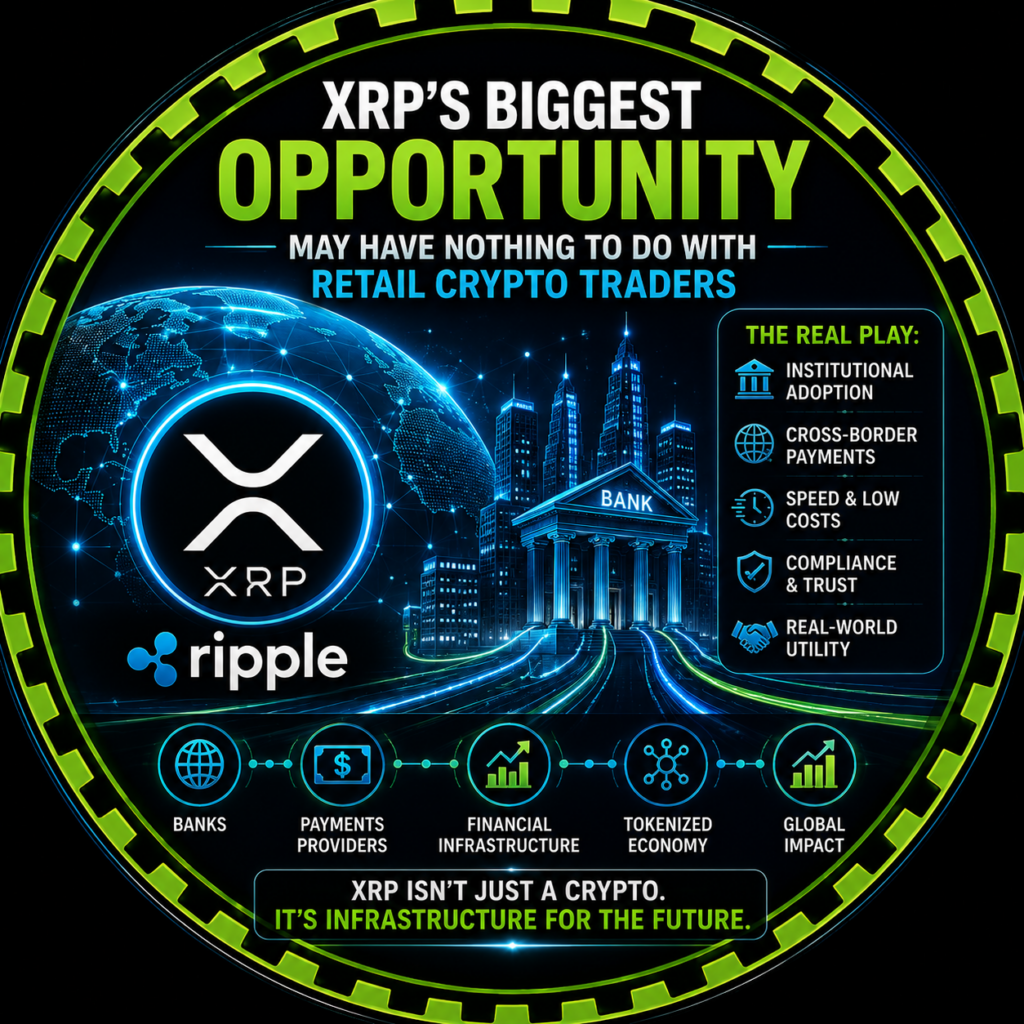
Ripple’s most important development is not another prediction about the price of XRP. It is the company’s transformation from a blockchain-payments provider into a diversified institutional financial platform.
For years, Ripple was discussed almost entirely through XRP.
Public attention centered on the token’s price, Ripple’s litigation with the Securities and Exchange Commission, exchange listings and the possibility that banks might use XRP for international settlement.
That view is now outdated.
Ripple still uses XRP and supports development around the XRP Ledger. But its business has expanded into cross-border payments, stablecoins, digital-asset custody, wallet infrastructure, prime brokerage, corporate treasury management and tokenization.
The company is no longer offering one solution to one financial problem. It is assembling the components required to manage the entire institutional lifecycle of money and digital assets:
- Collecting funds;
- Holding assets;
- Converting currencies;
- Moving money internationally;
- Providing liquidity;
- Settling transactions;
- Managing collateral;
- Controlling corporate cash;
- Issuing and safeguarding tokenized assets.
This does not mean Ripple has already built a financial empire or replaced the world’s banks. That interpretation would be premature.
What Ripple has built is a credible institutional financial stack—and a strategy that extends far beyond XRP.
Ripple, XRP and the XRP Ledger Are Different
Any serious analysis must separate Ripple, XRP and the XRP Ledger.
Ripple is a privately held financial-technology company. It develops products for payments, custody, stablecoins, liquidity, treasury management and institutional markets.
XRP is the native digital asset of the XRP Ledger. It can be used for transaction fees, liquidity and exchange between assets.
The XRP Ledger, or XRPL, is a public blockchain supporting XRP, issued currencies, tokenized assets and decentralized exchange functionality.
The three are connected, but they are not interchangeable.
Buying XRP does not provide:
- Ownership in Ripple;
- Voting rights in the company;
- A claim on Ripple’s revenue;
- Dividends from Ripple;
- Ownership of Ripple Prime or Ripple Treasury;
- A direct economic interest in Ripple’s acquisitions.
Ripple can also sell products that do not require customers to use XRP.
A bank may use Ripple Custody to protect digital assets. A corporation may use Ripple Treasury to manage cash. A financial firm may access Ripple Prime for clearing and financing. A payment provider may use RLUSD or another stablecoin rather than XRP.
Ripple’s growth can strengthen the surrounding XRP ecosystem, but it does not automatically translate into proportional demand for XRP.
That distinction should remain central throughout any investment analysis.
Ripple Payments Remains the Foundation
Ripple began by targeting inefficiencies in cross-border payments.
Traditional international transfers can involve correspondent banks, foreign-exchange intermediaries, prefunded accounts and several independent compliance systems. Transactions may take days to complete, particularly outside normal banking hours.
Ripple Payments is designed to connect collection, liquidity, conversion, blockchain settlement and local payout within a more unified service.
The platform can support combinations of:
- Fiat currencies;
- Stablecoins;
- XRP;
- Local bank rails;
- Digital wallets;
- Institutional payout partners.
In March 2026, Ripple reported that its payments platform had processed more than $100 billion in cumulative volume and was live across more than 60 major markets. Ripple also said it held more than 75 regulatory licenses and registrations globally. Ripple’s March 2026 payments announcement
These are Ripple’s own operating figures and should be described accordingly. Processed payment volume is not the same as revenue, profit or money owned by Ripple.
Nevertheless, the figures show that Ripple Payments is a commercial product operating beyond pilot projects.
Rail Filled the Missing Parts of the Payment Process
Moving a stablecoin between two blockchain addresses is only one step in an international payment.
An enterprise system must also collect funds, identify the payer, perform compliance checks, convert currencies, manage liquidity, route the transaction, deliver the local payout and reconcile the result.
Ripple’s acquisition of Rail addressed these operational layers.
Rail brought capabilities including:
- Named virtual accounts;
- Fiat and stablecoin collections;
- On- and off-ramps;
- Third-party payments;
- Treasury payments;
- Back-office automation;
- Banking-partner redundancy;
- Single-API access.
Ripple announced the $200 million Rail transaction in August 2025.
The strategic value is straightforward: Ripple can control more of the payment from collection to final payout instead of providing only the blockchain-settlement step.
That moves Ripple closer to a complete enterprise payment platform.
RLUSD Gives Ripple a Stable Settlement Asset
Ripple launched Ripple USD in December 2024.
RLUSD is issued by Standard Custody & Trust Company, LLC, a Ripple subsidiary chartered as a New York limited-purpose trust company.
It is designed to maintain a value of one U.S. dollar. Its reserves are held in segregated accounts and may include U.S. dollar deposits, short-term U.S. Treasury bills, government money-market funds and other qualifying liquid assets.
Ripple publishes monthly reserve reports supported by independent CPA attestations. BNY serves as the primary custodian of RLUSD reserves. Ripple’s RLUSD transparency reports
RLUSD gives Ripple a dollar-denominated asset suitable for:
- Cross-border settlement;
- Corporate treasury transfers;
- Institutional liquidity;
- Trading collateral;
- Tokenized-asset transactions;
- Prime brokerage;
- Blockchain-based payments.
This solves a problem XRP cannot solve by itself.
XRP has a variable market price. RLUSD is designed to remain stable against the dollar.
An institution that wants to move dollar value without assuming short-term token-price exposure may prefer RLUSD.
RLUSD Does Not Automatically Make XRP Obsolete
RLUSD and XRP serve different purposes.
RLUSD is intended to provide stable dollar value.
XRP can provide bridge liquidity between currencies or assets and is used for functions on the XRP Ledger.
Ripple can choose the appropriate asset according to:
- The payment corridor;
- Available liquidity;
- Customer preference;
- Regulatory treatment;
- Transaction cost;
- Counterparty requirements;
- Supported on- and off-ramps.
Some payment flows may use RLUSD without XRP. Others may use XRP for liquidity. Some customers may use neither and rely on different stablecoins or fiat settlement.
Ripple’s current strategy is therefore broader than the early argument that every transaction must use XRP.
That flexibility is commercially sensible. It also means that Ripple’s business expansion cannot be treated as automatic evidence of equivalent growth in XRP usage.
Ripple Custody Targets Banks and Institutions
Institutional adoption of digital assets requires secure control over cryptographic keys.
A consumer wallet can rely on relatively simple security. A bank or asset manager needs much more:
- Segregated roles;
- Multi-party approvals;
- Transaction policies;
- Audit trails;
- Access controls;
- Key recovery;
- Compliance integration;
- Disaster recovery;
- Support for multiple assets and networks.
Ripple entered this market through its acquisition of Metaco in 2023.
Metaco provided institutional custody technology and relationships with regulated financial institutions. Ripple has referenced custody work involving organizations such as BBVA, DBS, Société Générale–FORGE and Absa Bank.
This gave Ripple a position inside the systems banks use to safeguard and administer digital assets.
Custody is strategically important because payments, tokenization and institutional trading all depend on secure asset control. Without custody, the rest of the digital financial system cannot operate safely at scale.
Standard Custody Added Regulatory Infrastructure
Ripple completed its acquisition of Standard Custody in 2024.
The acquisition added a New York trust charter and strengthened Ripple’s regulated custody and stablecoin capabilities.
Standard Custody subsequently became the issuer of RLUSD.
This sequence shows that Ripple’s acquisitions were not isolated purchases. The custody, licensing and stablecoin strategies were designed to reinforce one another.
Ripple acquired:
- Technology through Metaco;
- Regulated trust infrastructure through Standard Custody;
- A dollar-denominated settlement asset through RLUSD.
The result is a more complete institutional custody and issuance platform.
Palisade Expanded Ripple Into Wallet-as-a-Service
Ripple acquired Palisade in November 2025.
Palisade added technology for creating and operating digital-asset wallets at scale. Its architecture includes multi-party computation, hardware security modules, policy controls and multi-chain support.
The product is designed for higher-frequency use cases such as:
- Payment collections;
- On- and off-ramps;
- Corporate wallets;
- Fintech applications;
- Automated treasury movements;
- Large-scale customer wallet provisioning.
Ripple’s Palisade acquisition announcement
Palisade complements Ripple’s existing custody platform.
Ripple Custody can provide heavily controlled institutional vault infrastructure. Palisade can provide lighter and faster wallet infrastructure for organizations processing frequent transactions.
A private bank protecting long-term client assets and a fintech creating thousands of transactional wallets have different requirements. Ripple is attempting to serve both.
Ripple Prime Moved the Company Into Capital Markets
Ripple’s acquisition of Hidden Road was one of its most significant strategic moves.
Hidden Road became Ripple Prime, a global multi-asset prime brokerage platform.
Prime brokers provide institutions with services such as:
- Clearing;
- Financing;
- Margin;
- Collateral management;
- Trade execution;
- Market access;
- Risk controls.
Ripple reports that Ripple Prime clears more than $3 trillion annually and serves more than 300 institutional customers across digital assets, foreign exchange, precious metals, derivatives and fixed-income markets. Ripple Prime
These figures describe transaction and clearing activity, not Ripple revenue.
The acquisition nevertheless moved Ripple into a very different category.
Cross-border payments help companies move money.
Prime brokerage helps financial institutions trade, finance positions and manage collateral across markets.
Ripple now participates in both.
RLUSD Can Become Settlement Cash and Collateral
RLUSD has begun to appear inside Ripple Prime as a settlement and collateral asset.
That may become more important than retail stablecoin use.
Institutional markets require reliable dollar-denominated assets for:
- Margin;
- Trading collateral;
- Settlement;
- Short-term liquidity;
- Movement between trading venues.
If RLUSD becomes integrated across Ripple Prime, Ripple Payments and tokenized markets, demand can come from institutional activity rather than consumer adoption.
A small number of financial institutions can generate more stablecoin volume than millions of occasional retail users.
That is why RLUSD should not be evaluated solely by wallet count or retail recognition.
Ripple Treasury Moved the Company Into the CFO’s Office
Ripple’s acquisition of GTreasury expanded the company into corporate treasury management.
GTreasury had spent decades developing software for:
- Cash visibility;
- Forecasting;
- Bank connectivity;
- Foreign-exchange risk;
- Debt management;
- Investments;
- Reconciliation;
- Corporate liquidity.
The business has since become Ripple Treasury.
Ripple Treasury says it serves more than 1,000 customers across 160 countries. The company reported that the platform facilitated $13 trillion in customer payment volume during 2025. Ripple Treasury’s digital-asset product announcement
This does not mean Ripple owned or controlled $13 trillion. It refers to activity managed through the treasury platform.
The strategic value is access to corporate financial workflows.
Treasury systems help determine:
- Where company cash is held;
- When payments are made;
- How liquidity is forecast;
- How foreign-exchange exposure is managed;
- How debt and investments are monitored;
- How transactions are reconciled.
Ripple is no longer trying only to persuade banks to use blockchain payments. It is placing its technology inside the systems used by corporate finance departments.
Digital Assets Become Part of Ordinary Treasury
In April 2026, Ripple Treasury launched native digital-asset capabilities.
The platform allows treasury teams to view traditional cash and digital assets within a consolidated environment.
Its announced capabilities include:
- Digital-asset accounts;
- Fiat and digital balance visibility;
- Connections to custody providers;
- Real-time valuation;
- Automated transaction records;
- Approval controls;
- Audit trails;
- Digital-asset reconciliation.
The goal is not to force finance departments into a separate cryptocurrency application.
It is to make digital assets behave like another treasury asset class inside familiar corporate controls.
This is important because corporations generally require digital assets to fit existing systems for:
- Accounting;
- Governance;
- Risk;
- Compliance;
- Reporting;
- Audit;
- Approvals.
Ripple Treasury provides a path for introducing XRP, RLUSD and other digital assets without requiring the CFO’s office to abandon established workflows.
Tokenization Is the Next Strategic Layer
Tokenization represents ownership of a traditional asset through blockchain-based records.
Potential tokenized assets include:
- Treasury securities;
- Money-market funds;
- Bonds;
- Private credit;
- Investment funds;
- Commodities;
- Real estate interests;
- Trade-finance instruments.
These markets require more than a blockchain.
Institutions need:
- Asset issuance;
- Custody;
- Dollar settlement;
- Liquidity;
- Compliance;
- Trading;
- Treasury management.
Ripple is assembling each of those capabilities.
The XRP Ledger already supports issued assets and native exchange functionality. Tokenized Treasury products, including Ondo Finance’s OUSG, have expanded to XRPL. Tokenized Treasuries on XRPL
Ripple can potentially connect a tokenized asset with:
- Ripple Custody for safekeeping;
- RLUSD for dollar settlement;
- XRP for selected liquidity functions;
- Ripple Prime for institutional trading;
- Ripple Treasury for cash and risk management;
- Ripple Payments for moving proceeds.
This integration is the central investment thesis behind Ripple’s expansion.
The value does not come from owning many unrelated products. It comes from making those products function as one institutional system.
Ripple Is Trying to Control the Full Financial Workflow
Ripple’s emerging platform covers most stages of an institutional transaction.
A customer can potentially:
- Collect money through virtual accounts or wallets;
- Hold fiat and digital assets;
- Convert between currencies and stablecoins;
- Send funds internationally;
- Secure assets through institutional custody;
- Access trading and financing;
- Settle with RLUSD or another supported asset;
- Manage liquidity through Ripple Treasury;
- Issue or hold tokenized assets;
- Reconcile the activity within enterprise systems.
This is the company’s actual strategic objective.
Ripple is not simply attempting to increase the number of XRP transactions.
It is attempting to become the infrastructure provider behind the complete movement and management of institutional value.
Ripple’s Acquisitions Follow a Coherent Pattern
Ripple’s recent acquisitions filled specific gaps:
- Metaco: institutional custody technology;
- Standard Custody: regulated trust and stablecoin infrastructure;
- Hidden Road: prime brokerage, clearing and financing;
- Rail: stablecoin payments, collections and virtual accounts;
- GTreasury: corporate treasury management;
- Palisade: scalable wallet infrastructure.
Ripple stated in late 2025 that it had invested approximately $4 billion in acquisitions and strategic opportunities.
The acquisition strategy is aggressive, but it is not random.
Every acquired capability supports one of four core activities:
- Moving value;
- Securing value;
- Financing value;
- Managing value.
Regulation Is Part of the Product
Financial institutions cannot adopt infrastructure based only on transaction speed.
They also require:
- Licensing;
- Anti-money-laundering controls;
- Sanctions screening;
- Regulatory reporting;
- Banking relationships;
- Legal certainty;
- Operational accountability.
Ripple says it holds more than 75 regulatory licenses and registrations globally.
In December 2025, the company announced that the Office of the Comptroller of the Currency had granted conditional approval to establish Ripple National Trust Bank. Ripple’s national trust bank announcement
Conditional approval is not final authorization to operate without restrictions.
Ripple must satisfy the OCC’s conditions before the institution can begin full operations.
A national trust bank would also not make Ripple equivalent to a conventional retail bank. Trust institutions generally focus on custody, fiduciary functions and asset administration rather than checking accounts, consumer loans and branch banking.
Ripple’s objective appears narrower: regulated control over the institutional services required for stablecoins and tokenized assets.
Why Ripple’s Strategy Was Easy to Miss
Most public attention remained focused on:
- XRP price movements;
- SEC litigation;
- Exchange listings;
- Crypto-market cycles;
- XRP investment products.
Meanwhile, Ripple was acquiring less glamorous but more operationally important infrastructure:
- Custody systems;
- Trust charters;
- Treasury software;
- Prime brokerage;
- Virtual accounts;
- Wallet policy engines;
- Compliance capabilities.
Institutional finance is built through licensing, enterprise integrations, risk controls and long sales cycles.
These developments generate less excitement than token-price predictions, but they are necessary before banks and corporations move substantial value onto blockchain infrastructure.
Ripple’s strategy was not secret.
It was obscured by the market’s obsession with XRP.
What Ripple’s Expansion Means for XRP
Ripple’s broader platform could benefit XRP indirectly.
Potential benefits include:
- More institutional relationships;
- Greater XRPL activity;
- Additional tokenized assets on XRPL;
- More custody support;
- Deeper RLUSD liquidity on XRPL;
- Institutional trading through Ripple Prime;
- More payment corridors capable of using XRP.
But there are important limitations.
Not every Ripple product requires XRP.
Not every Ripple Payments transaction uses XRP.
RLUSD and other stablecoins may be preferred when customers require stable value.
Corporate use of Ripple Treasury does not automatically create XRP purchases.
Ripple’s revenue does not belong to XRP holders.
The defensible conclusion is:
Ripple’s expansion increases the number of environments in which XRP could be used, but it does not guarantee that customers will use XRP or that its price will rise.
Any stronger claim would require transaction-level evidence that Ripple does not currently publish in sufficient detail.
The Strategy Has Serious Risks
Ripple’s expansion is credible, but execution is not guaranteed.
Integration risk
The acquired companies use different technologies, operating models and regulatory structures. Ripple must make them work as one platform.
Regulatory complexity
More products and jurisdictions create more compliance obligations.
Competition
Ripple competes with banks, payment networks, stablecoin issuers, custodians, treasury-software providers, prime brokers and public blockchains.
Stablecoin competition
RLUSD competes with USDT, USDC, PYUSD, tokenized deposits and future bank-issued stablecoins.
Network competition
XRPL competes with Ethereum, Solana, Stellar and other networks pursuing institutional finance.
Institutional sales cycles
Banks and large corporations may require years of testing before adopting new infrastructure.
Provider concentration
Customers using Ripple for custody, payments, liquidity and treasury could become dependent on one provider.
Private-company transparency
Ripple does not publish the same financial detail required from a publicly traded company.
Acquisition economics
Large transaction values do not prove that the acquired businesses will generate adequate returns.
Security
A broader custody, payments and wallet platform increases the number of systems Ripple must protect.
What Ripple Still Must Prove
Ripple has assembled the components. It has not yet proved that the complete platform will dominate institutional digital finance.
The company must demonstrate:
- Sustainable payment growth;
- Meaningful RLUSD settlement activity;
- Successful integration of its acquisitions;
- Profitable custody and prime brokerage operations;
- Corporate adoption of digital-asset treasury functions;
- Expanding tokenized-asset activity on XRPL;
- Completion of remaining regulatory conditions;
- Strong security across custody and wallet products;
- Clear reporting on real product usage;
- Evidence that an integrated platform is better than specialized competitors.
The acquisitions created the architecture.
Execution must create the business.
Final Analysis: Ripple Is Building Institutional Infrastructure, Not Merely Promoting XRP
Ripple began with a specific proposition: cross-border payments should not depend on slow and expensive chains of correspondent banks.
It has since expanded into nearly every function required for institutional digital finance.
Ripple Payments moves value.
Rail collects it.
RLUSD stabilizes it.
XRP can provide liquidity.
Ripple Custody protects it.
Palisade operates the wallets.
Ripple Prime trades and finances it.
Ripple Treasury manages it.
The XRP Ledger issues and settles tokenized assets.
Ripple’s licenses make the services operable in regulated markets.
This is no longer a business built around a single cryptocurrency.
It is an attempt to create an institutional platform connecting traditional finance with blockchain-based assets.
The strategy is coherent, but success is not assured.
Ripple must integrate several expensive acquisitions, compete against established financial institutions and prove that customers want one provider controlling multiple parts of their financial infrastructure.
It must also show that its reported volumes produce durable revenue and that RLUSD, XRP and XRPL gain genuine utility rather than promotional visibility.
Still, the transformation is real.
Ripple is no longer simply offering banks a faster payment rail.
It is positioning itself to help institutions collect, store, convert, move, finance, settle, manage and tokenize value.
XRP remains part of that system.
It is no longer the whole system.
That is the most important fact about Ripple’s current strategy.
Key Facts
- Ripple is a private financial-technology company; XRP is a separate digital asset.
- XRP ownership does not provide equity or ownership rights in Ripple.
- Ripple Payments supports fiat, stablecoin and digital-asset payment flows.
- Ripple reported more than $100 billion in cumulative processed payment volume as of March 2026.
- RLUSD is issued by Standard Custody & Trust Company, LLC.
- BNY serves as the primary custodian of RLUSD reserves.
- Metaco provided Ripple with institutional custody technology.
- Standard Custody added regulated trust and stablecoin infrastructure.
- Hidden Road became Ripple Prime.
- Rail added collections, virtual accounts and stablecoin-payment capabilities.
- GTreasury became Ripple Treasury.
- Palisade added Wallet-as-a-Service technology.
- Ripple Treasury launched native digital-asset capabilities in 2026.
- Ripple says it holds more than 75 global licenses and registrations.
- The OCC granted conditional approval for Ripple National Trust Bank in December 2025.
- Conditional approval does not mean the bank is already operating without restrictions.
- Not every Ripple product or payment transaction requires XRP.
Editorial Disclosure
This article contains independent editorial analysis. Ripple is not legally classified as a global financial empire, and it has not replaced conventional banking or capital-market infrastructure.
REVOLD Blog has not received compensation from Ripple, BNY, Metaco, Standard Custody, Hidden Road, Rail, GTreasury, Palisade or another organization mentioned in this publication.
Payment, clearing and treasury-management volumes cited in this article are company-reported operating figures. They do not represent Ripple revenue, profit or assets owned by Ripple.
This material is provided solely for informational and educational purposes. It does not constitute financial, investment, legal, tax, accounting or cryptocurrency advice.
Official Sources
- Ripple — Corporate and Product Overview
- Ripple — Payments Platform
- Ripple — 2026 Payments Expansion
- Ripple — RLUSD
- Ripple — RLUSD Transparency Reports
- Ripple — Ripple Prime
- Ripple — Hidden Road Acquisition Completion
- Ripple — Rail Acquisition
- Ripple — Ripple Treasury Digital-Asset Launch
- Ripple — Palisade Acquisition
- Ripple — Standard Custody Acquisition
- Ripple — National Trust Bank Conditional Approval
- Ripple — Tokenized Treasuries on XRPL
Information reviewed and verified: August 24, 2026.
Author: Roman Kravchina
Published by: REVOLD Blog
Powered by: AIR RISE INC & REVOLD AI